Europe
Miletus
At a glance
- The richest city of archaic Ionia, at the mouth of the Maeander, with its own oracle of Apollo at Didyma.
- Milesian colonists founded dozens of settlements around the Black Sea, and Thales and his successors began Greek philosophy there.
- Miletus led the Ionian Revolt against Persia and was sacked in 494 BCE, a disaster that led to the Persian Wars.
Rise & Fall
- c. 1000 BCEIonian Greeks settle Miletus, traditionally under Neleus, son of Codrus
- c. 600 BCEThrasybulus makes peace with Alyattes of Lydia after eleven years of war
- 546 BCEMiletus alone among Ionian cities gains a treaty with Cyrus the Great
- 499 BCEAristagoras launches the Ionian Revolt against the Achaemenid Empire
- 494 BCEPersia defeats the Ionians at the Battle of Lade and sacks Miletus
- 479 BCEMiletus is freed after the Battle of Mycale and rebuilt on a grid plan
- 334 BCEAlexander the Great takes Miletus after a siege
- 133 BCEBequest of Attalus III brings Miletus under Roman supremacy in Asia
Foundation
Miletus stood on a peninsula near the mouth of the Maeander River on the west coast of Asia Minor, with several sheltered harbours opening onto the Latmian Gulf. The site was occupied long before the Greeks arrived: a settlement with strong Minoan connections existed there in the Middle Bronze Age, and a Mycenaean town, later fortified with a wall, followed in the fourteenth and thirteenth centuries BCE. Most scholars identify this town with Millawanda, or Milawata, named in Hittite texts as a base of the Ahhiyawa, probably a Mycenaean Greek power, although the identification is not certain. After the collapse of the Bronze Age world, Ionian Greeks settled Miletus around 1000 BCE. Tradition named Neleus, a son of the Athenian king Codrus, as its founder, and Herodotus reports that the first settlers killed the Carian men of the district and married their women, a story that reflects the mixing of Greek and Carian populations in the region. Miletus became one of the twelve cities of the Ionian League, which met at the Panionion on Mount Mycale, and it controlled the oracle of Apollo at Didyma, about 16 kilometres to the south, joined to the city by a Sacred Way. By the seventh century BCE it was the largest and richest of the Ionian cities.
Socioeconomy
The prosperity of Miletus rested on commerce, manufacture and colonisation. Milesian wool and woollen cloth were prized across the Greek world, and the city's merchants traded with Lydia and the Anatolian interior, with Egypt and with the Black Sea. Pliny the Elder credited Miletus with founding some ninety colonies, a figure that is probably exaggerated but reflects a real and sustained movement. Milesians settled the shores of the Hellespont, the Propontis and the Black Sea, founding Abydos, Cyzicus, Sinope, Histria, Apollonia Pontica, Olbia and Panticapaeum, and these colonies sent grain, fish, timber and slaves in return for wine, oil and manufactured goods. In Egypt, Milesians were among the Greeks trading at Naucratis, where they had their own sanctuary of Apollo. Some of the earliest coins, small pieces of electrum stamped with a lion, may have been struck at Miletus in the late seventh or early sixth century BCE. Society was sharply divided between wealthy landowners and merchants and a large population of craftsmen and labourers; according to Plutarch, factions called the Ploutis, the party of the rich, and the Cheiromacha, the party of those who worked with their hands, fought bitterly for control. Religious life centred on Apollo, worshipped at Didyma and in the city as Apollo Delphinios, whose guild of singers, the Molpoi, stood at the heart of civic cult.
Military
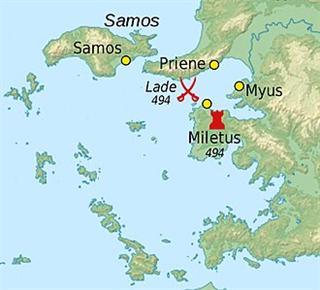
Miletus was above all a sea power, but it also held out on land against the kings of Lydia. Herodotus relates that under Sadyattes and then Alyattes the Lydians invaded Milesian territory every year for eleven years, burning the crops, but could not take the city because Miletus controlled the sea; the tyrant Thrasybulus finally persuaded Alyattes to make peace by staging a show of plenty when a Lydian envoy arrived. When Cyrus the Great conquered Lydia in 546 BCE, Miletus alone among the Ionian cities obtained a treaty on the same terms it had held with Croesus, and so escaped the Persian conquest that followed. Its great military venture was the Ionian Revolt. In 499 BCE Aristagoras, who governed the city for the tyrant Histiaeus, failed in a Persian-backed attack on Naxos and then led the Ionians in rebellion; with Athenian and Eretrian help the rebels burned Sardis in 498 BCE. In 494 BCE the Ionian fleet of 353 triremes, including 80 from Miletus, was defeated by the Persians at the Battle of Lade, an island just off the city, after most of the Samian squadron deserted. The Persians then besieged Miletus by land and sea and stormed it. In 334 BCE the city resisted Alexander the Great before falling to assault.
Governance & Law
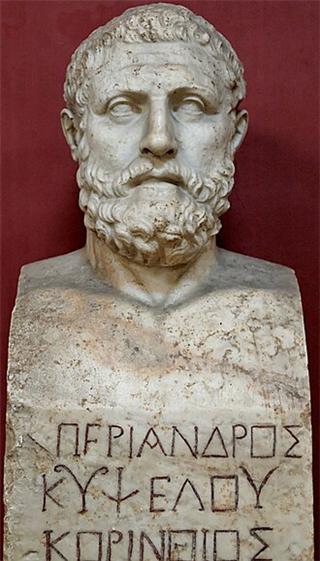
According to tradition Miletus was first ruled by kings descended from Neleus and then by an aristocracy. From the later seventh century BCE it repeatedly fell under tyrants. Thrasybulus, who ruled around 600 BCE, was the friend of Periander of Corinth, and Herodotus tells how, when Periander's messenger asked him how best to rule, he silently walked through a field cutting off the tallest ears of grain. After his time Miletus suffered two generations of civil strife, which Herodotus says was ended by arbitrators from Paros who gave power to the citizens whose farms they had found best kept. Under Persian rule the city was governed by tyrants loyal to the king. The best known was Histiaeus, who guarded the bridge over the Danube during the Scythian campaign of Darius I around 513 BCE, and his cousin and son-in-law Aristagoras, who formally gave up the tyranny in 499 BCE to win support for the revolt. The chief religious official of the city, the head of the Molpoi, served as its eponymous magistrate, later known as the stephanephoros, and an inscribed list of these officials survives from 525/524 BCE onward. After its refoundation Miletus belonged to the Delian League, and an Athenian decree of about 450 BCE regulated its government, probably after a period of oligarchic unrest.
Global & Regional Impact
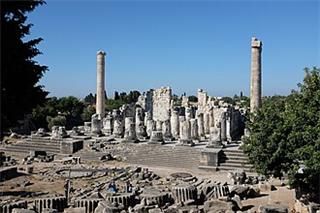
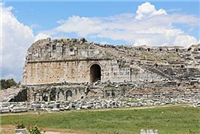
Miletus is often called the birthplace of Greek philosophy and science. In the sixth century BCE Thales, Anaximander and Anaximenes, known together as the Milesian school, sought natural rather than mythological explanations of the world, naming water, the boundless (apeiron) and air respectively as the source of all things. Herodotus reports that Thales foretold the solar eclipse that halted a battle between the Lydians and the Medes, conventionally dated 585 BCE, and Anaximander was said to have drawn the first Greek map of the world. Hecataeus of Miletus, who advised against the Ionian Revolt, wrote a description of the known world and a critical treatment of Greek genealogies, and was a forerunner of Herodotus. The sack of the city in 494 BCE shocked the Greek world: the Athenian dramatist Phrynichus staged The Capture of Miletus and was fined for reminding Athens of a disaster to its kinsmen. When Miletus was rebuilt after 479 BCE it was laid out on a regular grid of streets, a plan long associated with the town planner Hippodamus of Miletus, though his own part in it is debated. Its colonies spread Greek settlement around the Black Sea, and the Hellenistic temple of Apollo at Didyma, begun around 300 BCE and never finished, was among the largest Greek temples ever attempted.
Decline & Fall
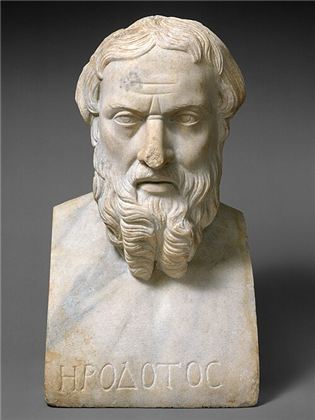
The Persian sack of 494 BCE ended the age of Milesian greatness. Herodotus says most of the men were killed, the women and children enslaved, the sanctuary at Didyma plundered and burned, and the captives settled at Ampe near the mouth of the Tigris. The city revived after the Greek victory at Mycale in 479 BCE, but it never regained its former standing. Within the Delian League it was a tribute-paying ally under close Athenian supervision, and its war with Samos over Priene in 440 BCE drew Athens into a war against Samos. Miletus revolted from Athens in 412 BCE and became a Spartan base, and under the King's Peace of 387/386 BCE it returned to Persian rule, later under the Hecatomnid satraps of Caria. Alexander the Great took the city in 334 BCE. Under the Hellenistic kings Miletus was usually a nominally free city that passed between Antigonus, Lysimachus, the Ptolemies and the Seleucids; its citizens honoured Antiochus II with the title Theos, god, for removing the tyrant Timarchus around 259 BCE. After Attalus III of Pergamon bequeathed his kingdom to Rome in 133 BCE, Miletus came under Roman supremacy in the province of Asia, organised by 129 BCE. The silting of the Maeander later left the site far inland, and its ruins lie near the village of Balat in Turkey.
Miletus was the leading city of archaic Ionia: a trading power that planted dozens of colonies around the Black Sea, the home of Thales, Anaximander and Anaximenes, and the instigator of the Ionian Revolt, whose destruction by Persia in 494 BCE helped set off the Persian Wars.
Test yourself
5 questions on this page, from its key events and facts.
The questions open here once the page has loaded.
References
- Gorman, V.B. (2001) Miletos, the Ornament of Ionia: A History of the City to 400 B.C.E. Ann Arbor: University of Michigan Press.
- Greaves, A.M. (2002) Miletos: A History. London: Routledge.
- Greaves, A.M. (2010) The Land of Ionia: Society and Economy in the Archaic Period. Chichester: Wiley-Blackwell.
- Hansen, M.H. and Nielsen, T.H. (eds) (2004) An Inventory of Archaic and Classical Poleis. Oxford: Oxford University Press.
- Herodotus, The Histories, trans. A. de Sélincourt, rev. J. Marincola (2003). London: Penguin.
Connections
Open the full connections map →