Egypt & North Africa
Africa Proconsularis
At a glance
- Rome made Carthage's land a province in 146 BCE; Augustus united it with Africa Nova and refounded Carthage as its capital.
- Its grain, olive oil and fine pottery fed and furnished Rome, and its cities were among the richest in the empire.
- It was a heartland of Latin Christianity, home to Tertullian, Cyprian and the long Donatist schism.
Rise & Fall
- 146 BCERome destroys Carthage and creates the province of Africa, governed from Utica
- 46 BCECaesar annexes Numidian lands as Africa Nova after Thapsus
- c. 27 BCEAugustus unites the provinces as Africa Proconsularis, with Carthage as capital
- 17–24 CERevolt of Tacfarinas among the peoples of the interior
- 238A revolt at Thysdrus proclaims Gordian I emperor
- c. 303Diocletian divides the province, creating Byzacena and Tripolitania
- 439The Vandals under Gaiseric seize Carthage
Foundation

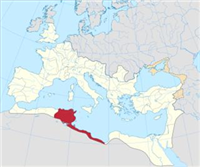
When the Roman Republic destroyed Carthage at the end of the Third Punic War in 146 BCE, it turned the city's remaining territory in what is now northern Tunisia into the province of Africa. The new province was small, bounded on the west by a ditch, the Fossa Regia, that separated it from the allied kingdom of Numidia, and its governor resided at Utica, which had sided with Rome. The site of Carthage was left empty, and an attempt by Gaius Gracchus to plant a colony named Junonia there in 122 BCE soon failed, although Roman settlers and veterans of Gaius Marius took land elsewhere in the province. After his victory over the Pompeians and Juba I at the Battle of Thapsus in 46 BCE, Julius Caesar annexed much of Numidia as a second province, Africa Nova, so that the old province became Africa Vetus. Caesar planned to refound Carthage, and the colony was established under Augustus as Colonia Iulia Concordia Carthago. Under Augustus, probably around 27 BCE, the two provinces were united as Africa Proconsularis, a senatorial province governed by a proconsul of consular rank, and the governor moved his seat to the new Carthage, which became the capital and soon one of the largest cities of the western empire.
Socioeconomy
Africa was among the richest provinces of the empire. Its wheat was shipped to Rome through the state grain supply, the annona, and Josephus, writing in the first century, says that Africa fed the city for eight months of the year. Vast estates were common; Pliny the Elder reports that six landowners held half the province until Nero had them put to death and their land passed to the emperor. Imperial estates were run by procurators and worked by tenant farmers under rules recorded in inscriptions such as those of Henchir Mettich and Souk el-Khmis. From the second century olive oil became a major export, carried in African amphorae, and the fine red tableware now called African Red Slip ware was traded across the Mediterranean. Hundreds of towns flourished, from Carthage and Hadrumetum to Thugga, Thuburbo Maius, Sufetula, Bulla Regia, Thysdrus and Leptis Magna, with forums, baths, theatres, amphitheatres and floor mosaics of outstanding quality. Latin was the language of government and the elite, but Punic remained in use for centuries and Berber languages survived in the countryside. Saturn, the Roman form of the Punic Baal Hammon, was the leading god of the countryside before Christianity spread rapidly in the second and third centuries.
Military

Africa Proconsularis was unusual among senatorial provinces in having a legion, the Third Legion Augusta, under the command of its proconsul. The army's main task was to control the frontier with the semi-nomadic and mountain peoples of the interior. The most serious early war was the revolt of Tacfarinas, a Numidian who had served in Roman auxiliary units and led the Musulamii and their allies from 17 to 24 CE, until he was killed in battle. Around 39 CE the emperor Caligula transferred command of the legion from the proconsul to an imperial legate, separating the military zone of Numidia from the civil province; the legion moved from Ammaedara to Theveste and finally to Lambaesis, where Hadrian addressed and inspected the troops in 128. Frontier works such as the fossatum Africae, a system of ditches and walls in the south, regulated the movement of herders. In 238 the legion's loyalty decided a civil war: when a revolt at Thysdrus proclaimed the elderly proconsul Gordian I emperor against Maximinus Thrax, the legate of Numidia, Capelianus, marched on Carthage, killed Gordian II in battle and drove his father to suicide. Gordian III later disbanded the legion in punishment, though it was restored in 253.
Governance & Law

The proconsul of Africa was one of the two most prestigious senatorial governors, chosen by lot from former consuls, normally for one year, and assisted by legates and a quaestor. From his headquarters at Carthage he heard cases on assize tours, while imperial procurators managed taxes and the emperor's estates. Local government rested on the cities, which were steadily promoted from native communities to Roman municipia and colonies, especially under Trajan, Hadrian and the Severans; many towns kept Punic-style magistrates called sufetes into the second century before adopting Roman offices. Leading African families entered the equestrian and senatorial orders, and in 193 Septimius Severus, born at Leptis Magna, became the first emperor from Africa, rewarding his home city with a new forum and basilica. Around 198, Severus formally made Numidia a separate province. Under Diocletian's reforms around 303 Africa Proconsularis was reduced to its old northern core, known as Zeugitana, while Byzacena and Tripolitania became separate provinces within the diocese of Africa under a vicarius. The proconsul nonetheless kept his high rank and answered directly to the emperor. Usurpers such as Domitius Alexander, around 308–311, and the general Gildo, who withheld the grain fleet from Rome in 397–398, show how far control of Africa mattered to the imperial government.
Global & Regional Impact

Africa Proconsularis gave Latin Christianity much of its early literature, leadership and identity. The Acts of the Scillitan Martyrs of 180 are the oldest dated Christian text in Latin, and the Passion of Perpetua and Felicity records the martyrdom of a young noblewoman and her slave in the amphitheatre at Carthage in 203. Tertullian, writing at Carthage around 200, shaped Christian Latin vocabulary, and Cyprian, bishop of Carthage until his execution in 258, influenced later thinking on the church and its bishops. A disputed episcopal election at Carthage around 311 started the Donatist schism, which divided African Christians for a century and prompted Augustine of Hippo, who had studied and taught at Carthage, to develop his ideas on the church and the use of coercion. Pagan Latin literature also owed much to Africa, from Apuleius, author of the Metamorphoses, who lectured at Carthage, to later grammarians and poets. The province's grain and oil were essential to feeding Rome, and its wealth made it a political prize in every civil war. Its towns, preserved at sites such as Dougga, El Djem, Sbeitla and Leptis Magna, are among the most complete Roman urban landscapes, and its mosaics fill the Bardo National Museum in Tunis.
Decline & Fall
The province remained prosperous through most of the fourth century, but its politics were troubled by the Donatist conflict, by the revolts of Firmus in the 370s and Gildo in 397–398, and by the growing independence of military commanders in a weakening western empire. In 429 the Vandals and Alans under King Gaiseric crossed from Spain into Mauretania and moved east, defeating the Roman general Boniface and besieging Hippo Regius, where Augustine died in 430. A treaty of 435 granted them land in Numidia and Mauretania, but on 19 October 439 Gaiseric took Carthage by surprise, ending Roman rule over the old province. A further treaty of 442 recognised the Vandal Kingdom's control of Proconsularis and Byzacena, and the western empire never recovered its richest source of grain and tax. Much of the Roman landowning class was dispossessed or fled, and the Arian Vandal kings persecuted the Catholic clergy, though Roman law, Latin culture and town life continued. In 533–534 the Byzantine Empire under Justinian sent Belisarius, who defeated the Vandals and restored imperial rule; a province called Africa Proconsularis existed again within the Byzantine Praetorian Prefecture of Africa until the Arab conquest of Carthage in 698.
Africa Proconsularis, built on the ruins of Punic Carthage, was one of the wealthiest and most urbanised regions of the Roman Empire, feeding Rome with grain and oil, supplying an emperor and senators, and nurturing the writers and controversies that shaped Latin Christianity from Tertullian to Augustine.
Test yourself
5 questions on this page, from its key events and facts.
The questions open here once the page has loaded.
References
- Brett, M. and Fentress, E. (1996) The Berbers. Oxford: Blackwell.
- Frend, W.H.C. (1952) The Donatist Church: A Movement of Protest in Roman North Africa. Oxford: Clarendon Press.
- Mattingly, D.J. and Hitchner, R.B. (1995) Roman Africa: an archaeological review. Journal of Roman Studies 85, 165–213.
- Merrills, A. and Miles, R. (2010) The Vandals. Chichester: Wiley-Blackwell.
- Raven, S. (1993) Rome in Africa. 3rd edn. London: Routledge.
Connections
Open the full connections map →