Egypt & North Africa
Ptolemaic Empire
At a glance
- The Ptolemaic Kingdom was a Macedonian dynasty that ruled Egypt as pharaohs from Alexandria for nearly three centuries.
- Nile grain made it rich, and Alexandria's Library, Mouseion and Pharos made it the intellectual capital of the Hellenistic world.
- Dynastic feuds, native revolts and Roman meddling wore it down; after Actium, Rome annexed Egypt in 30 BCE.
Rise & Fall
- 323 BCEPtolemy becomes satrap of Egypt after the death of Alexander the Great
- 305 BCEPtolemy I Soter proclaims himself king, founding the dynasty
- 283 BCEPtolemy II Philadelphus begins his reign over an empire reaching Cyprus and the Aegean
- 217 BCEPtolemy IV defeats Antiochus III at Raphia with a phalanx of native Egyptians
- 206–186 BCEA great native revolt disrupts Upper Egypt
- 196 BCEPriests issue the decree later inscribed on the Rosetta Stone
- 31 BCEOctavian defeats Cleopatra VII and Mark Antony at Actium
- 30 BCERome annexes Egypt, ending the Ptolemaic state
Foundation

The Ptolemaic Kingdom was established by Ptolemy I Soter, one of the generals of Alexander the Great, following the fragmentation of Alexander’s empire after his death in 323 BCE. Appointed satrap of Egypt in the settlement at Babylon, Ptolemy consolidated his position during the Wars of the Diadochi, famously diverting Alexander’s funeral cortège to Egypt, and proclaimed himself king in 305 BCE, founding a dynasty that would rule for nearly three centuries. Egypt’s geographical advantages, including the fertile Nile Valley and borders protected by deserts and sea, favoured political stability and prosperity. Ptolemy moved the seat of government from Memphis to Alexandria, which became a major centre of administration, culture and trade. The early Ptolemies strengthened their control through military power and diplomatic alliances, and by the reign of Ptolemy II Philadelphus (r. 283–246 BCE) they also ruled Cyrenaica, Cyprus, southern Syria and parts of the Aegean, while adopting the forms of pharaonic kingship to legitimise their rule among the Egyptian population. This combination of Macedonian leadership and Egyptian tradition formed the foundation of a durable Hellenistic state.
Socioeconomy

The socioeconomy of the Ptolemaic Kingdom was highly centralised and state-directed, with agriculture forming the backbone of economic activity. The annual flooding of the Nile ensured fertile land for the cultivation of wheat and barley, and grain became Egypt’s principal export to the Mediterranean world. The state exercised tight control over agricultural production, land tenure and taxation, with much land classed as royal land worked by tenant farmers, and a complex bureaucracy recording harvests and tax obligations village by village, as surviving papyri reveal. Society was stratified along ethnic and social lines, with a Greek-speaking elite occupying positions of power while the Egyptian majority worked the land, although intermarriage and the adoption of Greek culture by some Egyptians blurred these boundaries over time. Alexandria emerged as a thriving commercial hub linking Africa, the Mediterranean and the Near East, and Red Sea ports such as Berenice connected Egypt to Arabia and, later, India. The economy also featured state monopolies over goods such as vegetable oil, papyrus and salt. This highly regulated system generated substantial revenue for the dynasty but also created tensions between social groups.
Military
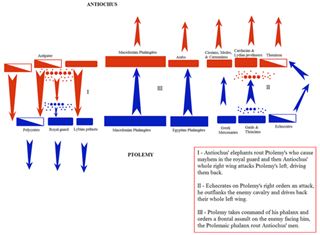
The military of the Ptolemaic Kingdom was essential for maintaining control over Egypt and defending its interests in the eastern Mediterranean. Initially composed of Macedonian and Greek soldiers, the army followed the Hellenistic traditions established by Alexander. The Ptolemies settled many soldiers as cleruchs, granting them plots of land in return for military service, and supplemented them with mercenaries and a powerful navy that secured maritime routes and protected Ptolemaic possessions in the Aegean. The principal conflicts were the Syrian Wars against the Seleucid Empire, fought over control of Coele-Syria and other strategic territories. For the campaign that culminated in the Battle of Raphia in 217 BCE, Ptolemy IV recruited and trained some 20,000 native Egyptians in the Macedonian phalanx, and their role in the victory over Antiochus III marked a turning point. While this broadened the military base, it also shifted the balance of power within society, and the great native revolt in Upper Egypt (206–186 BCE) followed soon afterwards. Despite periods of strength, internal instability and reliance on mercenaries weakened the army’s effectiveness in later years.
Governance & Law

Governance in the Ptolemaic Kingdom was characterised by a centralised bureaucratic system that combined Greek administrative practice with traditional Egyptian institutions. The king held absolute authority and was presented both as a Hellenistic monarch and as pharaoh, embodying dual political and religious legitimacy, reinforced by a royal cult and, from Ptolemy II onwards, by the Egyptian practice of brother-sister marriage within the dynasty. Administration was directed by a chief finance minister (dioiketes) and carried out through a hierarchy of officials, many of them Greek, in the traditional provinces (nomes) under governors known as strategoi, who oversaw taxation, agriculture and legal affairs. The legal system was pluralistic, with Greek and Egyptian courts applying different bodies of law. Alexandria served as the centre of government, housing the royal palace quarter and principal offices, while the Egyptian priesthood remained an important partner, as decrees such as that recorded on the Rosetta Stone (196 BCE) show. While this system ensured effective control and resource extraction, it also reinforced divisions between ruling elites and the native population.
Global & Regional Impact

The Ptolemaic Kingdom played a central role in the cultural and intellectual life of the Hellenistic world, serving as a meeting point of Greek and Egyptian civilisations. Alexandria became one of the greatest cities of the ancient world, home to the Library of Alexandria and the Mouseion, which attracted scholars such as Euclid, Eratosthenes and Herophilus, and to the Pharos lighthouse, one of the Seven Wonders of the ancient world. Tradition holds that the Hebrew scriptures were first translated into Greek, as the Septuagint, under Ptolemaic patronage, a work of lasting religious significance. The kingdom facilitated trade and cultural exchange between Africa, Asia and Europe, contributing to the spread of Hellenistic culture. The synthesis of Greek and Egyptian traditions in art, religion and government, exemplified by the cult of Serapis and by great temples such as Edfu and Dendera, created a distinctive legacy. However, Ptolemaic influence gradually diminished as Roman power expanded across the Mediterranean.
Decline & Fall

The decline of the Ptolemaic Kingdom was marked by internal political instability, economic difficulty and increasing Roman intervention. Dynastic conflicts, including bitter disputes over succession between royal siblings, weakened central authority and led to periods of civil war, while native revolts disrupted Upper Egypt. Heavy taxation and administrative abuses fuelled unrest, and most overseas possessions were lost during the second century BCE. Rome steadily extended its influence over Egyptian affairs: in 168 BCE a Roman envoy forced Antiochus IV to abandon his invasion of Egypt, and in 55 BCE Roman troops restored Ptolemy XII to his throne. The reign of Cleopatra VII (r. 51–30 BCE) represented the final phase of the dynasty, during which she sought to preserve Egyptian independence through alliances with Julius Caesar and Mark Antony. Following their defeat by Octavian at the Battle of Actium in 31 BCE, Egypt was annexed by Rome in 30 BCE, ending the Ptolemaic state.
The Ptolemaic Kingdom stands as a prominent example of Hellenistic rule in Egypt, whose combination of cultural fusion, economic centralisation and political ambition shaped the eastern Mediterranean world before its absorption into the Roman Empire.
References
- Bowman, A.K. (1996) Egypt after the Pharaohs, 332 BC–AD 642. 2nd edn. London: British Museum Press.
- Chauveau, M. (2000) Egypt in the Age of Cleopatra: History and Society under the Ptolemies. Translated by D. Lorton. Ithaca: Cornell University Press.
- Ellis, W.M. (1994) Ptolemy of Egypt. London: Routledge.
- Fraser, P.M. (1972) Ptolemaic Alexandria. 3 vols. Oxford: Clarendon Press.
- Hölbl, G. (2001) A History of the Ptolemaic Empire. Translated by T. Saavedra. London: Routledge.
- Walbank, F.W. (1981) The Hellenistic World. London: Fontana.
Connections
Open the full connections map →