South & Southeast Asia
Maurya Empire
At a glance
- The Maurya Empire, ruled from Pataliputra, was the first state to unite almost the whole Indian subcontinent.
- Its centralised administration and Ashoka's edicts promoting dhamma helped carry Buddhism across Asia.
- It fell apart after Ashoka's death and ended c. 185 BCE when Pushyamitra Shunga killed the last emperor, Brihadratha.
Rise & Fall
- c. 321 BCEChandragupta Maurya overthrows the Nanda dynasty of Magadha
- c. 305–303 BCEChandragupta gains the north-west from Seleucus I in exchange for 500 war elephants
- c. 261 BCEAshoka conquers Kalinga, then renounces conquest by force
- c. 232 BCEAshoka dies and the empire begins a rapid decline
- c. 185 BCEPushyamitra Shunga assassinates Brihadratha, ending Maurya rule
Foundation
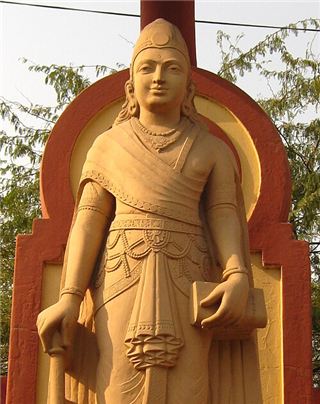
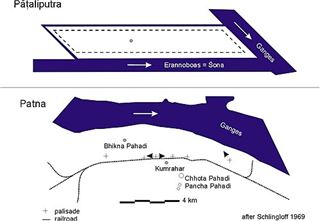
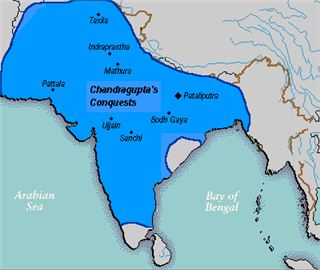
The Maurya Empire was founded around 321 BCE by Chandragupta Maurya, who overthrew the Nanda dynasty of Magadha and exploited the political vacuum left in north-western India after Alexander the Great's campaigns. Guided, according to tradition, by the Brahmin strategist Chanakya (also known as Kautilya), Chandragupta built a vast realm stretching from the Ganges plain to the north-western frontier. In a war and treaty with Seleucus I Nicator around 305–303 BCE, he gained Arachosia, Gedrosia and the Paropamisadae, covering much of modern Pakistan and parts of Afghanistan, in return for 500 war elephants, and received the Greek envoy Megasthenes at his court. The empire's rise was facilitated by the weakness of rival dynasties, the resources of the Gangetic heartland, and a centralised administrative vision rooted in earlier Magadhan statecraft. Pataliputra (modern Patna), already the Nanda capital, served as the imperial centre, which Megasthenes described as a vast city ringed by a timber palisade. Chandragupta's consolidation laid the foundation for one of the largest empires in Indian history, capable of projecting military and economic power across diverse ecological and cultural zones.
Socioeconomy
The Maurya Empire developed a highly structured economy anchored in agriculture, trade and state-controlled revenue. Society was hierarchical, with the emperor and his court at the apex, followed by officials, priests, merchants, artisans and a large peasantry; Megasthenes famously divided Indian society into seven classes, with farmers the most numerous. Agriculture formed the backbone of the economy, relying on the fertile Ganges basin and on irrigation works such as the Sudarshana reservoir in Saurashtra, attributed to Chandragupta's governor, to grow rice, wheat, barley and pulses. Trade flourished internally and externally, linking the subcontinent with Central Asia, the Middle East and the Hellenistic world along routes such as the great northern road (Uttarapatha) and the river systems. The state levied land revenue, trade duties and taxes on artisans, and directly operated mines, forests and workshops, supporting a large army and bureaucracy. Urban centres such as Pataliputra, Taxila and Ujjain thrived on craft production, silver punch-marked coinage and long-distance commerce. This combination of agriculture, state enterprise and trade underpinned the empire's stability and its roads and public works.
Military
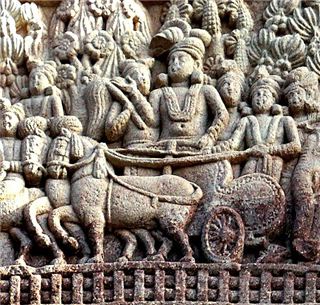
The Maurya army was a large, highly organised and professional force. It comprised the four traditional arms of infantry, cavalry, war elephants and chariots, and Greek sources report that it was administered by a board of thirty officials divided into six committees, including ones for the navy and for supply. War elephants provided both intimidation and battlefield dominance, while cavalry ensured mobility for reconnaissance and rapid strikes. River fleets protected trade and supported operations along the Ganges and its tributaries. Chandragupta and his successors, Bindusara and Ashoka, conducted campaigns that expanded and secured the empire, which eventually covered almost the whole subcontinent except the far south. The Kalinga War, Ashoka's conquest of Kalinga around 261 BCE, which by his own account caused a hundred thousand deaths and the deportation of many more, was the empire's last major war and led him to renounce conquest by force. Military discipline and the fortification of key cities enabled the Mauryas to control a vast and diverse territory, and the army served both to defend the frontiers and to enforce administrative authority within them.
Governance & Law

The Maurya Empire developed one of the earliest and most comprehensive administrative frameworks in South Asian history. Government was centralised under the emperor, assisted by a council of ministers, while major provinces centred on Taxila, Ujjain, Tosali and Suvarnagiri were governed by royal princes (kumaras) as viceroys, supported by senior officials known as Mahamatras. The Arthashastra, attributed to Chanakya but probably compiled and revised over several centuries, gives detailed guidance on administration, espionage, law and diplomacy, and is often used to illuminate Mauryan practice. Law combined royal regulation with customary practice, covering property, crime and social obligations. Specialised officers oversaw agriculture, trade, taxation and justice, enabling coordinated government across diverse provinces. Ashoka's reign added a distinctive dimension, with the Edicts of Ashoka inscribed on rocks and pillars proclaiming dhamma, welfare measures such as wells, rest-houses and medical care for people and animals, and special officers (dhamma-mahamattas) to promote moral conduct. This administrative sophistication enabled effective coordination across a vast empire, balancing centralised control with adaptability to local conditions.
Global & Regional Impact
The Maurya Empire had a profound influence across South Asia and beyond, establishing a model of centralised imperial government that shaped later Indian states. Under Ashoka, royal patronage helped spread Buddhism throughout the subcontinent and beyond; his son Mahinda is traditionally credited with bringing the faith to Sri Lanka, and missions are said to have reached Central and Southeast Asia. The Mauryas promoted trade along overland routes to Central Asia and maritime corridors across the Indian Ocean, encouraging the exchange of goods, ideas and technologies. Ashoka's thirteenth rock edict names the Hellenistic kings Antiochus II, Ptolemy II, Antigonus Gonatas, Magas of Cyrene and Alexander of Epirus as recipients of his dhamma missions, highlighting the empire's engagement with the wider world. Its roads, stupas and polished sandstone pillars, among them the Lion Capital of Sarnath, which became the national emblem of the Republic of India, left a lasting artistic and architectural legacy. The Maurya legacy in administration, economic regulation and statecraft influenced successor empires such as the Guptas and left enduring cultural and religious imprints across the subcontinent and beyond.
Decline & Fall
The Maurya Empire declined rapidly after Ashoka's death around 232 BCE under a combination of political, economic and regional pressures. Succession disputes and weaker rulers undermined central authority, and the empire may have been divided between rival branches of the dynasty. Maintaining a large bureaucracy and army strained the treasury, particularly as revenues fluctuated. Peripheral regions, including Kalinga, the Deccan and the north-west, increasingly asserted their independence, and Greco-Bactrian rulers began to push into the north-west in the early second century BCE. Around 185 BCE the last Maurya emperor, Brihadratha, was assassinated by his commander-in-chief, Pushyamitra Shunga, who founded the Shunga dynasty in the Gangetic heartland, marking the end of Mauryan rule. Economic contraction, internal factionalism and the difficulty of sustaining imperial infrastructure compounded the decline. Mauryan administrative practice, artistic traditions and Buddhist patronage nevertheless persisted, influencing successor states and regional institutions for centuries.
The Maurya Empire stands as one of the largest empires in Indian history, whose centralised administration, guided by the Arthashastra, and Ashoka's promotion of dharma and Buddhism left a model of governance and a religious legacy that long outlived the dynasty.
References
- Allen, C. (2012) Ashoka: The Search for India's Lost Emperor. London: Little, Brown.
- Basham, A.L. (1967) The Wonder That Was India. 3rd edn. London: Sidgwick and Jackson.
- Habib, I. and Jha, V. (2004) The Mauryan India. Delhi: Tulika Books.
- Kangle, R.P. (ed. and trans.) (1965–1972) The Kautaliya Arthasastra. 3 vols. Bombay: University of Bombay.
- Kulke, H. and Rothermund, D. (2004) A History of India. 4th edn. London: Routledge.
- Thapar, R. (1961) Aśoka and the Decline of the Mauryas. Oxford: Oxford University Press.
Connections
Open the full connections map →