South & Southeast Asia
Gupta Empire
At a glance
- A north Indian empire built from the Ganges plain by Chandragupta I and Samudragupta from around 320 CE.
- Its age saw Aryabhata's mathematics, Kalidasa's poetry and art that shaped Southeast Asia, earning it the name Golden Age of India.
- Huna invasions and feudatories who broke away dissolved it into regional kingdoms by the mid-sixth century.
Rise & Fall
- c. 320Chandragupta I ascends and takes the title Maharajadhiraja, great king of kings
- c. 335Samudragupta begins the campaigns recorded on the Allahabad Pillar
- c. 375Chandragupta II succeeds and later defeats the Shaka satraps of western India
- c. 455Skandagupta takes the throne and repels a major Huna incursion
- 499Aryabhata composes the Aryabhatiya
- c. 500Hunas under Toramana and Mihirakula occupy much of northwestern and central India
- c. 528Aulikara king Yashodharman, not a Gupta, defeats Mihirakula
- c. 540Vishnugupta, the last recognised Gupta emperor, rules only a remnant kingdom
Foundation
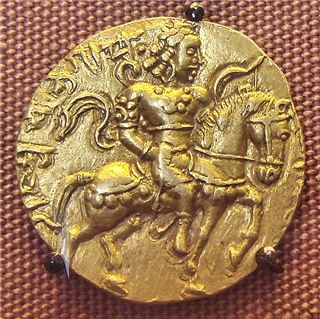
The Gupta Empire emerged in the Ganges plain during a period of political fragmentation following the decline of the Kushan Empire in the northwest. The dynasty's founder, Sri Gupta, established a modest kingdom in or near Magadha around 240 to 280 CE, but meaningful imperial expansion began under Chandragupta I, who ascended around 320 CE and is conventionally treated as the true founder. His marriage to the Lichchhavi princess Kumaradevi was a calculated political alliance that brought prestige and legitimacy, and he adopted the title Maharajadhiraja, great king of kings, marking the formal transition from regional ruler to imperial sovereign. His son Samudragupta (c. 335–375 CE) transformed the inheritance into a genuine pan-Indian empire through sustained campaigns recorded in the Allahabad Pillar Inscription composed by his court poet Harishena. Samudragupta uprooted nine kings of the north outright, defeated twelve southern rulers and reinstated them as tributaries, and received submission or homage from frontier peoples, the Kushan remnants, and the king of Sri Lanka. Three conditions enabled the rise: the political vacuum left by prior imperial collapses, the strategic marriage alliance securing the Gangetic heartland, and the extraordinary personal military capacity of Samudragupta himself.
Socioeconomy
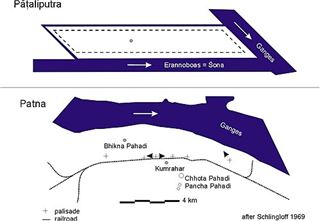
Gupta society was organised along Brahmanical varna hierarchies, with agriculture forming the economic base. The Ganges plain produced surplus grain sustaining both the imperial court and a substantial artisan and merchant class organised into powerful guilds. Long-distance trade with the Mediterranean world, Southeast Asia, and China was vigorous, with Indian merchants exporting cotton textiles, spices, ivory, and precious stones, and the dynasty's abundant gold coinage, the dinara, attests to the wealth this commerce generated. Land grants to Brahmins and Buddhist monasteries, recorded on copper plate inscriptions, delegated revenue rights and local administration to religious beneficiaries in exchange for ideological legitimacy. Taxation was levied on agricultural produce, trade, and artisan output, with the state maintaining rights over mines and salt production. Urban centres including Pataliputra, Ujjain, and Vaishali served as commercial and administrative hubs. The Chinese pilgrim Faxian, who travelled in India in the first decade of the fifth century, described light taxation, mild punishments, and effective administration, an account broadly consistent with other evidence of prosperity in the Gangetic heartland.
Military
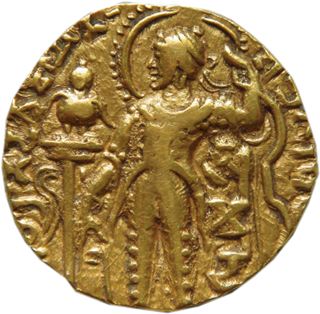
Gupta military power rested on a combined arms tradition of infantry, cavalry, and war elephants, with mounted archers increasingly prominent as the empire expanded, as the archer-type gold coins of the emperors suggest. Samudragupta's campaigns demonstrated a sophisticated strategic distinction between northern kingdoms, which were conquered and directly absorbed, and southern polities, which were defeated and released as tributaries, a pragmatic calibration of military effort to administrative capacity. Chandragupta II (c. 375–415 CE) extended the empire westward by defeating the Shaka satraps of western India, giving the Guptas access to the prosperous port cities of Gujarat and the Arabian Sea trade routes. The Gupta army maintained a standing imperial core supplemented by contingents from subordinate rulers, providing numerical mass but uneven reliability. Military innovation was less distinctive than in comparable empires; the Guptas excelled at campaign organisation and diplomatic consolidation rather than tactical revolution. The empire's military reputation rested above all on the achievements of Samudragupta and Chandragupta II, and their successors were progressively less able to sustain the same offensive momentum.
Governance & Law
The Gupta administrative system was deliberately decentralised, combining direct imperial administration of the core Gangetic territories with indirect rule over a wide periphery of feudatory kings who retained internal autonomy in exchange for tribute and military service. The empire was divided into provinces called bhuktis, administered by governors known as uparikas, sometimes members of the royal family. Below them, districts called vishayas were managed by appointed vishayapatis, who in some regions were advised by councils including the chief banker, the leading caravan merchant, and the head of the artisans, integrating existing power structures rather than replacing them. The Narada Smriti and Brihaspati Smriti legal texts, compiled or refined during this period, codified civil and criminal law along Brahmanical lines, addressing property rights, inheritance, contracts, and royal obligations. The system's weakness was structural: peripheral feudatories owed loyalty to individual rulers rather than to imperial institutions, meaning the empire's coherence depended on the personal authority of each successive emperor rather than on any self-sustaining bureaucratic apparatus.
Global & Regional Impact

The Gupta period is conventionally designated the Golden Age of India, supported by achievements across an exceptional range of disciplines. The mathematician Aryabhata, whose Aryabhatiya dates to 499 CE, approximated pi to four decimal places, proposed that the earth rotates on its axis, and worked within the place-value decimal system that was later transmitted through the Arab world to medieval Europe. The surgical tradition preserved in the Sushruta Samhita, an earlier compendium that continued to circulate and be revised, described rhinoplasty and cataract surgery by couching with remarkable precision. Sanskrit literature reached its classical peak under court patronage, with Kalidasa producing works including the Abhijnanasakuntalam that remain canonical in Indian literary tradition. Gupta artistic conventions in sculpture and iconography, seen at Sarnath and in the early cave temples of Udayagiri, were transmitted across Southeast Asia through trade and religious contact, shaping the artistic traditions of Cambodia, Thailand, and Java for centuries after the empire itself had dissolved.
Decline & Fall
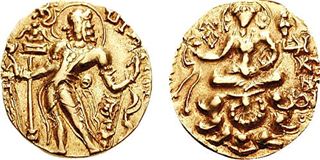
The Gupta decline was initiated by the Huna invasions of the later fifth century CE. The Hunas first pressed into northwestern India around the middle of the century and mounted sustained campaigns from approximately 480 CE onward. Emperor Skandagupta (c. 455–467 CE) repelled an initial major incursion, an achievement commemorated in his Bhitari pillar inscription, but continuous frontier warfare depleted the treasury and accelerated the loosening of feudatory loyalties. Following Skandagupta's death, succession disputes fragmented the dynasty into competing branches. By around 500 CE, the Hunas under Toramana and subsequently Mihirakula had occupied large portions of northwestern and central India, with Mihirakula remembered in Buddhist sources for his brutality towards monasteries. The peripheral feudatories the decentralised Gupta system had cultivated now asserted independence rather than providing assistance; it was the Aulikara king Yashodharman, not a Gupta, who claimed the decisive victory over Mihirakula around 528. The last recognised Gupta emperor, Vishnugupta, ruled only a remnant kingdom around 540 to 550 CE before the dynasty dissolved into regional successor states.
The Gupta Empire endures as one of history's most consequential demonstrations that an empire's civilisational legacy can vastly exceed its political durability, having produced mathematical, literary, medical, and artistic achievements that shaped Eurasian intellectual traditions for centuries while the administrative structure sustaining them lasted barely two hundred and fifty years.
References
- Kangle, R.P. (ed. and trans.) (1965–1972) The Kautaliya Arthasastra. 3 vols. Bombay: University of Bombay.
- Kulke, H. and Rothermund, D. (2004) A History of India. 4th edn. London: Routledge.
- Liu, X. (1988) Ancient India and Ancient China: Trade and Religious Exchanges, AD 1–600. Delhi: Oxford University Press.
- Majumdar, R.C. (1954) The Gupta Empire. Bombay: Hacker Art Books.
- Sharma, R.S. (2001) Early Medieval Indian Society: A Study in Feudalisation. Calcutta: Orient Longman.
- Upinder Singh (2008) A History of Ancient and Early Medieval India. Delhi: Pearson Longman.
Connections
Open the full connections map →