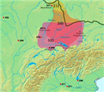
Islamic Caliphates & Middle East
Sasanian Empire
At a glance
- The Sasanian Empire ruled Iran and Mesopotamia from 224 to 651, a centralised Zoroastrian monarchy that was Rome's great rival for four centuries.
- Its armoured cavalry, fixed land tax and court culture shaped Byzantium and, above all, the Islamic caliphates that followed.
- A ruinous war with Byzantium and a succession crisis left it defenceless against the Arab conquests that ended it by 651.
Rise & Fall
- 224Ardashir I defeats and kills the last Parthian king, Artabanus IV, at Hormozdgan
- 260Shapur I captures the Roman emperor Valerian at the Battle of Edessa
- 363Shapur II wins Nisibis and lands beyond the Tigris in a peace with Rome's Jovian
- c. 557Khosrow I and the Göktürks begin destroying the Hephthalite empire
- 614Khosrow II's general Shahrbaraz captures Jerusalem
- 627Heraclius defeats the Sasanians at the Battle of Nineveh
- c. 636Arab armies destroy the main Sasanian field army at al-Qadisiyyah
- 651The last king, Yazdegerd III, is murdered near Merv
Foundation
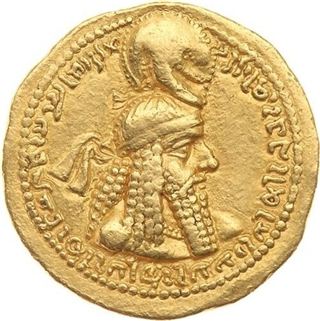
The Sasanian Empire was founded in 224 CE when Ardashir I, a local ruler from Pars (modern Fars in south-western Iran) and a vassal of the Arsacid Parthian dynasty, defeated and killed the last Parthian king, Artabanus IV, at the Battle of Hormozdgan, before taking the title Shahanshah, King of Kings, and entering the former Parthian capital of Ctesiphon on the Tigris around 226. Ardashir's family traced its descent from Sasan, traditionally a priest at the temple of Anahita at Istakhr, from whom the dynasty took its name, and this priestly lineage supplied both religious legitimacy and the ideological programme that distinguished the new empire from its predecessor. Where the Arsacids had ruled through a loose confederacy of semi-autonomous noble houses, Ardashir pursued centralisation, curbing the great clans, reorganising the administration of the Iranian plateau and elevating Zoroastrianism as the state-sponsored religion, supported by a network of royal fire temples. His son Shapur I (r. c. 240–270 CE) consolidated and greatly expanded the state, waging three major wars against Rome that culminated in the capture of Emperor Valerian at the Battle of Edessa in 260 CE, the only occasion on which a reigning Roman emperor was taken prisoner by a foreign power, an event commemorated in the rock relief at Naqsh-e Rostam, where the captive Valerian appears before the mounted king beside the kneeling Philip the Arab. The enabling conditions for the Sasanian revolution were the chronic dynastic instability of the late Parthian period, the ambitions of the Pars aristocracy under Arsacid overlordship, and Ardashir's ability to combine military capability with a coherent ideology rooted in Zoroastrian kingship and the claim to be restoring the imperial tradition of the Achaemenids.
Socioeconomy

Sasanian society was organised according to a hierarchy of estates formalised in Zoroastrian tradition: priests (asronan, or asravan), warriors (arteshtaran), scribes and administrators (dibiran, also dabiran), and commoners, divided into peasant cultivators (wastaryoshan, or vastryoshan) and artisans (hutukhshan). This framework was not merely theoretical: mobility between estates was restricted and occupational identity was largely hereditary. The agricultural economy of the Mesopotamian lowlands, the empire's wealthiest region, depended on an elaborate infrastructure of canals, dykes and water-management works, some of them built by Roman prisoners of war captured in Shapur I's campaigns; Shapur's foundation of Bishapur and the Band-e Kaisar dam across the Karun River at Shushtar, both associated with Roman captive labour and expertise, exemplify this deliberate exploitation of captured knowledge. Mesopotamian farms produced wheat, barley, rice, dates and sesame in quantities sufficient to sustain dense urban populations and generate a substantial taxable surplus. The fiscal system rested on a land tax (harag) assessed on agricultural production and a poll tax (gazidag) levied on commoners, from which nobles, priests, soldiers and scribes were exempt, supplemented by customs duties and royal monopolies. The empire's position at the junction of the overland Silk Road from China through Central Asia, the maritime route from India through the Persian Gulf, and the routes westward to the Mediterranean generated commercial revenues that successive rulers sought to maximise through military control of chokepoints and diplomacy with trading partners from China to Constantinople.
Military
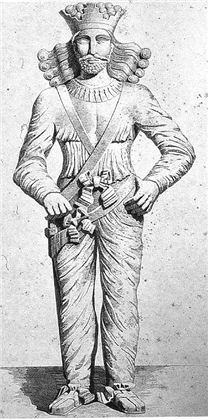
The Sasanian military evolved considerably over the empire's 427-year existence but relied throughout on the heavily armoured cavalry of the great noble houses as its premier strike force, supported by war elephants, infantry levies and, from the fifth century, increasingly professional units. The savaran, heavy cavalry in which both horse and rider could be clad in mail and lamellar armour, were among the most formidable mounted forces of western Eurasia and strongly influenced the development of the Roman and Byzantine clibanarii and kataphraktoi. Sasanian siege craft, learned partly from captured Roman specialists and refined over centuries of war against fortified Roman frontier cities, reached a high level of sophistication, enabling Shapur I's capture of Antioch in the 250s, Shapur II's seizure of Amida (modern Diyarbakir) in 359 CE after a 73-day siege, and the fall of Jerusalem to Khosrow II's general Shahrbaraz in 614 CE. A signal achievement was Shapur II's reversal of the humiliating peace imposed by Rome in 299 CE: after decades of war against Constantius II and Julian, Shapur obtained, in the Peace of 363 concluded with Jovian after Julian's death on campaign, the cession of Nisibis, Singara, five provinces beyond the Tigris and fifteen fortresses, the most favourable settlement Persia ever won from Rome. Khosrow I Anushirvan reorganised the army on a more professional footing, dividing high command among four regional generals (spahbed) and paying and equipping cavalrymen from the reformed treasury, and in alliance with the Göktürk Khaganate destroyed the Hephthalite empire (c. 557–560 CE) that had long threatened the north-eastern frontier, carrying Sasanian influence towards the Amu Darya.
Governance & Law

The Sasanian administration combined the centralising ambitions of its founders with the practical need to accommodate the great noble houses (wuzurgan), whose military power and regional authority could never be entirely suppressed. At the apex stood the Shahanshah, whose authority was theoretically absolute and sanctioned through the Zoroastrian concept of xwarrah, the divine royal glory that legitimised rule and was believed to abandon unworthy kings. Below him the wuzurg framadar (grand vizier) coordinated central administration, while the empire was divided into provinces (shahr), with frontier regions under marzban (margraves) responsible for both civil administration and defence. The Zoroastrian priestly hierarchy, headed by the mobedan mobed (chief priest), exercised authority over religious law, education and the ideological apparatus of the state, and the fire temple network functioned at once as a religious institution, an administrative centre and the keeper of the sacred fires whose maintenance symbolised dynastic legitimacy. Sasanian law is best known from the Madayan i Hazar Dadestan (Book of a Thousand Judgements), a compilation of the early seventh century that reveals a sophisticated jurisprudential tradition addressing contracts, property, inheritance and family relations with considerable technical precision. The most significant administrative reform of the period was Khosrow I's replacement, building on initiatives of his father Kavad I, of the traditional harvest-share tax, which required annual assessment and invited official corruption, with a fixed land tax based on surveys of cultivated area, crop type and irrigation, a reform that produced more stable revenues and survived the Islamic conquest into the fiscal systems of the caliphate.
Global & Regional Impact

The Sasanian Empire's influence on later Eurasian history operated through religious, cultural, administrative and military channels, and proved remarkably durable despite the empire's political extinction in 651 CE. Most consequential was the transmission of Persian administrative, artistic and intellectual traditions into the Islamic caliphates, above all the Abbasid Caliphate: Persian secretaries and scholars staffed the Abbasid government from its foundation, New Persian eventually rivalled Arabic as a language of administration and high culture across the eastern Islamic world, and Sasanian motifs such as the simurgh, the royal hunt and the enthroned audience scene permeated Islamic decorative arts from Andalusia to Central Asia. Under Khosrow I the court became a centre of cross-cultural scholarship: the king welcomed Neoplatonist philosophers who left Athens after Justinian's closure of the Neoplatonic Academy in 529 CE, sponsored translations from Greek and Sanskrit, and fostered medical learning at Gundishapur, whose later reputation as the great Academy of Gundishapur is probably exaggerated but whose physicians did serve the early Abbasid court, helping to transmit a synthesis of Greek, Indian and Iranian learning into the Islamic scientific tradition of the eighth to tenth centuries. Sasanian military practice, particularly heavily armoured cavalry and mounted archery, influenced both the Byzantine army and the warrior traditions of Central Asia. Zoroastrianism, though reduced to a minority faith in Iran after the conquest, survived in the Parsi communities of western India, descendants of Zoroastrian migrants from Iran, and continues as a living tradition whose cultural influence far exceeds its small numbers.
Decline & Fall
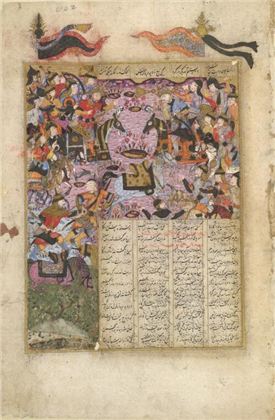
The Sasanian collapse between 628 and 651 CE was among the most rapid and complete in ancient history, transforming the dominant power of western Asia into conquered territory within little more than two decades, yet its causes had been accumulating across a century of intermittent war with Rome. The proximate trigger was the Byzantine-Sasanian War of 602–628 CE, launched after the emperor Maurice, who had helped restore Khosrow II to power against the usurper Bahram Chobin in 591 CE, was overthrown and murdered by the junior officer Phocas. Khosrow II seized upon Maurice's murder as a pretext for the most ambitious Sasanian offensive in centuries: from 603 his armies overran Armenia, Mesopotamia, Syria and Palestine, conquered Egypt by around 621, and twice reached the Bosphorus opposite Constantinople, culminating in the siege of 626, achieving an extent that rivalled the Achaemenid empire. This overextension proved fatal: the treasury was drained by continuous campaigning, the peasantry was heavily taxed to sustain armies across enormous distances, and the administration was strained beyond its capacity. Heraclius's counter-offensive from 622 CE reversed these gains within six years, culminating in the Battle of Nineveh on 12 December 627 CE; Khosrow II was then deposed and killed in a coup led by his son Kavad II in 628, opening a succession crisis in which perhaps a dozen rulers claimed the throne within four years, among them the queens Boran and Azarmidokht, none of whom could command the loyalty of the great noble houses or the army. This disintegration left the empire without effective central authority just as the armies of the Rashidun Caliphate invaded in 633 CE; the Battle of al-Qadisiyyah (c. 636 CE) destroyed the main Sasanian field army, and the last king, Yazdegerd III, fleeing eastward as province after province submitted, was murdered near Merv in 651 CE, traditionally by a local miller, while his son Peroz sought refuge at the Tang court in China.
The Sasanian Empire represents the culmination of pre-Islamic Iranian civilisation, and its administrative traditions, artistic achievements and intellectual life shaped the culture of the Islamic caliphates that succeeded it so thoroughly that Islamic civilisation cannot be understood without recognising the Sasanian foundations on which it was built.
References
- Brosius, M. (2006) The Persians: An Introduction. London: Routledge.
- Christensen, A. (1944) L'Iran sous les Sassanides. 2nd edn. Copenhagen: Ejnar Munksgaard.
- Daryaee, T. (2009) Sasanian Persia: The Rise and Fall of an Empire. London: I.B. Tauris.
- Frye, R.N. (1983) 'The Political History of Iran under the Sasanians', in E. Yarshater (ed.) The Cambridge History of Iran. Vol. 3(1). Cambridge: Cambridge University Press, pp. 116–180.
- Greatrex, G. and Lieu, S.N.C. (2002) The Roman Eastern Frontier and the Persian Wars, Part II: AD 363–630. London: Routledge.
- Wiesehöfer, J. (1996) Ancient Persia from 550 BC to 650 AD. Translated by A. Azodi. London: I.B. Tauris.
Connections
Open the full connections map →