Islamic Caliphates & Middle East
Parthian Empire
At a glance
- The Parthian Empire was an Iranian power founded by the Arsacids that ruled from the Euphrates to the Iranian plateau.
- Its cavalry held Rome at the Euphrates for centuries, and it profited as the Silk Road link between Rome and Han China.
- Noble rivalry, civil wars and Roman captures of Ctesiphon weakened it; Ardashir I's Sasanians ended Arsacid rule in 224 CE.
Rise & Fall
- c. 238 BCEArsaces I of the Parni seizes the satrapy of Parthia from Andragoras
- c. 141 BCEMithridates I conquers the Seleucid heartland of Mesopotamia
- 53 BCESurena's Parthian army destroys the Roman army of Crassus at Carrhae
- 36 BCEMark Antony's invasion ends in a costly Roman retreat
- 116Trajan captures the Parthian capital, Ctesiphon
- 198Septimius Severus captures Ctesiphon again
- 224Ardashir I kills Artabanus IV at Hormozdgan, founding the Sasanian Empire
Foundation
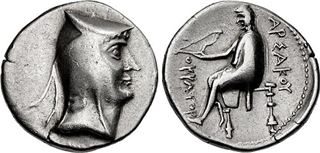
The Parthian Empire emerged in the mid-third century BCE amid the fragmentation of the Seleucid Empire, which was struggling to retain control of its eastern territories. Its founder, Arsaces I, was a leader of the Parni, a semi-nomadic Iranian people of the Dahae confederation, who seized the satrapy of Parthia from its rebel governor Andragoras around 238 BCE; the Arsacid era was later reckoned from 247 BCE. The weakening of Seleucid authority, compounded by revolts such as that of Bactria and by wars in the west, created favourable conditions for a new power in north-eastern Iran. Arsaces and his successors gradually extended their control over the Iranian plateau, adopting elements of Hellenistic administration and culture while maintaining an Iranian identity. The transformation from a small regional kingdom into a major imperial power came under Mithridates I (r. c. 171–132 BCE), who conquered Media and, around 141 BCE, the Seleucid heartland of Mesopotamia. Under Mithridates II (r. c. 124–91 BCE) Parthia reached the Euphrates and established the first diplomatic contacts with Rome, which would become its great western rival.
Socioeconomy
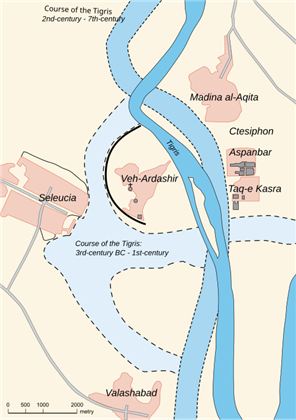
The socioeconomy of the Parthian Empire combined a decentralised agrarian base with significant involvement in long-distance trade. Agriculture remained the primary economic activity, with irrigated farming in Mesopotamia and the oases of the plateau and pastoralism in the steppe and mountain zones. The empire’s position across key segments of the Silk Road made it a critical intermediary between the Mediterranean world, Central Asia and China, and Parthian merchants profited from the transit of silk, spices, incense and precious metals; Chinese envoys knew the empire as Anxi. Society was hierarchically structured, with a powerful aristocracy dominating political and economic life while peasants and dependent labourers formed the foundation of production. Unlike more centralised empires, economic control was often exercised regionally by great noble families who enjoyed considerable autonomy. Urban centres such as Seleucia on the Tigris, with its large Greek population, and the neighbouring royal residence of Ctesiphon served as commercial and administrative hubs, and the silver drachms struck by the Arsacid kings, inscribed in Greek, reflected the blend of Iranian and Hellenistic influences that shaped the economy.
Military

The Parthian military was highly distinctive and decisive in the empire’s ability to resist external threats, particularly from Rome. It was composed primarily of cavalry, reflecting the steppe origins of the ruling elite. Two arms defined Parthian warfare: heavily armoured cataphracts, whose riders and horses were protected by scale or mail armour, and highly mobile horse archers. The latter were renowned for the “Parthian shot”, in which riders feigned retreat and fired arrows backwards from the saddle, a tactic that proved devastating against slower infantry armies. Its effectiveness was demonstrated at Carrhae in 53 BCE, where a Parthian army under the general Surena, supplied with arrows by a camel train, destroyed a Roman army led by Marcus Licinius Crassus, who was killed in the aftermath; Mark Antony’s invasion of 36 BCE also ended in a costly retreat. However, reliance on aristocratic cavalry contingents meant that military power depended on the loyalty of regional nobles, limiting central control and coordination in prolonged conflicts and siege warfare.
Governance & Law
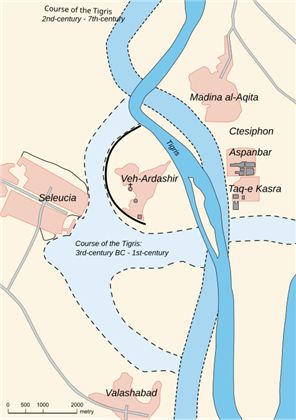
Governance in the Parthian Empire was marked by a loose and decentralised structure that balanced royal authority with significant autonomy for regional rulers and noble families. The Arsacid king, styled “King of Kings”, held supreme authority but relied heavily on great aristocratic houses such as the Suren and the Karen, which held hereditary privileges and vast estates. Alongside provinces governed by royal appointees, the empire included numerous subordinate kingdoms, among them Persis, Elymais, Characene and Adiabene, whose rulers retained their own administrative and military resources in exchange for loyalty and tribute. The empire thus lacked a highly centralised bureaucracy, operating instead through a network of semi-independent political entities. Legal and administrative practice combined Iranian traditions with Hellenistic elements, and Greek remained in use alongside Parthian in inscriptions and coinage. The royal court moved between residences such as Ctesiphon, Ecbatana and Hecatompylos, and effective governance depended on negotiation and alliance-building with regional elites. While this flexible system allowed the empire to manage a vast and diverse territory, it also left it vulnerable to dynastic rivalry.
Global & Regional Impact

The Parthian Empire played a crucial role in shaping the geopolitical landscape of the ancient Near East and served as a vital cultural and economic bridge between East and West. Its strategic position along the Silk Road facilitated the movement of goods, ideas and technologies between the Roman world and Han China, which first established contact with Parthia through embassies following the mission of Zhang Qian in the second century BCE. The Parthians also acted as a counterweight to Roman expansion, fixing the Euphrates as a long-lasting frontier and preventing Rome from dominating the entire Near East. Cultural exchange within the empire produced a synthesis of Iranian and Hellenistic traditions in art and architecture, visible in the frontal portraiture of Parthian sculpture and in the iwan, the vaulted hall that became a hallmark of later Iranian building. The persistence of Iranian political culture under Arsacid rule preserved and transmitted traditions that would be further developed by the Sasanian Empire. Through these contributions, the Parthian state left a lasting mark on regional history and intercultural exchange.
Decline & Fall

The decline of the Parthian Empire was a gradual process driven by internal fragmentation and external pressure, both from Rome and from within Iran itself. The decentralised nature of the state allowed powerful noble families to accumulate influence, producing frequent succession disputes and civil wars between rival Arsacid claimants. Repeated Roman invasions, in which Trajan (116 CE), Avidius Cassius (165 CE) and Septimius Severus (198 CE) each captured Ctesiphon, strained resources and damaged royal prestige. In the early third century CE, while Artabanus IV contended with his brother Vologases VI for the throne, a new power arose in Persis under Ardashir I, a local ruler of the house of Sasan. Ardashir capitalised on Parthian weakness and defeated and killed Artabanus IV at the Battle of Hormozdgan in 224 CE. This victory ended Arsacid rule in Iran and established the Sasanian Empire as the dominant power in the region, although branches of the Arsacid dynasty continued to rule in Armenia and elsewhere in the Caucasus. The fall of the Parthian state thus resulted from a combination of internal disunity and external conquest.
The Parthian Empire stands as a distinctive example of a decentralised imperial system whose military innovation and strategic position enabled it to shape the balance of power between the major civilisations of the ancient world.
References
- Bivar, A.D.H. (1983) 'The Political History of Iran under the Arsacids', in E. Yarshater (ed.) The Cambridge History of Iran. Vol. 3(1). Cambridge: Cambridge University Press, pp. 21–99.
- Brosius, M. (2006) The Persians: An Introduction. London: Routledge.
- Colledge, M.A.R. (1967) The Parthians. London: Thames and Hudson.
- Overtoom, N.L. (2020) Reign of Arrows: The Rise of the Parthian Empire in the Hellenistic Middle East. Oxford: Oxford University Press.
- Sellwood, D. (1980) An Introduction to the Coinage of Parthia. 2nd edn. London: Spink.
- Wiesehöfer, J. (1996) Ancient Persia from 550 BC to 650 AD. Translated by A. Azodi. London: I.B. Tauris.
Connections
Open the full connections map →