Ancient Near East
Seleucid Empire
At a glance
- Carved out of Alexander's conquests by his general Seleucus I, the Seleucid Empire stretched from Syria towards India at its height.
- Its many new Greek cities spread Hellenistic language and culture across the Near East and Central Asia for centuries.
- Defeat by Rome, Parthian conquest of the east and endless dynastic civil war reduced it to a Syrian rump that Pompey annexed in 64-63 BCE.
Rise & Fall
- 312 BCESeleucus retakes Babylon after the Battle of Gaza, the starting point of the Seleucid era
- 301 BCESeleucus and Lysimachus defeat and kill Antigonus at the Battle of Ipsus
- 281 BCESeleucus defeats Lysimachus at Corupedium but is assassinated within months
- 212 BCEAntiochus III begins a seven-year eastern campaign that earns him the title 'the Great'
- 190 BCERome routs Antiochus III's army at the Battle of Magnesia
- 167 BCEAntiochus IV's suppression of Jewish practice sparks the Maccabean revolt
- 141 BCEMithridates I of Parthia conquers Mesopotamia and captures Seleucia-on-Tigris
- 64 BCEPompey deposes Antiochus XIII and makes Syria a Roman province
Foundation

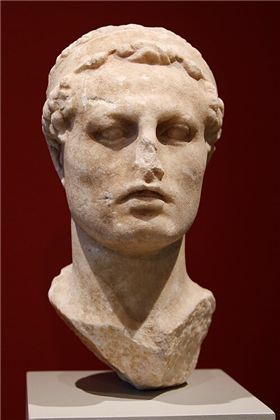
The Seleucid Empire emerged from the fragmentation of Alexander the Great's conquests after his death in Babylon in June 323 BCE, when his generals, the Diadochi, began competing for control of his vast inheritance. Seleucus I Nicator, who had commanded the royal hypaspists under Alexander and the Companion cavalry under the regent Perdiccas, was appointed satrap of Babylonia in 320 BCE but was driven out by the dominant Diadochos Antigonus I Monophthalmus in 316 BCE, spending several years in exile at the court of Ptolemy I in Egypt. His opportunity came when he and Ptolemy defeated Antigonus's son Demetrius at the Battle of Gaza in 312 BCE, allowing Seleucus to retake Babylon with a small force, an event so significant that it became the starting point of the Seleucid era, a calendar that remained in use across the Near East for centuries. His eastern campaign (c. 305–303 BCE) brought him into confrontation with Chandragupta Maurya, founder of the Mauryan Empire, who had seized Alexander's Indian territories after the Macedonian withdrawal; the resulting Treaty of the Indus ceded the eastern satrapies of Paropamisadae, Arachosia and Gedrosia, in whole or in part, to the Mauryas in exchange for 500 war elephants, which proved decisive at the Battle of Ipsus in 301 BCE, where Seleucus and Lysimachus killed Antigonus and divided his domains. The Battle of Corupedium in 281 BCE, in which Seleucus defeated and killed Lysimachus, the last of his rivals in Asia, left him master of almost all of Alexander's former territories outside Egypt and Macedonia, but his assassination by Ptolemy Ceraunus within months, before he could consolidate this supreme position, foreshadowed the dynastic instability that would characterise the empire throughout its history.
Socioeconomy
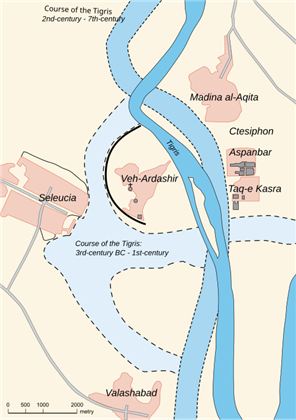
The Seleucid Empire's economic geography was defined by extraordinary ethnic, cultural and agrarian diversity, encompassing the irrigated river valleys of Mesopotamia, the mixed agricultural and pastoral economies of the Iranian plateau, the Mediterranean coastal cities of Syria, and the steppe and mountain economies of the eastern satrapies from Bactria to the borders of India. The most productive zone was Babylonia, the alluvial plain between the Tigris and Euphrates, whose ancient irrigation network could generate surpluses sufficient to sustain both dense urban populations and substantial armies; Seleucia-on-Tigris, founded by Seleucus I on the Tigris north of Babylon, grew into one of the largest cities of the Hellenistic world, with a population that ancient sources put in the hundreds of thousands, and served as both the empire's eastern capital and its chief commercial entrepôt. The Seleucids founded Greek and Macedonian military colonies (katoikiai) and new cities (poleis) across their domains, Seleucus I alone being credited by Appian with nine cities named Seleucia and sixteen named Antioch, as instruments of both military control and economic development, introducing Greek urban organisation and commercial networks into regions previously governed through Persian satrapal administration. The royal economy drew on taxation of agricultural production on royal land (basilike chora), tribute from subordinate rulers, cities and temple estates, customs duties at commercial chokepoints including the Persian Gulf ports and the Syrian coastal cities, and revenues from royal monopolies such as salt. The Seleucid coinage, struck on the Attic silver standard inherited from Alexander and maintained with reasonable consistency across the core territories, facilitated commercial integration across diverse regional economies and enabled the payment of the mercenary soldiers on whom military operations depended.
Military

The Seleucid army was built around the Macedonian-style phalanx, dense ranks of infantry armed with the sarissa, a pike some five to seven metres long that presented an almost impenetrable wall of points to any frontal assault, supported by Companion cavalry on the flanks, war elephants as shock troops, and a wide array of mercenary and allied contingents drawn from across the empire's many peoples. Maintaining a Macedonian phalanx far from its Aegean recruiting grounds was a chronic strategic problem: the military colonies provided a partly self-reproducing source of trained infantry, but over generations their populations intermarried with local communities, diluting both military readiness and Macedonian identity. The empire's greatest military achievement was Antiochus III's eastern anabasis of 212–205 BCE, a seven-year campaign that reasserted Seleucid suzerainty over Armenia, Parthia, Bactria and the regions towards the Indus, earning Antiochus the epithet 'the Great' and invited comparison with Alexander. His later campaigns revealed both the potential and the limits of Seleucid power: the Fifth Syrian War (202–195 BCE), decided at the Battle of Panium around 200 BCE, where Antiochus's son Antiochus led the cavalry and elephants to rout the Ptolemaic army under the Aetolian general Scopas, permanently secured Coele-Syria; but the invasion of Greece in 192 BCE and the ensuing war with Rome ended in catastrophic defeat at the Battle of Magnesia in 190 BCE, where a Roman army of perhaps 30,000, supported by the Pergamene cavalry of Eumenes II, routed a Seleucid force of some 70,000, exposing the tactical limitations of the phalanx against the more flexible Roman manipular legion.
Governance & Law
The Seleucid administration represented a creative synthesis of Macedonian royal authority, Achaemenid Persian administrative traditions and the practical requirements of governing an empire that at its greatest extent covered some 3.9 million square kilometres and encompassed dozens of distinct ethnic, linguistic and legal communities. At the apex stood the basileus, whose authority was theoretically absolute but in practice constrained by the loyalty of the army, the cooperation of local elites, cities and temple communities, and the impossibility of imposing uniform government across such geographic and cultural diversity. The empire was divided into satrapies administered by governors (strategoi or satraps) appointed by the king and answerable to the court, whose principal seats at Antioch-on-the-Orontes and Seleucia-on-Tigris reflected the empire's dual Mediterranean and Mesopotamian character. The Seleucids took a pragmatic approach to local diversity, generally permitting subject communities to retain their traditional laws and internal government: Babylonian temple communities continued to operate under cuneiform legal traditions, the Jews of Judaea retained their ancestral law (until Antiochus IV's intervention), and Greek poleis kept their civic institutions, while a layer of royal authority above these arrangements extracted revenue and military service. Royal correspondence, preserved chiefly in inscriptions and in later literary citations, reveals a sophisticated chancellery working mainly in Greek, alongside Aramaic and local languages, and adapting its documents to the expectations of different recipient communities. The empire never developed the systematic census and cadastral apparatus of Ptolemaic Egypt, creating persistent difficulties in revenue assessment and recruitment that weakened Seleucid fiscal capacity relative to its Egyptian rival.
Global & Regional Impact

The Seleucid Empire's most transformative and enduring contribution to world history was the dissemination of Hellenistic Greek culture, its language, urban planning, philosophy, art and science, across the arc of territory from the Mediterranean coast to the borders of India, creating a cultural koine that shaped every civilisation within its reach. The cities founded by Seleucus I and his successors across Syria, Mesopotamia, Iran and Central Asia introduced Greek civic forms, the agora, the gymnasium and the theatre, into landscapes with no previous tradition of this kind of civic organisation, and the Greek language they propagated became a medium of administration, commerce and intellectual life across the Near East for centuries, persisting as the language of the early Christian church, Byzantine administration and scientific discourse long after the Seleucid state had disappeared. In Bactria the Greek settler population gave rise to the Greco-Bactrian and later Indo-Greek kingdoms, which outlived Seleucid rule in the east and contributed to the cultural synthesis later visible in Gandharan Buddhist art, where the conventions of Greek sculpture were adapted to represent the Buddha and bodhisattvas, a visual tradition that subsequently spread across Central and East Asian Buddhism. The Seleucid confrontation with the Maccabean revolt in Judaea (167–142 BCE), triggered by Antiochus IV Epiphanes's desecration of the Jerusalem Temple and attempted suppression of Jewish religious practice, produced the independent Hasmonean state, commemorated in the festival of Hanukkah, whose political and religious dynamics shaped the world into which Christianity was born. The empire's role as intermediary between the Mediterranean and the Indian Ocean also fostered the exchange of goods, technologies and ideas on a scale not seen before.
Decline & Fall

The Seleucid Empire's decline was a protracted, multi-stage process spanning some 125 years from the Peace of Apamea in 188 BCE to Pompey's annexation of Syria in 64–63 BCE, driven by Roman pressure from the west, Parthian expansion from the east and chronic dynastic civil war that steadily undermined the empire's capacity to respond to either. The Treaty of Apamea, imposed by Rome after Antiochus III's defeat at Magnesia, stripped the empire of its Anatolian territories beyond the Taurus Mountains, imposed an indemnity of 15,000 talents in all, and barred the Seleucids from waging war west of the Taurus or keeping war elephants and a substantial fleet, effectively confining their ambitions to Syria, Mesopotamia and the Iranian lands. The eastern losses proved equally irreversible: Mithridates I of Parthia exploited the succession struggles that followed Antiochus IV's death to conquer Media (c. 148–147 BCE) and Mesopotamia (141 BCE), capturing Seleucia-on-Tigris, the empire's eastern capital, and in 138 BCE taking the Seleucid king Demetrius II prisoner; Antiochus VII Sidetes made the last serious attempt to reverse these losses, briefly reconquering Babylonia before his death in battle against Phraates II in 129 BCE, after which no Seleucid ruler had the resources to contest Parthian control of the east. What remained after 129 BCE was essentially a Syrian rump state centred on Antioch and extending into Cilicia, whose rulers spent their remaining decades in fratricidal civil wars that rotated the throne among rival claimants with bewildering rapidity, each faction seeking outside support that further eroded Seleucid sovereignty. Tigranes II of Armenia absorbed even this remnant between 83 and 69 BCE, and when Rome defeated Tigranes and reorganised the eastern Mediterranean, Pompey deposed the last Seleucid, Antiochus XIII, and made Syria a Roman province, ending the dynasty not through a final battle but through the indifference of a power for which the last Seleucid claimants were too insignificant to preserve.
The Seleucid Empire's most consequential legacy was the Hellenisation of the Near East and Central Asia, a cultural transformation so thorough that Greek remained a language of administration, commerce and Christian scripture in the eastern Mediterranean for centuries after the dynasty's extinction, and whose artistic encounter with Buddhist and Iranian traditions left a lasting mark on the visual culture of much of Asia.
References
- Aperghis, G.G. (2004) The Seleukid Royal Economy. Cambridge: Cambridge University Press.
- Bar-Kochva, B. (1976) The Seleucid Army: Organisation and Tactics in the Great Campaigns. Cambridge: Cambridge University Press.
- Grainger, J.D. (1990) Seleukos Nikator: Constructing a Hellenistic Kingdom. London: Routledge.
- Green, P. (1990) Alexander to Actium: The Historical Evolution of the Hellenistic Age. Berkeley: University of California Press.
- Sherwin-White, S. and Kuhrt, A. (1993) From Samarkhand to Sardis: A New Approach to the Seleucid Empire. London: Duckworth.
- Walbank, F.W. (1981) The Hellenistic World. London: Fontana.
Connections
Open the full connections map →