Europe
Antigonid Kingdom of Macedonia
At a glance
- Founded by Alexander's general Antigonus I, the dynasty lost Asia at Ipsus in 301 BCE but won Macedon under Antigonus II Gonatas.
- From Pella its kings dominated Greece with the sarissa phalanx and garrisons at Corinth, Chalcis and Demetrias.
- Philip V's alliance with Hannibal began a series of wars with Rome that ended at Pydna in 168 BCE.
Rise & Fall
- 306 BCEAntigonus I and Demetrius take the royal title after the naval victory off Salamis
- 301 BCEAntigonus I is killed at the Battle of Ipsus
- 277 BCEAntigonus II Gonatas defeats the Gauls near Lysimachia and wins Macedon
- 243 BCEAratus of Sicyon seizes Acrocorinth from its Macedonian garrison
- 222 BCEAntigonus III Doson defeats Cleomenes III of Sparta at Sellasia
- 215 BCEPhilip V allies with Hannibal against Rome
- 197 BCERome defeats Philip V at Cynoscephalae
- 168 BCEPerseus is defeated at Pydna; Rome abolishes the monarchy
Foundation

The Antigonid dynasty began not in Macedon but in Asia. Antigonus I Monophthalmus, ‘the One-Eyed’, one of Alexander the Great's senior officers, had governed Phrygia since 333 BCE, and in the wars of the Successors after 323 BCE he built up the largest of the competing realms, stretching from western Asia Minor to Syria. In 307 BCE his son Demetrius expelled Cassander's governor Demetrius of Phalerum from Athens, and in 306 BCE, after Demetrius destroyed Ptolemy's fleet off Salamis in Cyprus, Antigonus took the title of king and conferred it on his son, the first of the Successors to do so. Their bid for Alexander's whole empire failed at the Battle of Ipsus in 301 BCE, where Antigonus was killed. Demetrius, called Poliorcetes, ‘the Besieger’, kept his fleet and several Greek cities, and in 294 BCE had the young Alexander V murdered and made himself king of Macedon, only to be driven out by Pyrrhus of Epirus and Lysimachus in 288 BCE. His son Antigonus II Gonatas held on to a string of Greek fortresses, and after destroying a Gallic army near Lysimachia in 277 BCE he won the Macedonian throne, which his family kept until 168 BCE.
Socioeconomy
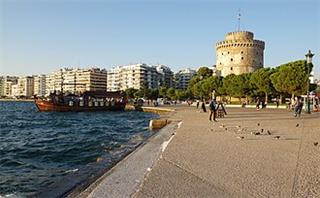
Antigonid Macedon was a land of farmers, herders and a powerful landed aristocracy. The lowland plains around Pella and along the Haliacmon and Axius rivers produced grain, the uplands supported flocks, and the forests supplied ship timber and pitch, a royal resource coveted by every Hellenistic navy. The kings controlled the mines of the Pangaeum region and other districts, and Philip V in particular reopened mines, raised revenues and resettled populations to rebuild the kingdom's manpower after its wars. Macedonian society was less urban than that of southern Greece, though old and new cities flourished: Pella was the royal seat, Thessalonica and Cassandreia were major ports, and Demetrias, founded by Demetrius Poliorcetes around 293 BCE on the Gulf of Pagasae, became a royal residence and fortress. The court attracted intellectuals. Antigonus Gonatas was a student and friend of the Stoic Zeno of Citium, whose pupil Persaeus lived at his court; the poet Aratus of Soli wrote his astronomical poem, the Phaenomena, there; and the historian Hieronymus of Cardia, who served three generations of the dynasty, wrote the history of the Successors on which Diodorus and Plutarch later drew. Religion followed the traditional Greek and Macedonian cults, and the kings advertised their piety with dedications and buildings at Delos and other sanctuaries.
Military
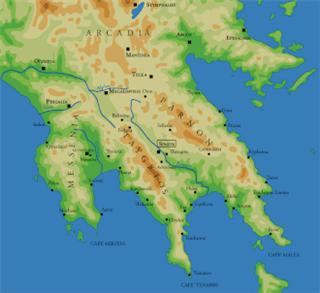
The core of Antigonid power was the Macedonian phalanx, a dense formation of infantry armed with the sarissa, a pike some five to six metres long, supported by peltasts, cavalry and mercenaries. The kingdom usually fielded armies of 20,000 to 30,000 men, and Perseus raised around 40,000 for the final war with Rome. The early Antigonids were also great naval powers: Demetrius won the sea battle off Salamis in 306 BCE, besieged Rhodes in 305–304 BCE with enormous siege engines, and built some of the largest warships of the age. Antigonus Gonatas defeated the Ptolemaic fleet off Cos, at a date still debated, and the Chremonidean War (c. 267–261 BCE) ended with the surrender of Athens and Macedonian garrisons in its harbours. Antigonus III Doson crushed Cleomenes III of Sparta at the Battle of Sellasia in 222 BCE. Against Rome the phalanx proved inflexible on broken ground: Philip V was defeated by Titus Quinctius Flamininus at the Battle of Cynoscephalae in Thessaly in 197 BCE, and Perseus' army was destroyed by Lucius Aemilius Paullus at the Battle of Pydna in 168 BCE, when Roman maniples exploited gaps in the advancing line. Garrisons at Corinth, Chalcis and Demetrias, which Philip V reportedly called the ‘fetters of Greece’, anchored Macedonian control of the south.
Governance & Law

The Antigonid king ruled as a personal monarch, commanding the army, conducting diplomacy and controlling much of the land and its resources. He governed with a circle of ‘Friends’ (philoi), courtiers who served as generals, envoys and governors, and he relied on the loyalty of the Macedonian nobility and the citizen army. Dedications made in the name of ‘King Antigonus and the Macedonians’ show that the Macedonians kept a collective identity alongside the crown. Unlike the Ptolemies and Seleucids, the Antigonids ruled a largely Macedonian population and did not promote a royal cult at home. Royal letters and ordinances regulated the cities, which kept their own magistrates, sometimes under royal overseers (epistatai), and an inscription from Amphipolis preserves part of Philip V's regulations for the army. In southern Greece the kings worked through garrisons, friendly tyrants and, from 224 BCE, the Hellenic alliance that Antigonus Doson led against Sparta. Succession was usually orderly. Gonatas was followed by his son Demetrius II (239–229 BCE), and when Demetrius died leaving the boy Philip V, his cousin Antigonus Doson ruled first as guardian and then as king before passing the throne to Philip in 221 BCE. Gonatas reportedly told his son that kingship was a ‘glorious servitude’, a phrase that captures the dynasty's sober style of rule.
Global & Regional Impact

For over a century the Antigonids were the dominant power in mainland Greece, and the politics of Athens, Sparta and the Aetolian and Achaean leagues revolved around their garrisons and alliances. They gave Macedon a long period of stable government after the chaos of the Successor wars and the Gallic invasion, and their court was a centre of Stoic philosophy, Hellenistic poetry and historical writing. Their story also shaped Rome's entry into the Greek East. Philip V's treaty with Hannibal in 215 BCE drew Rome across the Adriatic in the First Macedonian War (214–205 BCE), and the Second and Third Macedonian Wars turned Rome into the arbiter of Greece. In 196 BCE Flamininus proclaimed the freedom of the Greeks at the Isthmian Games, a policy that soon gave way to direct control. The fall of Macedon brought Greek culture to Rome on a new scale: Aemilius Paullus let his sons take Perseus' library, and among the thousand Achaean hostages deported to Italy was the historian Polybius, whose account of Rome's rise centres on the Macedonian wars. Through Polybius, Livy and Plutarch's lives of Demetrius, Aratus and Aemilius Paullus, the dynasty became for later readers a classic example of Hellenistic kingship and of its defeat by Rome.
Decline & Fall
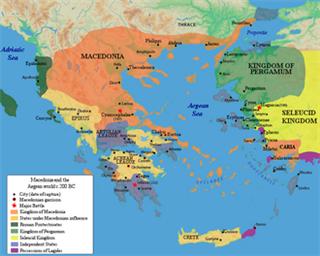
The Antigonid decline was driven by the rise of Rome. Philip V (221–179 BCE) began energetically, winning the Social War against the Aetolian League (220–217 BCE), but his alliance with Hannibal made Rome an enemy, and his aggressive campaigns in the Aegean after 202 BCE alarmed Rhodes and Pergamon, which appealed to the Senate. Defeat at Cynoscephalae in 197 BCE cost him his possessions in Greece, most of his fleet and an indemnity of 1,000 talents, and confined him to Macedon. He cooperated with Rome against Antiochus III and rebuilt his kingdom's finances and manpower, but his reign ended in bitterness after he had his younger son Demetrius, a favourite of the Romans, executed in 180 BCE. His elder son Perseus (179–168 BCE) restored Macedonian prestige among the Greeks, which Rome's ally Eumenes II of Pergamon denounced before the Senate. The Third Macedonian War broke out in 171 BCE; after early successes Perseus was decisively beaten at Pydna in June 168 BCE. He surrendered on Samothrace, walked in Paullus' triumph in Rome and died in captivity at Alba Fucens. In 167 BCE Rome abolished the monarchy and split the kingdom into four republics, and after the revolt of the pretender Andriscus, Macedonia became a Roman province in the 140s BCE.
The Antigonid Kingdom of Macedonia, founded by Alexander's general Antigonus I and his heirs, dominated mainland Greece for more than a century with its phalanx and fortresses, patronised Stoic philosophy and Hellenistic letters, and fell to Rome at Pydna in 168 BCE, opening the Greek world to Roman rule.
References
- Billows, R.A. (1990) Antigonos the One-Eyed and the Creation of the Hellenistic State. Berkeley: University of California Press.
- Errington, R.M. (1990) A History of Macedonia. Berkeley: University of California Press.
- Gabbert, J.J. (1997) Antigonus II Gonatas: A Political Biography. London: Routledge.
- Hammond, N.G.L. and Walbank, F.W. (1988) A History of Macedonia, Volume III: 336–167 B.C. Oxford: Clarendon Press.
- Tarn, W.W. (1913) Antigonos Gonatas. Oxford: Clarendon Press.
- Walbank, F.W. (1940) Philip V of Macedon. Cambridge: Cambridge University Press.
Connections
Open the full connections map →