At a glance
- Kartli, the ancient kingdom of eastern Georgia, ruled from Mtskheta and later Tbilisi, and called Iberia by Greeks and Romans.
- It guarded the passes of the Caucasus and balanced for centuries between Rome and Persia as client of one or the other.
- It adopted Christianity in the 4th century and produced the earliest Georgian inscriptions and literature.
Rise & Fall
- c. 300 BCEPharnavaz I unites Kartli, according to Georgian tradition
- 65 BCEPompey invades Iberia and forces King Artoces to submit
- 35 CEPharasmanes I seizes Armenia for his brother Mithridates
- 75 CEVespasian fortifies Mtskheta for King Mithridates of Iberia
- c. 330sKing Mirian III adopts Christianity through the mission of St Nino
- 482Vakhtang I Gorgasali joins the Armenian revolt against Persia
- c. 580Hormizd IV abolishes the Iberian monarchy
Foundation

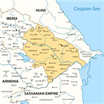
The Kingdom of Iberia, known to Georgians as Kartli, was the principal state of eastern Georgia in Antiquity, centred on the valley of the Mtkvari (Kura) river where it meets the Aragvi. The name Iberia was used by Greek and Roman writers and has no connection with the Iberian peninsula. Medieval Georgian tradition, preserved in the chronicle collection Kartlis Tskhovreba, credits Pharnavaz I with uniting the land around 300 BCE, after the fall of the Achaemenid Empire and the campaigns of Alexander the Great, and with dividing it into provinces under governors called eristavis. These accounts were written many centuries later and mix history with legend, but archaeology confirms that a centralised kingdom with a fortified royal seat at Mtskheta and the acropolis of Armaztsikhe was taking shape in the early Hellenistic period. Its rise drew on the agricultural wealth of the Mtkvari valley and on control of routes through the Caucasus, including the Darial Pass, which classical writers called the Caucasian Gates. By the first century BCE Iberia was a recognised state, described by Strabo as a well-ordered kingdom whose people lived in towns with tiled roofs, market places and public buildings, in contrast to the pastoral peoples of the surrounding mountains.
Socioeconomy

Strabo describes Iberian society as divided into four classes: the royal family, from which the king and his deputy were chosen; the priests, who also handled disputes with neighbouring peoples; the soldiers and farmers; and the common people, whom he calls royal slaves, who did the work of the land. Most of the population farmed the fertile valleys of the Mtkvari, Aragvi and Alazani, growing grain and vines, while herding was important in the uplands. Iberia lay on a trade route that ran from the Black Sea up the Phasis (Rioni) river through Colchis and over the Likhi range, then down the Mtkvari towards Albania and the Caspian, and it traded with the Greek cities of the Black Sea, with Armenia and with Iran. Rich burials at Armaziskhevi and Bagineti near Mtskheta, containing gold jewellery, engraved gems and silver vessels, reveal a wealthy aristocracy open to both Roman and Iranian fashions. Pre-Christian religion honoured deities such as Armazi, whose great idol, according to the chronicles, stood on the heights above Mtskheta, and Iranian and Zoroastrian influences were strong among the elite. A Greek and Aramaic bilingual inscription from Armazi, the epitaph of a noblewoman named Serapit, shows that Aramaic served as a written language before the Georgian alphabet was created.
Military

Iberia’s mountain setting shaped its warfare. Its armies, drawn from the aristocracy and the farming population, combined infantry with heavy and light cavalry in the Iranian manner, and fortresses guarded the river valleys and the passes of the Greater Caucasus. Control of the Darial Pass made Iberia valuable to both Rome and Iran, since steppe peoples such as the Alans and later the Huns could ride through it into Armenia, Iran and the Roman east. In 65 BCE Pompey, pursuing Mithridates VI of Pontus, invaded Iberia and defeated King Artoces in battles on the Mtkvari and Aragvi, forcing him to submit. In the first century CE King Pharasmanes I pursued an aggressive policy: in 35 CE, with Roman encouragement, he seized Armenia for his brother Mithridates and brought Sarmatian allies through the passes to defeat the Parthians, and his son Rhadamistus later ruled Armenia for a few turbulent years. A Greek inscription found at Mtskheta records that in 75 CE the Emperor Vespasian strengthened the city’s walls for King Mithridates of Iberia, a friend of Rome. In late Antiquity Iberia fought repeatedly against Sasanian armies and against raiders from the north, often retreating into the mountains of western Georgia and seeking Roman and later Byzantine help.
Governance & Law

Iberia was a hereditary monarchy, ruled in turn by dynasties that Georgian tradition calls the Pharnavazids, Arsacids and, from Mirian III, the Chosroids, although the lists of early kings are partly legendary. Strabo notes that the second in rank after the king served as judge and commander of the army. Inscriptions and burials confirm a high office of pitiakhsh, a viceroy or deputy, whose family was buried at Armaziskhevi, and the title eristavi, ‘head of the people’, was used for regional governors. Great noble houses held hereditary lands and armed followings, and the balance between king and aristocracy shaped Iberian politics throughout its history. Externally, the kings had to manoeuvre between Rome and Iran. After Pompey’s campaign Iberia became a client of Rome, and King Pharasmanes II visited Rome, probably under Antoninus Pius, where he was received with honour and allowed to sacrifice on the Capitol. In the third century the Sasanian king Shapur I listed Iberia among his dominions, but the Peace of Nisibis of 298 or 299 gave Rome the right to invest Iberian kings. After 363, when Rome gave up its claims in the region, Iberia passed under Sasanian supremacy, and Persian officials increasingly supervised the royal court.
Global & Regional Impact

Iberia laid the foundations of Georgian statehood, religion and letters. Its conversion to Christianity under King Mirian III, traditionally through the preaching of St Nino, a woman from Cappadocia, is usually dated to the 320s or 330s, which makes Iberia one of the first states, after Armenia, to adopt Christianity as its official religion; the church historian Rufinus of Aquileia, writing c. 402, recorded the story of a captive woman who converted the king and queen. The Svetitskhoveli Cathedral at Mtskheta stands on the site of the first royal church and remains one of the principal cathedrals of the Georgian Church. The Georgian alphabet, in its earliest form called Asomtavruli, was in use by the fifth century, as shown by inscriptions at Bir el Qutt near Bethlehem and at the Bolnisi Sioni church, dated 493–494, and the Martyrdom of the Holy Queen Shushanik, written in the late fifth century, is the oldest surviving work of Georgian literature. Iberian monks and pilgrims linked the kingdom with Jerusalem, Syria and the wider Christian world. Later Georgian states, above all the Bagrationi monarchy that united Georgia in the eleventh century, saw themselves as heirs of Kartli, and Mtskheta, where Georgian kings were crowned and buried, remained the spiritual centre of the nation.
Decline & Fall

Iberia’s independence eroded steadily under the Sasanian Empire. After Rome withdrew from the Caucasus in 363, Shapur II installed his own candidate on the throne, and for a time the kingdom was divided between Roman and Persian protégés. In the later fifth century King Vakhtang I Gorgasali, who according to tradition reigned from c. 447 to c. 502 or 522, tried to restore Iberian power, strengthened the Church under its own catholicos and is traditionally credited with founding Tbilisi, which his successor Dachi made the capital. In 482 he joined an Armenian revolt against the Persian king Peroz, but the rebels were defeated, and Georgian tradition records that he later died fighting the Persians. In the 520s King Gurgenes rose against Kavad I and appealed to the Byzantine Emperor Justin I, but when Persian armies invaded he fled with his family and nobles to Lazica, according to Procopius. Persian control tightened during the long wars between Byzantium and Iran. When King Bakur III died around 580, the Persian king Hormizd IV abolished the monarchy and governed Iberia through a marzban, while the great nobles kept their estates. In 588 the nobility, with Byzantine support, chose Guaram I as presiding prince, beginning the Principality of Iberia, and Georgian kingship was restored only in the ninth century.
The Kingdom of Iberia, or Kartli, was the cradle of Georgian statehood: it guarded the Caucasus passes between Rome and Persia for nearly nine centuries, became one of the first Christian kingdoms in the 4th century and produced the earliest Georgian script and literature before Persia abolished its monarchy.
References
- Braund, D. (1994) Georgia in Antiquity: A History of Colchis and Transcaucasian Iberia, 550 BC–AD 562. Oxford: Clarendon Press.
- Rapp, S.H. Jr (2014) The Sasanian World through Georgian Eyes: Caucasia and the Iranian Commonwealth in Late Antique Georgian Literature. Farnham: Ashgate.
- Suny, R.G. (1994) The Making of the Georgian Nation. 2nd edn. Bloomington: Indiana University Press.
- Thomson, R.W. (1996) Rewriting Caucasian History: The Medieval Armenian Adaptation of the Georgian Chronicles. Oxford: Clarendon Press.
- Toumanoff, C. (1963) Studies in Christian Caucasian History. Washington, DC: Georgetown University Press.
Connections
Open the full connections map →