Social ladder · 1609–1779 (from the start of the Beaver Wars to the Sullivan Expedition)
Social Hierarchy of the Haudenosaunee
From Clan Mother to Captive

The Haudenosaunee, “the people of the longhouse”, ranked people less by wealth or birth into a class than by clan and lineage, age, sex and deeds. Descent ran through the mother: children belonged to her clan and took their standing from hers. The clans’ elder women, the clan mothers, chose and could depose the fifty chiefs of the League’s Grand Council, and decisions needed consensus. A British colonial administrator wrote in 1749 that they allowed “no Kind of Superiority of one over another”. Yet the same society took captives in its “mourning wars” to replace its dead: some were adopted, often into lesser places, others were tortured and killed, and a few were kept as slaves. The Haudenosaunee live today in the United States and Canada, on eleven reservations and seven reserves, and continue to consider themselves sovereign; what is known of the past comes from their oral tradition, archaeology and the accounts of Jesuits and other Europeans, who came from a patriarchal society and often overlooked the power of women.
Period 1609–1779 (from the start of the Beaver Wars to the Sullivan Expedition)People c. 10,000–25,000 (est.)Ranks 8Profile Iroquois Confederacy
The ladder
By rank, the ladder is drawn as a pyramid. To scale, each bar is as wide as that rank’s share of the people. Shares marked est. are estimates where no count survives; their boxes and bars are dashed.
Nobility and officials · c. 0.5–2% (est.)
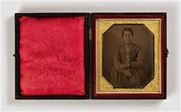
Clan mothers
-
Clan mothers were respected older women who chose the chiefs of their clans and could remove them.
The clan mothers, the elder women of each clan, chose its chiefs. When a chief’s title fell vacant, the most senior woman of the hereditary lineage selected his successor in consultation with other women, and the chief’s sister was historically responsible for nominating the successor. A chief who proved unsound, became corrupt or did not listen to the people could be removed by the council of the clan’s women elders, a process called “dehorning”: the deer antlers of his office were taken from his headgear. The women held councils of their own, sent runners or an orator to the men’s councils, often proposed legislation and could veto treaties and declarations of war.
Moving in or out. The clan mothers were the elder women of their clans, held in high regard as those who had raised children; leadership passed within the clan’s female line.
How many? Estimate: one clan mother for each clan of about 50 to 200 people, the size the History of the Haudenosaunee article gives for a typical clan.
Picture: A Haudenosaunee woman, a daguerreotype of about 1846–1856 (Smithsonian American Art Museum) · Unknown author · CC0 · Wikimedia Commons
Ruler · c. 0.2–0.6% (est.)
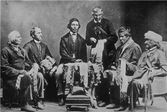
Royaner (League chiefs)
hoyenah
Fifty chiefs met in the Grand Council of the League, and they had to agree before acting together.
The League’s Grand Council was an assembly of fifty chiefs (royaner), each representing a clan of a nation. Their offices were hereditary within the clan: when one fell vacant, a candidate was selected from the clan’s members and “raised up” by a council of all chiefs in the Condolence Ceremony, and the new chief gave up his own name for the title. The Onondaga chief who held the title Tadodaho chaired the council. Unanimity in public acts was essential, so the council worked by consensus; it ruled on disputes, but the nations still acted on their own and formed their own war bands.
Moving in or out. Clan mothers chose a chief from his clan and could remove him, when he gave up the title and took his old name again. In 1687 the French seized fifty chiefs under a flag of truce and shipped them to Marseille as galley slaves; 13 came back in 1689.
How many? Estimate: fifty chiefs among some 8,000 to 25,000 people; the Grand Council’s seats went by clan, not by numbers.
Picture: Chiefs of the Six Nations reading wampum belts at Brantford, 1871 · Hale, Horatio · Public domain · Wikimedia Commons
Nobility and officials · c. 0.1–0.5% (est.)
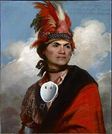
Pine tree chiefs and war chiefs
Pinetree Chiefs, War Chiefs
War chiefs led war parties, and other chiefs travelled as messengers to talk with other nations.
Below the League chiefs stood two kinds of leader who could not vote in council: the pine tree chiefs, who served as diplomats, and the war chiefs, who led the war parties. The Great Law of Peace, as later written down, names one war chief for each nation, to carry messages for the chiefs, take up arms in an emergency, watch the council’s proceedings and bring the complaints of the people and the warnings of the women to a chief who erred. In the 18th century such men led their nations in the colonial wars: the old Mohawk war chief Peter Hendricks was killed at Lake George in 1755, and Joseph Brant raised forces for the Crown in the Revolution.
Moving in or out. No birthright made a war chief: valour in war was a prerequisite for any man to be made a chief, and patronage counted, as Molly Brant’s did when her brother Joseph became a war chief.
How many? Estimate: the Great Law names one war chief for each nation; with the pine tree chiefs who served as diplomats and the leaders of the many war parties, a few dozen to about a hundred men.
Religious and learned · c. 0.5–2% (est.)
Faithkeepers and healers
Faithkeepers
Faithkeepers, both men and women, led the festivals that gave thanks for maple sap, strawberries and corn.
Faithkeepers are part-time specialists who conduct the religious ceremonies. Both men and women are appointed by the elders, and some personal names are reserved for faithkeepers, as for chiefs. The ceremonies follow the farming year, from the Maple and Planting festivals to the Strawberry, Green Corn and Harvest festivals and Midwinter, the New Year; in the 17th century Europeans counted seventeen festivals. Male and female healers knew the use of herbs, dressed wounds, set broken bones and performed surgery, and fortune-tellers sought the spiritual causes of illness. The medicine societies, brotherhoods entered by formal initiation, held curing rites: in the best known, the False Face Society, masked dancers sought to frighten away the spirits believed to cause illness.
Moving in or out. Faithkeepers were appointed by the elders and took names reserved for their office; the medicine societies admitted members by initiation, at first, it seems, by moiety.
How many? Estimate: faithkeepers were part-time specialists, men and women; with the healers and the leaders of the medicine societies, perhaps one or two people in a hundred.
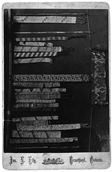
Picture: Wampum belts of the Six Nations, 1872 · Jas. N. Edy (Library and Archives Canada) · Public domain · Wikimedia Commons

Soldiers, merchants and craftsmen · c. 15–20% (est.)
Warriors
-
Young men went to war to prove their courage, often to bring back captives rather than to kill.
War was a young man’s road to standing. It showed valour and courage, a prerequisite for becoming a chief and essential for a man who wanted to marry. A war party succeeded when it took many prisoners without losses of its own: killing was accepted only when necessary, and captives counted for far more than scalps. Warriors preferred ambushes and surprise attacks, almost never attacked a fortified place and retreated when outnumbered. When a family lost a member, the clan mothers could demand a mourning war, and men who refused were marked as cowards forever and could not marry. Guns bought from the Dutch and the English made war far deadlier in the Beaver Wars of 1609–1701.
Moving in or out. Every man could become a warrior; renown in war opened the way to a chief’s title, while cowardice, branded by the clan mothers, left a man unmarriageable.
How many? Estimate: Marc Lescarbot put the Haudenosaunee at 8,000 warriors in 1609, which the Haudenosaunee article reckons at around 40,000 people, one in five; adopted men are counted with the adopted.
Free commoners · About 56% (the rest, est.)
The people of the longhouse
-
Families lived in long bark houses; women grew corn, beans and squash, and children belonged to their mother’s clan.
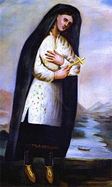
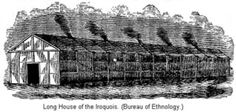
Most people lived in palisaded villages that Europeans called castles, one to four for each nation at a time, moved every five to twenty years as soil and firewood ran out. Between two and twenty families shared a longhouse of elm bark, with fires down the middle. Clans of about 50 to 200 people were grouped into two halves (moieties), and marrying within one’s own clan was incest. Farming was women’s work: they planted, harvested and cooked the corn, beans and squash called the Three Sisters, and gathered with the children, while men hunted deer and went to war. No one owned land; women were held to be its stewards. Some became Christians, among them the Mohawk-Algonquin Kateri Tekakwitha.
Moving in or out. One was born into one’s mother’s clan. Outsiders entered by adoption, and at marriage a young couple lived in the longhouse of the wife’s family.
How many? Everyone not counted in the other tiers: the women, children and older men of the clans. The other ranks are estimates, so this share is one too.
Serfs and dependants · c. 15–30% (est.)
Adopted captives
-
Captives taken in war were often adopted into families to take the place of people who had died.
The mourning wars brought captives into the villages to replace the dead. All captives were stripped, tied to poles and burned, and some had fingernails pulled out; then the families decided for each whether to adopt or kill. Women and children were adopted more often than older men. Adoptees were renamed and expected to reject their former lives; those who made a sincere effort were embraced and could take the place of the person they replaced, though many were adopted to fill lesser places and did chores for their families. Those who did not were swiftly executed, and runaways were punished: the recaptured French teenager Pierre-Esprit Radisson had his fingernails pulled out.
Moving in or out. Capture and adoption brought people here; an adoptee who lived up to the dead person’s place could rise with it, and in time many became full members, while one who resisted or fled could be killed.
How many? Estimate: in 1658 the Jesuits noted more adopted foreigners than natives, and in 1668 two-thirds of an Oneida village were assimilated Algonquians and Hurons; many adoptees in time became full members of their clans, so the share of those still in lesser places is put lower.
Picture: A Haudenosaunee longhouse, after the Bureau of Ethnology · Unknown author · Public domain · Wikimedia Commons


Enslaved · c. 0.5–2% (est.)
Gatsennen (Captives kept as slaves)
Some captives were not adopted and had to work for the village, or were traded away.
Not every captive was adopted. A few never were and only performed tasks in the village, perhaps to be exchanged. Jacques Bruyas’s Mohawk dictionary defines gatsennen as “domestic animal, servant, slave”, and Oneida and Onondaga words likewise compared slaves to dogs. Captives slated for execution wore red and black face paint, were addressed as “uncle” or “nephew” by a family that fed them, and were killed after a day of torture; the body was then eaten by the community, a practice modern anthropologists seem to accept as probable, which ended, with the ritual torture, in the early 18th century. Most European captives were ransomed or killed, and later Indigenous captives were traded to European settlers, some ending in Quebec households.
Moving in or out. War, ransom or a family’s choice put a captive here; adoption was the way out, and a captive who resisted could be killed. Once European settlers brought African slavery to North America, some Haudenosaunee, such as Joseph Brant, owned enslaved Africans.
How many? Estimate: the articles name only “a few cases” of captives never adopted; with those held for ransom or awaiting execution, a small share at any one time.
Picture: An Iroquois war club · Rama · CC BY-SA 3.0 fr · Wikimedia Commons

Born into history
Where would you have stood? Chance places you on the ladder, as birth placed most people: weighted by how many each rank held.
Moving up and down
Standing among the Haudenosaunee came from clan and lineage, age, sex and deeds rather than from wealth. Chiefs’ titles were hereditary within clans, but the clan mothers chose who held them and could take them away, and only valour in war made a man a chief. Adoption moved whole peoples into the League: during the Beaver Wars the Haudenosaunee defeated and assimilated most of the Wendat (1649), Petun (1650), the Neutral Nation (1651), the Erie (1657) and the Susquehannock (1680), and in 1722 the Tuscarora, sponsored by the Oneida, were accepted as a sixth nation. New wealth brought new distinctions in the 18th century: after about 150 Palatine families leased land from the Haudenosaunee by 1713, the Haudenosaunee elite gave up longhouses for European-style houses, on an income equal to a middle-class English family’s. Many Catholic converts moved to the mission villages of Kahnawake and Kanesatake near Montreal. The Revolution broke the League apart, and after the Sullivan Expedition of 1779 destroyed 40 to 60 towns, more than 5,000 Haudenosaunee fled to British Canada.
Women on the ladder
Women held real power. Kinship was matrilineal: children belonged to their mother’s clan, and her brothers were important teachers of her children, introducing boys to men’s roles. Women held the dwellings and farmed land; a woman’s property before marriage stayed hers, and the work of her hands was hers to use as she saw fit. At marriage a couple lived in the longhouse of the wife’s family, and a woman could divorce an unsatisfactory husband by asking him to leave with his possessions; if a couple separated, the woman kept the children. Agoianders, women named for their good qualities, served social, political and diplomatic functions. Canadian Haudenosaunee clan mothers met in council with men on war and peace and joined delegations to the French in Montreal, and in 1711 Palatine refugees asked the clan mothers for leave to settle on their land. Tradition names Jigonhsasee, the Mother of Nations, among the founders of the League, but early researchers consulted only male informants, so the women’s oral tradition was largely lost to them.
Compare with another society
Test yourself
5 questions on the ladder of the Haudenosaunee Confederacy.
The questions open here once the page has loaded.
Sources and further reading
- Mann, C. C. (2005) 1491: New Revelations of the Americas Before Columbus. New York: Alfred A. Knopf.
- Morgan, L. H. (1870) Systems of Consanguinity and Affinity of the Human Family.
- Morgan, L. H. (1904) League of the Ho-dé-no-sau-nee or Iroquois. New York: Dodd, Mead.
- Parker, A. C. (1916) The Constitution of the Five Nations. Albany: The University of the State of New York.
- Taylor, A. (2006) The Divided Ground: Indians, Settlers, and the Northern Borderland of the American Revolution.
- Wallace, P. A. W. (1946) The Iroquois Book of Life: White Roots of Peace.
- Williams, K. P. (2018) Kayanerenkó:wa: The Great Law of Peace. Winnipeg: University of Manitoba Press.
The shares are of the whole population, children included. Where a scholar has counted or estimated a rank, its share follows that work, named on the rank; where no count survives, the share is an estimate, marked est. and drawn dashed, made from what the rank was and did, from related figures and from the same rank in comparable societies, and its note says what it rests on. Population: Estimate: modern estimates for the 17th century range from 5,500 to more than 100,000; Snow and Jones put the people at about 20,000 before the epidemics of the 1630s, Jones at 8,000 for 1634–1660 without the thousands adopted from conquered peoples, and the contemporary Lahontan at 70,000 around 1690.
Cite this page
- APA
- The Epoch Institute. (2026). Social Hierarchy of the Haudenosaunee Confederacy. In Social Ladders. https://the-epoch-institute.org/societies/haudenosaunee
- MLA
- “Social Hierarchy of the Haudenosaunee Confederacy.” Social Ladders, The Epoch Institute, 2026, https://the-epoch-institute.org/societies/haudenosaunee. Accessed .
- Chicago
- The Epoch Institute. “Social Hierarchy of the Haudenosaunee Confederacy.” Social Ladders. 2026. https://the-epoch-institute.org/societies/haudenosaunee.
- Harvard
- The Epoch Institute (2026) ‘Social Hierarchy of the Haudenosaunee Confederacy’, Social Ladders. Available at: https://the-epoch-institute.org/societies/haudenosaunee (Accessed: ).