Americas
Chavín
At a glance
- A temple town in Peru’s Ancash highlands, c. 950–400 BCE, whose priests drew pilgrims and offerings from the coast, mountains and forests.
- Its stone galleries hid the Lanzón, a carved granite god, and its art of jaguars, eagles and caimans spread far across Peru.
- It held sway through religion rather than armies; after its decline regional cultures such as Paracas developed their own styles.
Rise & Fall
- c. 950 BCEA temple settlement is founded at Chavín de Huántar, on Richard Burger’s revised dates
- c. 950–800 BCEThe U-shaped Old Temple and the Lanzón gallery form the heart of the cult
- c. 700–400 BCEIn the Janabarriu phase the town grows to some 42 hectares and Chavín art spreads widely
- c. 400 BCEThe ceremonial centre is abandoned; a village later grows over the old plaza
- 1919Julio C. Tello begins work at the site and calls Chavín the mother culture of the Andes
- 1945A debris flow buries much of the site and the modern town under mud
- 1985Chavín de Huántar is inscribed as a UNESCO World Heritage Site
Foundation

Chavín de Huántar lies at about 3,180 metres in the Conchucos valley of Peru’s Ancash region, east of the Cordillera Blanca, where the Huachecsa stream joins the Mosna River. The site stood on routes linking the Pacific coast, the high grasslands and the forests of the Amazon basin. A temple was founded here early in the first millennium BCE, but its date is disputed. Richard Burger’s radiocarbon sequence, revised in 2019, places the foundation of the settlement around 950 BCE and its abandonment by about 400 BCE, while John Rick’s team at Stanford argues that temple building began as early as 1200 BCE. The first major building, now called the Old Temple, was a U-shaped stone platform around a sunken circular plaza, a plan known from older ceremonial centres of the central Andes. Over the following centuries it was enlarged in a long series of building episodes into the so-called New Temple, with a larger rectangular plaza and the Black and White Portal. Chavín was not the oldest temple of the Andes, and it grew among neighbours with traditions of their own, such as the Cupisnique of the north coast, but it became the most influential religious centre of its age.
Socioeconomy

Chavín de Huántar was both a sanctuary and a town. Burger’s excavations in the surrounding settlement suggest that it grew from a few hundred people in its first phase to perhaps 2,000–3,000 at its height, spread over about 42 hectares, far larger than the villages around it. Its people grew potatoes and other highland crops, and in the later phases ate mostly the meat of llamas and alpacas, much of it apparently brought from the higher grasslands as dried meat. Exotic goods arrived from great distances: obsidian from the Quispisisa source some 580 kilometres to the south, Spondylus and Strombus shells from the warm seas off Ecuador, and pottery from other regions. Workshops for shell beads and other crafts appeared in the later town. Households closest to the temple had stone walls, more marine shell and imported pottery and more meat from young llamas, signs of a privileged group serving the cult. Religion was the town’s reason to exist. Carvings in the temple show jaguars, harpy eagles, caimans and snakes, and a figure holding a San Pedro cactus, the source of a hallucinogen, while stone mortars and pestles from the temple and carved bone tubes in Chavín style point to the ritual use of mind-altering substances.
Military
Chavín’s influence was not won by conquest. No fortifications protect the temple, and its carvings show gods and mythical beings rather than battles, unlike the much older carved slabs of Cerro Sechín in the Casma valley with their warriors and dismembered victims. The power of its priests seems to have rested on awe rather than armies. The temple appears designed to overwhelm visitors: inside the platforms ran a maze of narrow stone galleries, ventilation shafts and drains, some of which may have channelled rushing water to make the building roar, and in 2001 John Rick’s team found twenty decorated trumpets made from Strombus shells in a small gallery beside the Circular Plaza. Predators dominate the imagery, and the fanged and taloned beings of the carvings expressed the cult’s authority through the jaguar and the eagle, the most powerful hunters of land and sky. Some scholars think the shared cult kept the peace between distant communities and allowed exchange to flourish, a so-called pax Chavín. The contrast with the centuries after its decline is marked: hilltop fortresses then appeared across the region, among them the fortified temple of Chankillo in the Casma valley, in use in the third century BCE.
Governance & Law

No ruler of Chavín is known by name, and nothing suggests a royal dynasty. Most archaeologists see the centre as a theocracy run by a priestly elite, whose authority came from privileged access to the gods. The focus of worship was the Lanzón, a granite shaft some 4.5 metres high carved as a fanged being with snakes for hair, standing in a cross-shaped gallery deep inside the Old Temple. Its tip passes through the ceiling of the gallery, and some scholars have suggested that a hidden priest could have spoken there as the god, as at the later oracle of Pachacamac. Richard Burger interprets Chavín as the seat of a regional cult that may have had branch shrines and drew pilgrims and offerings from distant regions, while John Rick argues that its priests built their authority step by step through control of ritual space, light, sound and hallucinogenic experience. The temple was repeatedly rebuilt to new plans, which implies leaders able to command skilled masons and large workforces over generations. Status differences in the town and the concentration of exotic goods near the temple show that a privileged group grew up around the cult, but how decisions were made and who held power remain unknown.
Global & Regional Impact
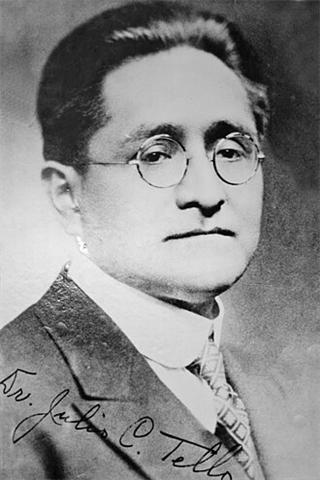
Chavín was the first Andean religious tradition to spread across much of Peru. Its art, with intricate fanged beings, interlocking motifs and what John Rowe called ‘kennings’, visual metaphors in which hair becomes snakes and other body parts are drawn as fanged mouths, appears in local versions at Kuntur Wasi and Pacopampa in the northern highlands, on remodelled temples of the coast and on painted cotton textiles from Karwa near Paracas on the south coast. Archaeologists use this spread to define the Early Horizon, the first of the great horizons of Andean prehistory. Julio C. Tello, who worked at the site from 1919, saw Chavín as the ‘mother culture’ of Andean civilisation. That view is no longer held in its original form, since older temples are now known on the coast and in the highlands, but Chavín remains central to the story of how shared religion linked distant Andean peoples. Its staff-bearing god, carved on the Raimondi Stela, is often compared with the staff gods of later traditions such as Tiwanaku and Wari. Chavín de Huántar became a UNESCO World Heritage Site in 1985, and the Tello Obelisk and other sculptures are kept in the nearby Museo Nacional Chavín.
Decline & Fall
Chavín’s decline came in the middle of the first millennium BCE, though its dating depends on the chronology used. On Burger’s revised dates the town reached its largest extent in the Janabarriu phase, about 700–400 BCE, and the ceremonial centre was abandoned by around 400 BCE; Rick’s team places the end of major ceremonial activity around 500 BCE. The signs of the end are clearer than its causes. Building projects were left unfinished, carved stones were reused in ordinary houses, and the exchange of obsidian and cinnabar across the Chavín sphere fell away. Local pottery styles multiplied and the shared imagery broke up, as regional centres developed traditions of their own. The cult may have lost credibility, rivalry between regional elites may have grown, and the rise of new styles in places such as Paracas suggests that religious leadership passed elsewhere. A small village later grew over the old plaza, and people of the Huarás tradition lived among the ruins. In January 1945 a debris flow down the Huachecsa buried much of the site and the modern town under mud, and excavation and conservation have continued since, notably by Peruvian archaeologists such as Luis Lumbreras and by John Rick’s Stanford team.
Chavín de Huántar, a temple town in the Peruvian highlands, was the centre of the first religious tradition to spread across much of the Andes, its fanged gods, labyrinthine galleries and pilgrim cult shaping art from the north coast to Paracas and leaving motifs that later Andean religions carried on.
Test yourself
3 questions on this page, from its key events and facts.
The questions open here once the page has loaded.
References
- Burger, R.L. (1992) Chavín and the Origins of Andean Civilization. New York: Thames and Hudson.
- Conklin, W.J. and Quilter, J. (eds) (2008) Chavín: Art, Architecture, and Culture. Los Angeles: Cotsen Institute of Archaeology, University of California.
- Lumbreras, L.G. (1989) Chavín de Huántar en el nacimiento de la civilización andina. Lima: Instituto Andino de Estudios Arqueológicos.
- Rowe, J.H. (1962) Chavín Art: An Inquiry into Its Form and Meaning. New York: Museum of Primitive Art.
- Tello, J.C. (1960) Chavín: cultura matriz de la civilización andina. Lima: Universidad Nacional Mayor de San Marcos.
Connections
Open the full connections map →