Americas
Moche
At a glance
- A civilisation of Peru’s north coast, c. 100–800 CE, whose lords ruled irrigated desert valleys from huge adobe platforms such as the Huaca del Sol.
- Its potters made lifelike portrait vessels and painted scenes of combat and sacrifice; its smiths plated copper with gold and silver.
- Royal tombs at Sipán and El Brujo reveal warrior-priests and powerful women; climate crises and unrest ended it around 800.
Rise & Fall
- c. 100Moche culture emerges in the Moche and Chicama valleys of Peru’s north coast
- c. 250The Lord of Sipán is buried with gold, silver and copper regalia in the Lambayeque valley
- c. 450The tattooed Lady of Cao is buried with war clubs at Huaca Cao Viejo in the Chicama valley
- c. 562–594A severe drought recorded in Andean ice cores, with El Niño floods, strains Moche agriculture
- c. 600Late Moche centres grow at Galindo in the Moche valley and at Pampa Grande in Lambayeque
- c. 700Pampa Grande is burned and abandoned, probably after a revolt
- c. 800Galindo is abandoned and the Moche tradition comes to an end
- 1987Walter Alva excavates the intact tomb of the Lord of Sipán at Huaca Rajada
Foundation
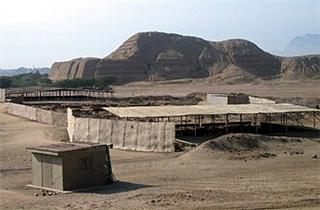
The Moche, or Mochica, culture took shape around 100 CE in the valleys of Peru’s north coast, a desert crossed by short rivers running down from the Andes. Its heartland lay in the Moche and Chicama valleys near modern Trujillo, and its art and temples eventually reached from the Piura valley in the north to the Nepeña valley in the south. The Moche left no writing, and their name for themselves is unknown: ‘Moche’ comes from the valley and village beside their greatest monuments, while the alternative name Mochica is borrowed from a language recorded on the north coast in colonial times. They built on older coastal traditions, the Cupisnique and the Salinar, as local elites gathered followers around new temple platforms and a shared art of gods, warriors and rituals. Rafael Larco Hoyle divided the southern pottery into five phases, still used for dating, while the northern valleys followed a sequence of their own. Most scholars no longer see the Moche as one centralised state. In the south a polity centred on the Huacas de Moche, at the foot of Cerro Blanco, probably came to rule several valleys, whereas in the Jequetepeque and Lambayeque valleys to the north separate lordships shared Moche religion and art.
Socioeconomy
Moche prosperity rested on irrigation. Canals carried river water across the valley floors and turned desert into fields of maize, beans, squash and cotton, while fishermen in reed boats, often shown on Moche pottery, worked the rich coastal waters. Society was sharply ranked. Lords and priests were buried with gold, silver and copper regalia, while ordinary people were laid in simple graves near their homes. Between the two great platforms at the Huacas de Moche lay a planned town of streets, plazas and walled compounds that housed at least 5,000 people, among them potters whose workshops turned out moulded vessels for ritual use. Moche ceramics are the culture’s best-known product: stirrup-spout bottles, fineline paintings of myths, battles and ceremonies, and portrait heads so individual that Christopher Donnan, studying more than 900 of them, could follow some men from boyhood to middle age. Metalworkers coated copper objects with gold and silver by electrochemical replacement plating and depletion gilding. Spondylus shell, turquoise and lapis lazuli reached the coast from distant regions through long-distance exchange. Religion was bound up with human sacrifice, and fanged gods appear throughout the art, among them the being known today as the Decapitator, who often holds a knife and a severed head.
Military
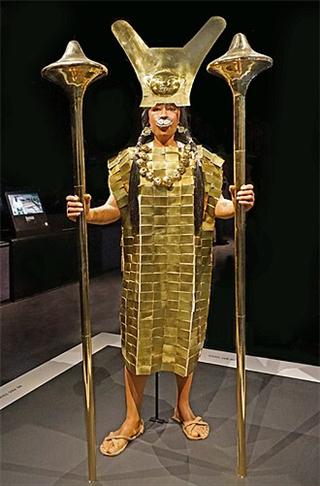
Warfare and its aftermath fill Moche art. Fineline paintings show warriors in helmets and tunics fighting with conical-headed war clubs, small round or square shields, spear-throwers and darts, usually in single combat; the victor strips his opponent, puts a rope around his neck and leads him away. The captives then appear in the scene known as the Sacrifice Ceremony or Presentation Theme, in which their blood is collected in goblets and offered to a richly dressed figure, the Warrior Priest. Archaeology has shown that such rites really took place. At Huaca de la Luna, Steve Bourget excavated the remains of some seventy adolescent and young men who had been killed and dismembered beside a rocky outcrop, some of them left lying in mud laid down by heavy rains. Weapons accompanied elite burials, and the Lady of Cao was buried with war clubs and spear-throwers. Whether Moche combat was chiefly a ritual contest between elite warriors or real warfare between rival polities is still debated. The southern polity probably extended its rule by force over the Virú, Santa and Nepeña valleys in its middle phases, and defensive walls and fortified settlements became common again in the troubled late period.
Governance & Law

Without writing, Moche government has to be read from monuments, tombs and images. At the Huacas de Moche the Huaca del Sol, built of well over 100 million adobe bricks and still about 40 metres high, probably served as a palace, administrative platform and burial place, while the Huaca de la Luna, rebuilt in successive stages and painted with murals, was the main temple. More than a hundred different makers’ marks on the bricks of the Huaca del Sol suggest that many communities owed labour and delivered their quotas of bricks, a system archaeologists have compared with the rotating labour service known under the Incas as mit’a. Rulers combined military, religious and political roles. The Lord of Sipán, buried around 250 CE in the Lambayeque valley with ornaments of gold, silver and copper, wore regalia matching that of the Warrior Priest of the Sacrifice Ceremony, and the tombs of women excavated at San José de Moro from 1991 by Christopher Donnan and Luis Jaime Castillo matched the Priestess of the same scene. This suggests that the figures in the art were offices held in turn by real people. The Lady of Cao, who died around 450 CE, shows that a woman could hold the highest rank, perhaps ruling a valley.
Global & Regional Impact
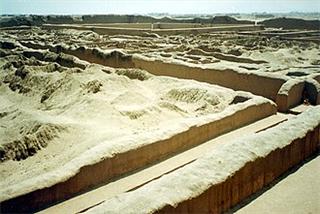
The Moche produced the most naturalistic art of the ancient Andes, and their pottery, murals and metalwork are among the fullest sources for life, belief and ritual in South America before the Incas. Their portrait vessels, made in quantity by no other ancient American people, preserve the faces of individual men, and fineline scenes record hunting, weaving, farming, ritual and myth. Their skills passed to the peoples who followed on the north coast: the Sicán of the Lambayeque valley built on Moche metalworking, and the Chimú raised their capital, Chan Chan, in the same Moche valley, continuing traditions of adobe platforms, irrigation and moulded pottery. The Moche were also central to the modern rediscovery of Peru’s past. Max Uhle excavated at the Huacas de Moche in 1899–1900, and Rafael Larco Hoyle, whose collection forms the Museo Larco in Lima, defined the culture and its phases. The intact tomb of the Lord of Sipán, excavated by Walter Alva in 1987 after looters had found gold at Huaca Rajada, was one of the great archaeological discoveries of the late twentieth century and focused attention on the damage done by looting. The Royal Tombs of Sipán Museum in Lambayeque opened in 2002, and excavations at the Huacas de Moche have continued since 1991.
Decline & Fall

The Moche world was hit hard in the sixth century. Ice cores from the Quelccaya ice cap in the southern Peruvian Andes record a severe drought between about 562 and 594, and El Niño rains and floods damaged canals and fields on the coast in the same period. Political change followed. In the late phase, Moche V, new centres grew at Galindo, inland in the Moche valley, and at Pampa Grande in the Lambayeque valley, a town of more than 400 hectares dominated by the platform of Huaca Fortaleza. Galindo was divided by high walls, and fortified settlements appeared in the Jequetepeque valley, signs of tension within Moche society. Garth Bawden has argued that rulers without a formal administration or a standing army could not maintain their legitimacy against the communal traditions of Andean society. The Huacas de Moche lost their importance, and soon after 700 the houses and stored maize and beans of Pampa Grande were burned, probably in a revolt, and the town was abandoned. Galindo was given up around 800, and only at San José de Moro did Moche burial traditions continue a little longer, until about 850. On the north coast the Sicán culture then rose in the Lambayeque valley, while the Chimú emerged in the Moche valley itself.
The Moche were the great civilisation of Peru’s north coast in the first eight centuries CE, irrigating desert valleys, raising the largest adobe platform in the Americas and making portrait vessels and gilded metalwork of striking realism, while royal tombs such as Sipán reveal the warrior-priest rulers whose sacrificial rites their art depicts.
References
- Alva, W. and Donnan, C.B. (1993) Royal Tombs of Sipán. Los Angeles: Fowler Museum of Cultural History, University of California.
- Bawden, G. (1996) The Moche. Cambridge, MA: Blackwell.
- Bourget, S. (2016) Sacrifice, Violence, and Ideology among the Moche: The Rise of Social Complexity in Ancient Peru. Austin: University of Texas Press.
- Donnan, C.B. (2004) Moche Portraits from Ancient Peru. Austin: University of Texas Press.
- Quilter, J. (2010) The Moche of Ancient Peru: Media and Messages. Cambridge, MA: Peabody Museum Press.
- Shimada, I. (1994) Pampa Grande and the Mochica Culture. Austin: University of Texas Press.
Connections
Open the full connections map →