Sub-Saharan Africa
Aksumite Empire
At a glance
- Aksum, in highland Ethiopia and Eritrea, grew rich trading African ivory and gold through its Red Sea port of Adulis.
- Under King Ezana it became one of the first states to adopt Christianity, founding Ethiopia's Orthodox tradition.
- Cut off from Red Sea trade by Persia and the early Islamic conquests, it shrank into a regional highland kingdom.
Rise & Fall
- c. 270King Endubis introduces Aksumite gold, silver and bronze coinage
- c. 350King Ezana conquers the Kingdom of Kush, reaching the Nile
- c. 525King Kaleb's seaborne expedition overthrows the Himyarite king Dhu Nuwas in Yemen
- 570sA Sasanian force takes Yemen, cutting Aksum off from the Arabian trade
- c. 615Aksum shelters early Muslim emigrants from Arabia
- Early 7th centuryAksumite coinage ceases after more than three centuries
Foundation
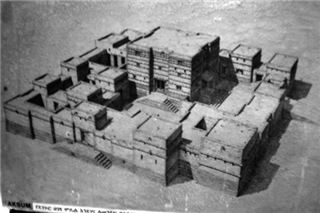
The Aksumite Empire emerged in the highlands of northern Ethiopia and Eritrea around the first century CE, though its roots extend to the pre-Aksumite civilisation that had absorbed South Arabian cultural and linguistic influences centuries earlier. The earliest historical reference to Aksum as a functioning polity appears in the Periplus of the Erythraean Sea, a Greek merchant's guide of the mid-first century CE, which names the metropolis of the Axomites and describes the local ruler Zoskales as versed in Greek letters, early evidence of the region's engagement with the Graeco-Roman world. The port of Adulis on the Red Sea coast is described as a major hub for the export of ivory, tortoiseshell, rhinoceros horn and other African goods, suggesting that Aksum was already overtaking the declining Kingdom of Kush as a leading supplier of African luxury goods to Roman markets. The empire's geography was its founding advantage: situated between the Ethiopian highland agricultural zone and the Red Sea coast, it controlled the movement of goods between the African interior and the maritime routes linking Rome, Arabia and India. The introduction of Aksumite coinage under King Endubis around 270 CE, making Aksum one of the very few states of the ancient world to issue its own gold coins, marked a threshold of institutional maturity: gold, silver and bronze issues, inscribed mainly in Greek and later also in Ge'ez, enabled Aksum to participate fully in the Mediterranean monetary economy. In the third century the Persian prophet Mani reportedly counted Aksum alongside Rome, Persia and China as one of the four great kingdoms of the world.
Socioeconomy
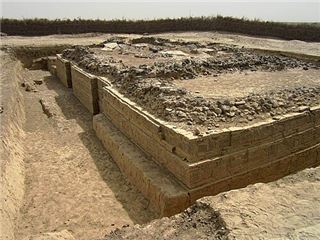
The Aksumite economy was fundamentally a commercial enterprise of extraordinary geographic reach, built on Aksum's position as the entrepôt linking the African interior to the Indian Ocean trade network. The port of Adulis handled a remarkable volume of luxury commodities: ivory from the interior, gold from the lands to the south and west, tortoiseshell from the Red Sea coast, aromatics from the Horn, obsidian and live animals, destined for Roman, Arabian and Indian markets. In return, Aksum imported textiles, glassware, wine, olive oil and metalwork from the Mediterranean world, and spices, cotton and gems from India. Finds of Aksumite coins as far afield as southern Arabia and India testify to the empire's participation in a genuinely intercontinental commercial system. The highlands provided a productive farming base that supported significant urban populations, with terracing, irrigation, ox-drawn ploughs and the cultivation of crops such as teff, wheat and barley. Aksumite society comprised a royal elite, a clergy that gained greatly in prestige and power after the adoption of Christianity under King Ezana in the fourth century, a merchant community of mixed origins, and a large agricultural population. The loss of influence in Yemen to the Sasanian Persians in the 570s cut Aksum off from the eastern shore of the Red Sea and from the revenues of the trans-Arabian trade. The rise of Islam and the Arab conquests of Arabia and Egypt in the seventh century completed Aksum's commercial isolation, ending the trade-based prosperity that had sustained the kingdom for some five centuries.
Military

Aksumite military power reflected the empire's commercial rather than purely territorial ambitions, though at its height it could project force across the Red Sea and deep into the African interior. The kings led a royal army supplemented by contingents drawn from tributary peoples, and war elephants appear in accounts of Aksumite campaigns and diplomacy. King Ezana's conquest of the Kingdom of Kush around 350 CE, which reached the Nile and destroyed the remnants of Meroitic power, removed the last significant rival for control of African trade routes to Egypt and was the most consequential military achievement of the empire's classical phase. Ezana's inscriptions, including the trilingual Ezana Stone in Ge'ez, Sabaean and Greek, record campaigns against peoples across what is now Sudan, Eritrea and the Ethiopian interior, presenting the king as a divinely sanctioned conqueror who destroyed towns and deported populations. The Yemen campaigns of King Kaleb (r. c. 514–542 CE) marked the fullest extension of Aksumite reach: a major seaborne expedition around 525, undertaken with the encouragement of the Byzantine Emperor Justin I, overthrew the Himyarite king Dhu Nuwas, who had persecuted the Christians of Najran, and installed a Christian client ruler in South Arabia. Historians such as Stuart Munro-Hay have described this venture as Aksum's swan song as a great power, since it overextended the empire's military and financial resources: within a few years the Aksumite general Abraha had made himself effectively independent ruler of Yemen. The Sasanian conquest of Yemen in the 570s demonstrated the limits of a military system that had never developed the logistical depth needed to sustain power across the Red Sea against a determined imperial opponent.
Governance & Law

The Aksumite system combined central royal authority with a hierarchy of subordinate kings and local chiefs and, from the fourth century, an increasingly powerful Christian church. The Aksumite ruler bore the title negusa nagast, king of kings, reflecting a structure in which tributary rulers acknowledged Aksumite suzerainty while retaining local authority. The state's sophistication is evident in its coinage, which broadcast the king's image and titles across the trading world in Greek and Ge'ez, and in the monumental stelae of Aksum itself: carved granite monoliths, often called obelisks, the largest of which measured some 33 metres, though it probably fell during or soon after its erection, which marked the tombs of the Aksumite elite and expressed royal power. The adoption of Christianity under Ezana in the mid-fourth century, following the influence of his Syrian-Greek tutor Frumentius, who was consecrated as the first Bishop of Aksum by Athanasius of Alexandria, made the church a major pillar of government. Frumentius, remembered in Ethiopia as Abba Salama, oversaw the integration of Christian religious authority into the existing royal order, and the tie to the patriarchate of Alexandria, which appointed Ethiopia's bishops for some sixteen centuries, began here. The Ethiopian Orthodox Church, which traces its institutional lineage directly to this conversion, became an enduring framework that outlasted the Aksumite dynasty by more than a millennium. The empire governed through direct royal control over the highland core and tributary arrangements with peripheral peoples, a system adequate during the commercial boom but fragile once the trade revenues sustaining the centre contracted.
Global & Regional Impact
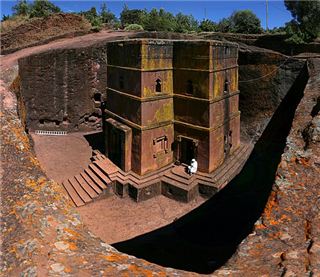
The Aksumite Empire's legacy operated on several registers at once, commercial, religious, cultural and architectural, and its influence extended far beyond the boundaries of the state itself. As one of the great powers of late antiquity, Aksum was a principal conduit for African goods entering the Graeco-Roman and Indian Ocean economies, an indispensable node in an early intercontinental commercial network. Ezana's conversion made Aksum one of the first states to adopt Christianity officially and the first to place the cross on its coinage, decades before Christianity became the official religion of the Roman Empire under Theodosius I, and established the Ethiopian Orthodox tradition as one of the oldest continuous Christian institutions in the world. Ge'ez, the language of Aksumite inscriptions, became the liturgical and literary language of the Ethiopian Orthodox Church, and its script, which the Aksumites developed into a fully vocalised alphabet, is still used to write Amharic, Tigrinya and other languages today. Architecturally, the great stelae of Aksum, among the most ambitious monuments in ancient Africa, demonstrate a level of technical and organisational sophistication that shaped later Ethiopian building traditions. The Zagwe dynasty, which succeeded Aksum, built the famous rock-hewn churches of Lalibela in a style showing clear Aksumite architectural influence, demonstrating that Aksum's cultural legacy survived its political collapse. The Ethiopian royal tradition of descent from Solomon and the Queen of Sheba, codified in the fourteenth-century Kebra Nagast and traced through the kings of Aksum, shaped Ethiopian identity, statecraft and diplomacy for centuries after the empire's fall.
Decline & Fall

The Aksumite Empire's decline was the product of successive and compounding shocks that destroyed the commercial foundation on which its prosperity rested. The first blow came with the Sasanian conquest of Yemen in the 570s, when a Sasanian expeditionary force under the general Wahrez took Sana'a, overthrew the Abyssinian rulers of Yemen, the successors of Abraha, and installed Persian rule, cutting Aksum off from the eastern shore of the Red Sea and ending decades of commercial and strategic influence over the Arabian trade. The second and more devastating blow was the rise of Islam: the Arab conquests of Arabia, the Levant and Egypt in the seventh century transferred control of the Red Sea trade to Muslim powers whose networks increasingly bypassed Aksum, even though relations between the two remained initially cordial, Aksum having sheltered early Muslim emigrants around 615. Aksumite coinage, issued for over three centuries, ceased around the early seventh century, a strong indication that the commercial economy was in decline. A third pressure was probably environmental: deprived of trade revenues, the highland farmland around the capital appears to have been worked ever harder, and many scholars link the kingdom's contraction to soil erosion, deforestation and declining agricultural productivity. Together, economic isolation, agricultural degradation and demographic contraction reduced Aksum from an international commercial power to a regional highland kingdom within two centuries. The political centre shifted southwards, to a capital known in Arabic sources as Kubar, by the ninth century. According to Ethiopian tradition, the last Aksumite king, Dil Na'od, was overthrown by Mara Takla Haymanot, who founded the Zagwe dynasty, though the date of this transition is uncertain and usually placed in the tenth to twelfth century, bringing to an end a dynasty that had ruled for many centuries.
The Aksumite Empire stands as one of Africa's most consequential ancient civilisations: its adoption of Christianity in the Ethiopian highlands, its development of the Ge'ez script and its integration of north-east Africa into the commercial networks of the ancient world created a cultural and institutional legacy that has endured without interruption to the present day.
References
- Bowersock, G.W. (2013) The Throne of Adulis: Red Sea Wars on the Eve of Islam. Oxford: Oxford University Press.
- Haas, C. (2008) 'Mountain Constantines: The Christianization of Aksum and Iberia', Journal of Late Antiquity, 1(1), pp. 101–126.
- Kobishchanov, Y.M. (1979) Axum. Translated by L. Kapitanoff. University Park: Pennsylvania State University Press.
- Munro-Hay, S.C. (1991) Aksum: An African Civilisation of Late Antiquity. Edinburgh: Edinburgh University Press.
- Pankhurst, R. (1998) The Ethiopians: A History. Oxford: Blackwell.
- Phillipson, D.W. (2012) Foundations of an African Civilisation: Aksum and the Northern Horn, 1000 BC–AD 1300. Woodbridge: James Currey.
Connections
Open the full connections map →