Sub-Saharan Africa
Hausa kingdoms
At a glance
- A group of walled city-kingdoms in northern Nigeria and southern Niger, including Kano, Katsina, Zazzau, Daura and Gobir.
- They never united, but shared a language, court institutions and a trade network linking the Sahara and the forest.
- The jihad of Usman dan Fodio (1804–1808) replaced their dynasties with the Fulani emirates of the Sokoto Caliphate.
Rise & Fall
- c. 999Bagauda becomes the first king of Kano, according to the Kano Chronicle
- 14th centuryWangarawa merchants bring Islam to Kano under Sarki Yaji
- c. 1463Muhammad Rumfa becomes king of Kano and reforms its government
- c. 1516Kanta Kotal of Kebbi throws off Songhai rule
- c. 1762Gobir destroys Birnin Zamfara, the capital of Zamfara
- 1804Usman dan Fodio’s followers defeat Gobir at Tabkin Kwotto
- 1808Alkalawa falls and Sarki Yunfa of Gobir is killed
Foundation

The Hausa kingdoms grew out of farming communities on the savanna of what is now northern Nigeria and southern Niger. Around the end of the first millennium some of these communities built fortified settlements, called birni, around sacred hills, iron-working sites and markets, and their leaders took the title sarki. Hausa tradition explains their origin through the legend of Bayajidda, a prince from the east who killed a sacred snake at the well of Daura and married its queen; their descendants were said to have founded the seven ‘legitimate’ states, the Hausa Bakwai of Daura, Kano, Katsina, Zazzau (Zaria), Gobir, Rano and Biram, while seven other states, the Banza Bakwai, including Zamfara, Kebbi, Yauri and Nupe, were considered less legitimate offshoots. The legend is a charter rather than a record, and historians see the states as forming gradually between roughly the tenth and fourteenth centuries. The Kano Chronicle, written down in the nineteenth century from older traditions, names Bagauda as the first king of Kano, traditionally around 999. Kano and Katsina emerged as the strongest commercial centres, Zazzau expanded southwards as a raiding frontier state, and Gobir in the north guarded the approaches from the desert. They never formed a single empire, but shared one language, similar institutions and an expanding network of trade.
Socioeconomy
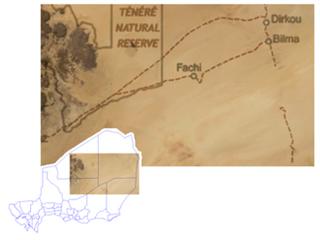
The economy of Hausaland rested on intensive farming of millet, sorghum, cotton and later maize, worked largely by household groups called gandu and, increasingly, by slaves on estates around the towns. Hausa cities became the leading manufacturing centres of the central Sudan. Kano was famous for cotton cloth dyed in indigo pits, and Hausa tanners produced fine goatskin leather that reached Europe by way of North Africa as ‘Morocco leather’. Merchants carried cloth, leather and grain north across the Sahara through Agadez, imported salt from Bilma and horses from the north, and traded southwards for kola nuts from the forest zone of modern Ghana. Cowrie shells became the common currency in later centuries. Islam was introduced through traders: the Kano Chronicle credits Wangarawa merchants from the Mali Empire with bringing it to Kano under Sarki Yaji in the fourteenth century. For centuries Islam was mainly the religion of courts and merchants, practised alongside the older bori spirit cults and the veneration of local deities, and many rulers combined both. Muslim scholars, Arabic learning and the writing of Hausa in Arabic script, known as ajami, spread through the towns. By the eighteenth century Hausa had become the main trade language across much of West Africa.
Military
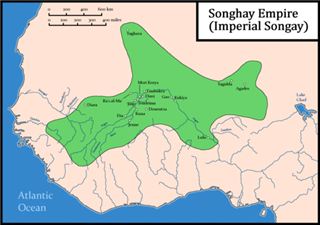
Warfare between the Hausa states was frequent, and military power rested on armoured cavalry. Wealthy horsemen wore quilted cotton armour or imported chain mail and fought with lances and swords, supported by infantry archers using poisoned arrows. Every capital was protected by massive earthen walls with fortified gates, enclosing farmland and wells so that the population could withstand sieges; the walls of Kano, extended under Muhammad Rumfa in the fifteenth century, ran for many kilometres. Kano and Katsina fought a long series of wars over trade and territory, including a protracted conflict in Rumfa’s time. The states were also exposed to stronger neighbours. Kano paid tribute to the Kanem-Bornu Empire from about the mid-fifteenth century, and Songhai forces under Askia Muhammad probably campaigned in Hausaland around 1513, although the extent of Songhai control is debated. Soon afterwards Kanta Kotal of Kebbi threw off Songhai rule and for much of the sixteenth century made Kebbi the leading power of the western Hausa region. In the seventeenth century the Kwararafa (Jukun) confederacy from the Benue valley raided Kano and Katsina. In the eighteenth century Gobir rose to military prominence, destroying the capital of Zamfara around 1762 and fighting Katsina and Kano, wars that exhausted the region before the jihad.
Governance & Law
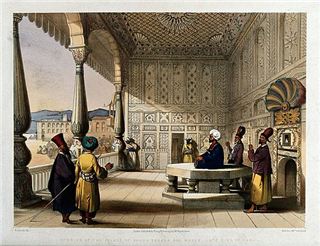
Each Hausa kingdom was governed by a sarki chosen from eligible royal lineages by a council of senior officials, and his authority combined sacred and political roles. Courts developed elaborate hierarchies of titled offices, such as the galadima, who acted as chief minister, the madawaki, who commanded the cavalry, and officers responsible for the treasury, markets and the palace. In Kano a council of nine senior office-holders advised the ruler, and Muhammad Rumfa (r. c. 1463–1499) strengthened royal power by building the palace still used by the emirs of Kano, founding the Kurmi market, appointing slaves and eunuchs to high office and introducing Islamic reforms. The Maghrebi scholar Muhammad al-Maghili visited Kano in his reign and wrote for him a treatise on the obligations of Muslim rulers. Revenue came from market dues, taxes on crafts and caravans, tribute from subject villages and the proceeds of slave raiding. Territorial officials collected these through networks of village heads. Justice combined customary law with Islamic law administered by alkali judges in the larger towns. Because succession was contested among royal lineages, and because ruling houses depended on the support of titled officials and wealthy merchants, Hausa monarchies were frequently unstable, and Muslim scholars increasingly criticised rulers for corruption and heavy taxation.
Global & Regional Impact

The Hausa kingdoms created the commercial and urban core of the central Sudan, and their influence outlasted their dynasties. Their towns became the leading markets between the middle Niger and Lake Chad, linking the trans-Saharan trade with the forest zone, and Hausa merchants established communities, called zongo in the south, from the Gold Coast to Cameroon. Through them the Hausa language spread as a lingua franca, and it is today spoken by tens of millions of people as a first or second language, making it one of the most widely spoken languages of Africa. The court titles, tax systems, walled cities and markets of the Hausa states were largely taken over by the Sokoto Caliphate, whose Fulani emirs ruled through the institutions they had overthrown, and many of them survive in the emirates of northern Nigeria, such as Kano, Katsina and Zaria. The Kano Chronicle is among the most important indigenous historical sources for West Africa. Hausa cloth, leatherwork and architecture, including the decorated mud palaces and mosques of Kano and Zaria, remain distinctive. The criticisms that Muslim reformers made of Hausa rulers also shaped the ideology of the jihad that ended them, which became a model for later reform movements across West Africa.
Decline & Fall
The Hausa kingdoms were weakened in the late eighteenth century by continual warfare, especially Gobir’s campaigns against Zamfara, Katsina and Kano, by heavy taxation and by tensions between rulers and Fulani pastoralists and Muslim scholars. In Gobir the preacher Usman dan Fodio built a large following that demanded strict application of Islamic law, the abolition of non-Islamic taxes and an end to the enslavement of Muslims. When Sarki Yunfa of Gobir moved against his community, Usman withdrew to Gudu in February 1804 and was proclaimed commander of the faithful. His followers defeated a Gobir army at Tabkin Kwotto in June 1804, and the jihad spread as local Fulani leaders received flags from Usman to raise revolt in other kingdoms. Katsina, Kano, Zazzau and Daura fell to the jihadists between about 1805 and 1808, and in 1808 the Gobir capital, Alkalawa, was taken and Yunfa killed. Fulani emirs replaced the Hausa dynasties within the new Sokoto Caliphate. Some royal lines continued in independent successor states: Zazzau’s rulers founded Abuja, Katsina’s rulers settled at Maradi, and Gobir’s at Tsibiri, from where they fought the caliphate for decades. The emirates themselves passed under British rule in 1903.
The Hausa kingdoms built the walled market cities, crafts and trade networks that made the central Sudan one of West Africa’s most productive regions, spread the Hausa language far beyond their borders, and left institutions that the Sokoto Caliphate and the modern emirates of northern Nigeria inherited.
Test yourself
3 questions on this page, from its key events and facts.
The questions open here once the page has loaded.
References
- Hiskett, M. (1973) The Sword of Truth: The Life and Times of the Shehu Usuman dan Fodio. New York: Oxford University Press.
- Last, M. (1967) The Sokoto Caliphate. London: Longmans.
- Palmer, H.R. (1928) Sudanese Memoirs. Lagos: Government Printer.
- Smith, M.G. (1960) Government in Zazzau, 1800–1950. London: Oxford University Press.
- Smith, M.G. (1997) Government in Kano, 1350–1950. Boulder: Westview Press.
Connections
Open the full connections map →