
At a glance
- An Igbo sacred kingdom whose priest-king, the Eze Nri, held ritual rather than military authority over much of northern Igboland.
- Nri agents marked with ichi scars cleansed abominations, settled disputes and conferred Ozo titles across a wide area.
- Its traditional history begins in 948; in 1911 British officials forced the Eze Nri to renounce his ritual powers.
Rise & Fall
- 948Traditional date for Eri, founder of the Nri line, in Onwuejeogwu’s reconstruction
- 1043Ifikuanim, remembered as the first Eze Nri, begins his reign (traditional date)
- c. 850–1150Bronzes, beads and a seated burial are deposited at Igbo-Ukwu, near Nri
- c. 1580Nri influence reaches Igbo communities west of the Niger, by one reconstruction
- 1700sNri influence declines as the Atlantic slave trade and the Aro network expand
- 1901–1902The Anglo-Aro War opens the Igbo interior to British rule
- 1911A British expedition forces the Eze Nri to renounce his ritual powers
Foundation

Nri lies in the northern Igbo heartland of south-eastern Nigeria, in what is now Anaocha local government area of Anambra State. Its early history is known from oral tradition and archaeology, not from written records. Nri traditions trace the kingdom to Eri, a sky being said to have been sent down by Chukwu, the creator, who settled in the Anambra valley near Aguleri, and to his son Nri, founder of the town and of its priestly kingship. The first Eze Nri, or priest-king, is remembered as Ifikuanim. The anthropologist M. Angulu Onwuejeogwu, reconstructing the king-list from genealogies, placed Eri in 948 and Ifikuanim’s reign from 1043, but the long interregnums between reigns make such dates uncertain, and other scholars place the first Eze Nri later. Archaeology suggests that ritual authority of the Nri kind is old. At nearby Igbo-Ukwu, a villager digging in his compound in 1938 found bronzes, and Thurstan Shaw’s excavations of 1959–1960 and 1964 uncovered a shrine store of regalia, a cache of objects and the burial of a dignitary seated on a stool. Shaw dated the finds to the ninth century; radiocarbon dates published in 2022 suggest that the shrine was in use into the eleventh or twelfth century. Whether Igbo-Ukwu belonged to Nri is unproven, but the finds are widely associated with Nri ritual kingship.
Socioeconomy
The Nri heartland was a land of dense farming villages where yams were the staple and the most prestigious crop, grown alongside cocoyams. Nri’s own wealth came less from its fields than from its ritual services. In Nri tradition the first Nri, faced with hunger, was told by Chukwu to sacrifice his son and daughter; yams grew from the son’s head and cocoyams from the daughter’s, and Nri thereby gained the ‘yam medicine’ (ogwu ji) that other communities sought in return for annual tribute. At the Igu Aro, the ‘counting of the year’, representatives of these communities brought tribute to the Eze Nri, who blessed them and gave yam medicine for the planting season. Nri’s travelling agents brought home payments for cleansing rites and title-taking, and tradition credits Eri with naming the four days of the Igbo market week, Eke, Orie, Afo and Nkwo. The Igbo-Ukwu finds point to wide connections: some 165,000 glass and carnelian beads, much of the glass probably made in the Middle East and brought by long-distance trade, and bronzes cast from copper and lead mined around Abakaliki, about 100 kilometres away. Nri was also remembered as a sanctuary for people rejected by their communities, and tradition holds that after the tenth Eze Nri any slave who reached Nri soil became free.
Military
Nri had no army, and its authority never rested on conquest. Its teaching held that bloodshed was an abomination that polluted the earth, the domain of the earth deity Ana, and the Eze Nri and his agents existed to remove such pollution, not to make war. Their sanctions were ritual. Nri could declare offences against the earth to be abominations and withhold cleansing, title-taking and the blessing of crops from those who refused to make amends, a ritual boycott that cut them off from the wider moral order; whole communities could be isolated in this way. Travelling Nri men carried a fresh palm frond, the omu, as a sign of protection, which let them pass through country closed to others by local feuds. Their work included ending quarrels, purifying ground on which blood had been shed and proclaiming peace. Such power depended on belief. As the Atlantic slave trade spread raiding and kidnapping through the Igbo hinterland, ritual sanctions could not protect communities from armed men, and by the eighteenth century the most powerful network in much of Igboland was that of the Aro, who relied on their oracle at Arochukwu and on warriors from allied communities such as Abam, Ohafia and Edda. No battle fought by Nri is recorded, and it had no means of resisting British conquest.
Governance & Law
The Eze Nri was a ritual ruler rather than a king in the usual sense. After a ruler’s death a long interregnum followed, often lasting years, while the Nri lineages waited for signs revealing the chosen successor. He was then installed after a symbolic journey to Aguleri, the home of Eri, a ritual burial and exhumation, and anointing with white clay. Thereafter he lived largely secluded in his palace, and at his death he was buried seated in a wood-lined chamber, a custom that recalls the seated burial at Igbo-Ukwu. Everyday government in Igboland lay with village assemblies, elders and titled men; Nri supplied the ritual framework within which they acted. Its agents, the ndi Nri, bore ichi, lines cut on the forehead and face, and travelled with ritual staffs to cleanse abominations, settle disputes and install title-holders. Men in other communities could buy a series of ranked titles, notably Ozo and Nze, which made them sharers in Nri’s moral authority and its representatives across a wide area known as Odinani Nri. Nri rules defined abominations, from the birth of twins to children who cut their upper teeth first, and families far away sent such children to Nri for cleansing rather than have them killed. By one reconstruction, Nri’s influence reached Igbo communities west of the Niger by the late sixteenth century.
Global & Regional Impact
Nri left a deeper mark on Igbo culture than its size suggests. The Ozo title system spread through northern Igboland under Nri’s ritual sponsorship and became one of the main ladders of social advancement for Igbo men, and the ichi marks of titled men, the yam rites and the rules of abomination and cleansing that Nri agents enforced became widespread. The traditions of origin of the Umueri clans centre on Nri and Aguleri, the communities descended from Eri, which many Igbo remember as an ancestral and religious centre. The Igbo-Ukwu finds, whatever their exact relation to Nri, rank among the masterpieces of early African metalwork. Cast in bronze by the lost-wax method, they include a vessel modelled as a pot enclosed in rope on a stand, pendants in the form of human, ram and elephant heads, and objects encrusted with insects, beads and fine relief, and one pendant head bears facial lines resembling ichi marks. They show that a society in the forest zone of West Africa produced sophisticated metalwork centuries before European contact, in a tradition distinct from the later ones of Ife and Benin. Nri is remembered today as a cradle of Igbo civilisation, and its history was reconstructed in detail by Onwuejeogwu in An Igbo Civilization: Nri Kingdom and Hegemony (1981).
Decline & Fall
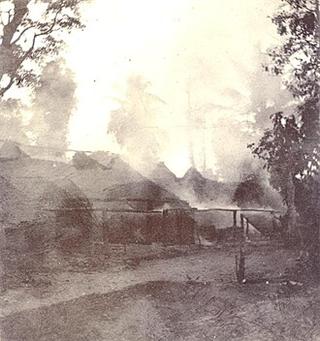
Nri’s influence waned from the eighteenth century. On Onwuejeogwu’s reconstruction, the reigns from the tenth to the fourteenth Eze Nri saw growing conflict, which probably reflected the profits of the Atlantic slave trade. Captives from the Igbo hinterland were carried in large numbers to the ports of the Bight of Biafra, such as Bonny and Calabar, and the Aro, with their oracle at Arochukwu and their chain of trading settlements, built a new kind of power that ritual sanctions could not restrain. At the same time Igbo communities on and near the Niger, such as Onitsha, founded in the seventeenth century by migrants from the Benin region according to its traditions, developed monarchies on a different model, ruled by an Obi. In the nineteenth century palm oil replaced captives as the main export, and from 1857 British traders and missionaries settled at Onitsha. Colonial conquest followed. The Anglo-Aro War of 1901–1902 broke the Aro network, and British officials extended their rule over the northern Igbo through appointed warrant chiefs. In 1911 a British expedition forced the reigning Eze Nri, Obalike, to renounce the ritual powers on which Nri’s influence rested, ending Nri as a political force. The office itself survived: new Eze Nri have continued to be installed, and the title is now a traditional office in Anambra State.
The Kingdom of Nri was a sacred kingship rather than a conquest state: for centuries its priest-king and travelling ritual specialists cleansed abominations, conferred titles and proclaimed peace across much of Igboland, shaping Igbo religion and the Ozo title system, while nearby Igbo-Ukwu yielded some of Africa’s finest early bronzes.
References
- Afigbo, A.E. (1981) Ropes of Sand: Studies in Igbo History and Culture. Ibadan: University Press in association with Oxford University Press.
- Isichei, E. (1976) A History of the Igbo People. London: Macmillan.
- Northrup, D. (1978) Trade without Rulers: Pre-colonial Economic Development in South-Eastern Nigeria. Oxford: Clarendon Press.
- Onwuejeogwu, M.A. (1981) An Igbo Civilization: Nri Kingdom and Hegemony. London: Ethnographica; Benin City: Ethiope.
- Shaw, T. (1970) Igbo-Ukwu: An Account of Archaeological Discoveries in Eastern Nigeria. London: Faber and Faber for the Institute of African Studies, University of Ibadan.
- Shaw, T. (1977) Unearthing Igbo-Ukwu: Archaeological Discoveries in Eastern Nigeria. Ibadan: Oxford University Press.
Connections
Open the full connections map →