
Oceania
Tuʻi Tonga Empire
At a glance
- A line of 39 sacred kings, traditionally founded by ʻAhoʻeitu around 950, whose royal centre at Muʻa on Tongatapu is marked by great stone tombs.
- Its voyaging and tribute networks reached ʻUvea, Samoa and eastern Fiji, and its royal centres held stone tools from as far as the Society Islands.
- From the fifteenth century junior royal lines governed in its name; the last Tuʻi Tonga, Laufilitonga, died in 1865 and the title lapsed.
Rise & Fall
- c. 950ʻAhoʻeitu becomes the first Tuʻi Tonga, according to Tongan genealogies
- c. 1200Tradition credits Tuʻitātui with raising the Haʻamonga ʻa Maui trilithon at Heketā
- c. 1300–1400The royal tomb of Paepae-o-Teleʻa is built at Lapaha, Muʻa
- 15th centuryTakalaua’s assassination leads to the creation of the Tuʻi Haʻatakalaua line
- c. 1610The Tuʻi Kanokupolu title is created for Ngata, son of the sixth Tuʻi Haʻatakalaua
- 1777James Cook watches the ʻinasi first-fruits ceremony at Muʻa
- 1826Tāufaʻāhau defeats Laufilitonga at the Battle of Velata
- 1865Laufilitonga, the last Tuʻi Tonga, dies and the title lapses
Foundation
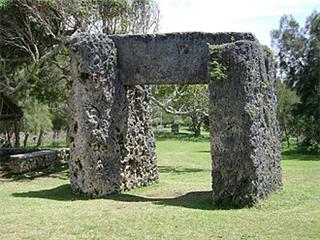
Tonga was first settled almost 3,000 years ago by people of the Lapita culture, ancestors of the Polynesians, whose descendants developed farming chiefdoms across the archipelago. Tongan tradition traces the line of paramount kings to ʻAhoʻeitu, son of the sky god Tangaloa and a mortal woman, who became the first Tuʻi Tonga, or lord of Tonga. Genealogies list 39 Tuʻi Tonga, and counting back the generations places ʻAhoʻeitu around 950, although such reckonings are approximate. The early kings are remembered as living in eastern Tongatapu, at Heketā, where tradition credits the eleventh Tuʻi Tonga, Tuʻitātui, with raising the stone trilithon known as the Haʻamonga ʻa Maui around 1200. Under his son Talatama, tradition holds, the royal residence moved to Lapaha, on the lagoon shore at Muʻa. Archaeology gives a later and more gradual picture. Archaeologists working at Heketā argue that its stone platforms, tomb and trilithon were the setting for new ceremonies introduced by the emerging Tuʻi Tonga lineage in the fourteenth century, and the monumental centre at Lapaha, marked out by a rock-cut ditch and soon the site of a sequence of megalithic tombs, developed in the fourteenth and fifteenth centuries. Geoffrey Clark, a leading archaeologist of Tonga, dates the dynasty’s rule to roughly 1200–1800, while tradition places its beginnings more than two centuries earlier.
Socioeconomy

Tongan society was steeply ranked. Chiefs (ʻeiki) took their rank from both parents, ceremonial attendants (matāpule) served them, and commoners (tuʻa) worked the land, owing labour and produce to their chiefs. Within families a sister outranked her brother, so the Tuʻi Tonga’s eldest sister, the Tuʻi Tonga Fefine, stood above the king in social rank; she married into the Fale Fisi, a chiefly line of Fijian origin, and her daughter, the Tamahā, was among the most sacred persons in Tonga. Yams, taro, breadfruit, coconuts and fish fed the population of the fertile limestone islands, and each year produce from across the realm was presented to the Tuʻi Tonga in the ʻinasi, an offering of first fruits for the gods. Exchange linked Tonga with its neighbours. Geochemical study of stone tools from the royal centres has shown that about two-thirds were long-distance imports, mostly from Samoa and Fiji, with one adze from the Society Islands some 2,500 kilometres away, and that such contacts intensified after about 1200. By the time Europeans arrived, Tongan chiefs also prized Samoan fine mats and Fijian canoes, sandalwood and red feathers. Religion centred on gods such as Tangaloa and Hikuleʻo and on the sacred person of the Tuʻi Tonga himself.
Military
The power of the Tuʻi Tonga rested on command of the sea. Large double-hulled canoes carried chiefs, warriors and tribute between Tongatapu, Haʻapai, Vavaʻu and the islands beyond, and Tongan expeditions carried war to neighbouring archipelagos. On ʻUvea (Wallis), Tongan chiefs built fortified settlements such as Talietumu, enclosed by stone walls and usually dated to around the fifteenth century. Samoan tradition recalls a period of Tongan domination that ended when Savea and his kinsmen drove out the Tongan ruler Talakaifaiki, traditionally in the thirteenth century, and holds that the Malietoa title, one of Samoa’s paramount titles, arose from words of praise spoken by the departing Tongans. Violence also struck at the heart of the dynasty: tradition records that the Tuʻi Tonga Havea I, Havea II and Takalaua were assassinated, and that Takalaua’s son Kauʻulufonua I pursued his father’s killers from island to island before reorganising royal power. In later centuries warfare increasingly pitted Tongan chiefs against one another. After the assassination of the Tuʻi Kanokupolu Tukuʻaho in 1799 the islands fell into civil wars fought from fortified villages, and in 1806 the Haʻapai chief Fīnau ʻUlukālala seized the British ship Port-au-Prince at Lifuka, sparing the young William Mariner, whose later account is a major source for the period, and turned its guns to his own campaigns.
Governance & Law
The Tuʻi Tonga was a sacred ruler, descended from the gods, whose person and possessions were surrounded by tapu. He received the ʻinasi, presided over the great ceremonies at Muʻa and was served by hereditary attendants and chiefs. Over time the dynasty divided its functions. Tradition relates that after the assassination of Takalaua, probably in the fifteenth century though some reckonings place it in the sixteenth, his son Kauʻulufonua I gave day-to-day authority to his brother Moʻungāmotuʻa, the first Tuʻi Haʻatakalaua, while the Tuʻi Tonga kept supreme rank and sacred functions. Around 1610, by traditional reckoning, the sixth Tuʻi Haʻatakalaua, Moʻungātonga, created the title of Tuʻi Kanokupolu for his son Ngata, whose mother was Samoan, and the Kanokupolu line, based at Hihifo in western Tongatapu, gradually became the most powerful of the three. Marriage bound the lines together: Tuʻi Tonga often took principal wives from the junior lines, and the Tuʻi Tonga Fefine married into the Fale Fisi. Chiefs of Haʻapai, Vavaʻu and the districts of Tongatapu owed tribute and service to the paramount lines, and gifts flowed back down the hierarchy. When James Cook visited in 1777 he found the Tuʻi Tonga Paulaho treated with the greatest reverence, while other chiefs exercised much of the practical power.
Global & Regional Impact
The Tuʻi Tonga polity drew several archipelagos of the central Pacific into a network of rank, tribute and exchange. Its influence touched ʻUvea, Futuna, Samoa and eastern Fiji, and archaeologists describe it, with its central place, monumental tombs and long-distance exchange, as an early archaic state and the only Pacific society known to have extended its power significantly to other archipelagos. Its monuments remain landmarks of Tongan identity. The Haʻamonga ʻa Maui still stands at Heketā, and at Lapaha the stone-faced, terraced royal tombs called langi hold most of the 39 Tuʻi Tonga; one of the most elaborate, Paepae-o-Teleʻa, has been dated to about 1300–1400. The tombs are still used for the burials of senior title holders, and in 2007 they were placed on Tonga’s tentative list for World Heritage. The ranking system the dynasty produced, with its sacred king, senior sisters and interlocking chiefly lines, shaped Tongan society into modern times, and Tonga’s present monarchy descends from the Tuʻi Kanokupolu, the youngest of the three royal lines. European accounts, from Abel Tasman’s visit in 1643 to James Cook’s voyages of the 1770s and William Mariner’s narrative of 1806–1810, recorded the realm’s ceremonies and politics late in its long ascendancy.
Decline & Fall
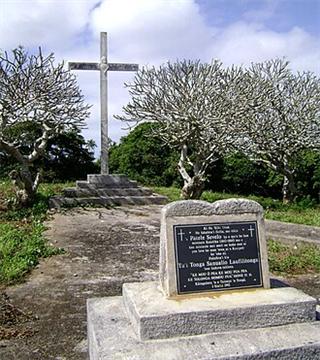
The decline of the Tuʻi Tonga was gradual. Once everyday government had passed to the Tuʻi Haʻatakalaua and then to the Tuʻi Kanokupolu, the sacred king’s authority rested on reverence rather than force. European contact, which reached Tongatapu with Abel Tasman’s visit in January 1643 and grew with James Cook’s visits of 1773, 1774 and 1777, brought new goods, weapons and ideas. The assassination of the Tuʻi Kanokupolu Tukuʻaho in 1799 plunged Tonga into civil war, and after the death of the Tuʻi Tonga Fuanunuiava in 1810 the title remained vacant until 1827. Christianity, taught by a permanent Wesleyan mission from 1826, undermined the religious foundation of the sacred kingship. In 1826 Laufilitonga, heir to the title, was defeated at the Battle of Velata on Lifuka by Tāufaʻāhau, the rising leader of Haʻapai; the chiefs of Tongatapu installed Laufilitonga as Tuʻi Tonga in 1827, but he never regained real power. Tāufaʻāhau, baptised in 1831, became Tuʻi Kanokupolu and King George Tupou I in 1845 and had subdued the last resistance on Tongatapu by 1852. When Laufilitonga, the thirty-ninth Tuʻi Tonga, died in 1865, the title was not renewed. The sacred line that had stood at the head of Tongan society for centuries came to an end, and its prestige passed to the new monarchy.
The Tuʻi Tonga line of sacred kings, traditionally founded around 950, built from Tongatapu a seaborne chiefdom that archaeologists regard as the only Pacific polity to extend its power significantly to other archipelagos, linking Tonga with ʻUvea, Samoa and Fiji through voyaging, tribute and marriage, and its ranks, ceremonies and royal tombs still frame the Tongan monarchy.
Test yourself
5 questions on this page, from its key events and facts.
The questions open here once the page has loaded.
References
- Bott, E. (1982) Tongan Society at the Time of Captain Cook’s Visits: Discussions with Her Majesty Queen Sālote Tupou. Wellington: The Polynesian Society.
- Campbell, I.C. (1992) Island Kingdom: Tonga Ancient and Modern. Christchurch: Canterbury University Press.
- Clark, G., Burley, D. and Murray, T. (2008) Monumentality and the development of the Tongan maritime chiefdom. Antiquity 82 (318): 994–1008.
- Clark, G., Reepmeyer, C. and Melekiola, N. (2016) The rapid emergence of the archaic Tongan state: the royal tomb of Paepaeotelea. Antiquity 90 (352): 1038–1053.
- Gifford, E.W. (1929) Tongan Society. Honolulu: Bernice P. Bishop Museum.
- Kirch, P.V. (1984) The Evolution of the Polynesian Chiefdoms. Cambridge: Cambridge University Press.
Connections
Open the full connections map →