Sub-Saharan Africa
Kanem-Bornu Empire
At a glance
- A Lake Chad empire ruled for close to eight centuries by the Sayfawa dynasty, one of the longest in world history.
- Its control of the trans-Saharan route to Tripoli and its Islamic institutions tied the central Sudan to the Muslim world.
- The Fulani jihad, the rise of the shehus and Rabih's 1893 conquest ended it before European powers divided the land.
Rise & Fall
- c. 1085Mai Hummay, by tradition, adopts Islam for the ruling house
- c. 1221Mai Dunama Dabbalemi begins a reign that expands and institutionalises the state
- c. 1470Driven from Kanem by the Bulala, Mai Ali Gaji founds a new capital at Ngazargamu in Bornu
- 1808Fulani jihadist forces sack Ngazargamu
- 1846Umar, son of al-Kanemi, ends the Sayfawa line and founds the dynasty of the shehus
- 1893Sudanese warlord Rabih az-Zubayr conquers Bornu and destroys Kukawa
- 1900French forces kill Rabih at Kousseri; Britain, France and Germany partition the territory
Foundation

The Kanem–Bornu Empire originated around the ninth century north-east of Lake Chad as the Kingdom of Kanem, ruled first by the Duguwa dynasty, linked to the Zaghawa, and from the late eleventh century by the Sayfawa, who claimed descent from the legendary Yemeni hero Sayf ibn Dhi Yazan. The adoption of Islam by the ruling house, traditionally under Mai Hummay around 1085, strengthened diplomatic and commercial ties with Muslim states across the Sahara. Historically verifiable rulers such as Mai Dunama Dabbalemi (r. c. 1221–1259) played a decisive role in expanding and institutionalising the state. Its rise rested on control of the trans-Saharan route through the Fezzan, linking Lake Chad with Tripoli and dealing in salt, slaves and horses. In the late fourteenth century, sustained pressure from the Bulala forced the dynasty to abandon Kanem and migrate west of the lake to Bornu, where Mai Ali Gaji founded a new capital at Ngazargamu around 1470, marking the transition from Kanem to Kanem–Bornu and ensuring continuity through adaptation.
Socioeconomy
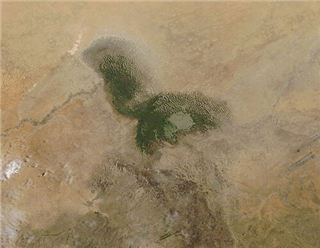
Kanem–Bornu was deeply integrated into long-distance trade networks, forming one of the most enduring commercial economies of the central Sudan. Society was stratified, with a ruling aristocracy, free commoners engaged in farming and trade, and enslaved people who performed labour and were themselves traded in regional markets. Agriculture around Lake Chad produced millet and sorghum, while pastoralism contributed livestock and mobility. Prosperity depended heavily on trans-Saharan commerce, exporting slaves, ivory and ostrich feathers in exchange for horses, textiles, metalwares and luxury goods from North Africa, while salt from Bilma was a vital regional commodity. Revenue was systematically organised, with duties on caravans and tribute from subject territories, reflecting a more structured fiscal system than many contemporary West African states. Njimi in Kanem and later Ngazargamu in Bornu functioned as commercial and administrative hubs. This prosperity, however, remained contingent on the security of the desert routes and the stability of the region.
Military
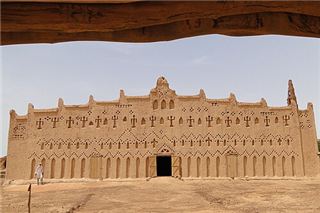
The military apparatus of Kanem–Bornu was one of its defining features, enabling both expansion and long-term resilience. The army combined cavalry and infantry, with heavy cavalry, mounted on horses from North Africa and often protected by quilted armour and mail, forming the elite striking force that gave a decisive advantage on the open plains of the Sahel. Infantry, often drawn from subject populations, supported campaigns and garrisoned territories. Under Idris Alooma in the late sixteenth century, the army underwent significant reforms, including improved organisation, the use of fortified camps, and musketeers trained with the help of Turkish instructors from Ottoman Tripoli. Alooma's campaigns against the Bulala, Tuareg groups and Hausa states such as Kano, recorded by his chronicler Ahmad ibn Furtu, restored and expanded the empire's influence. Strategic mobility, combined with logistical planning such as the provision of water along campaign routes, enhanced operational effectiveness. Nevertheless, the army remained dependent on sustained economic resources and external supply networks for horses and firearms.
Governance & Law

Governance in Kanem–Bornu was characterised by a relatively centralised monarchy under the mai, supported by a structured administrative hierarchy and a royal council of great officeholders. The Sayfawa dynasty ruled for close to eight centuries, one of the longest dynastic continuities in world history, reinforcing political legitimacy. Provincial governors administered outlying regions, collecting taxes and maintaining order while remaining accountable to the centre. Islam profoundly shaped governance, particularly in the development of law based on Maliki jurisprudence alongside customary practice. Under Idris Alooma, judicial reforms strengthened the application of Sharia, and administration was improved through the appointment of qadis and other officials. The move of the capital from Njimi to Ngazargamu reflected strategic adaptation to political pressure and economic opportunity. Bureaucratic mechanisms, though not fully formalised, were more developed than in many contemporary African states, allowing more direct control over resources and populations. This administrative sophistication contributed to the empire's longevity but required continuous maintenance of elite cohesion.
Global & Regional Impact

Kanem–Bornu exerted a profound influence on the political and economic landscape of the central Sudan, serving as a key intermediary between North Africa and the lands south of the Sahara for around a thousand years. Its control of trans-Saharan routes facilitated the movement of goods, people and ideas, above all the spread of Islam, which became deeply embedded in the region's cultural and political life; as early as the thirteenth century a hostel for Kanem students and pilgrims was maintained in Cairo. Its interactions with neighbouring states, including the Hausa city-states and Tuareg confederations, shaped patterns of alliance, conflict and cultural exchange. Diplomatic and commercial links extended to the Ottoman Empire and the rulers of Tripoli and Egypt, integrating it into a wider Afro-Eurasian network. The administrative and military models developed in Kanem–Bornu influenced later states in the Lake Chad basin. Its longevity and adaptability made it one of the most enduring political entities in African history, leaving a legacy still visible in regional political traditions and Islamic institutions, including the office of the Shehu of Borno.
Decline & Fall
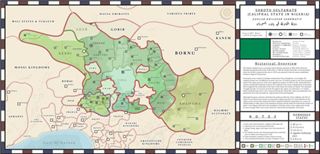
The decline of Kanem–Bornu was a gradual process of internal weakening and external pressure. From the seventeenth century onward the empire faced mounting challenges from Tuareg raiders and other neighbours, along with recurrent drought and famine. Divisions within the ruling elite weakened central authority, while trans-Saharan commerce, though it continued, lost relative importance as wider trade patterns shifted. The nineteenth century brought acute crisis with the Fulani jihad inspired by Usman dan Fodio: Fulani forces sacked Ngazargamu in 1808. Bornu survived only through the leadership of the scholar and warrior Muhammad al-Amin al-Kanemi, who repelled the jihadists and became the real power in the state; his son Umar ended the Sayfawa line in 1846, establishing the dynasty of the shehus. In 1893 the Sudanese warlord Rabih az-Zubayr conquered Bornu and destroyed its capital at Kukawa, marking the end of Kanem–Bornu independence. After French forces killed Rabih at Kousséri in 1900, the territory was partitioned among Britain, France and Germany, marking the conclusion of one of Africa's longest-lasting empires.
The Kanem–Bornu Empire stands as one of the longest-lasting states in African history, sustained for most of a millennium by the Sayfawa dynasty's control of trans-Saharan trade, its cavalry power, and the Islamic institutions that bound the Lake Chad basin to the wider Muslim world.
References
- Brenner, L. (1973) The Shehus of Kukawa: A History of the Al-Kanemi Dynasty of Bornu. Oxford: Clarendon Press.
- Connah, G. (1981) Three Thousand Years in Africa: Man and His Environment in the Lake Chad Region of Nigeria. Cambridge: Cambridge University Press.
- Holt, P.M. and Daly, M.W. (1988) A History of the Sudan. 4th edn. London: Longman.
- Lange, D. (1977) Le Dīwān des sultans du (Kanem-)Bornou. Wiesbaden: Franz Steiner.
- Lavers, J.E. (1980) 'Kanem and Bornu to 1800', in J.F.A. Ajayi and M. Crowder (eds.) History of West Africa. 2nd edn. Vol. 1. London: Longman, pp. 187–224.
- Nehemia Levtzion and Hopkins, J.F.P. (eds.) (2000) Corpus of Early Arabic Sources for West African History. 2nd edn. Princeton: Markus Wiener.
Connections
Open the full connections map →