Americas
Teotihuacan
At a glance
- A planned city in the Valley of Mexico that grew to perhaps 100,000 people, among the largest in the world in the 3rd–6th centuries CE.
- Its pyramids, obsidian, art and talud-tablero architecture influenced Mesoamerica as far as the Maya cities of Tikal and Copán.
- No ruler is named in its art; around 550 its centre was burned, probably in a revolt, and the Aztecs later revered its ruins.
Rise & Fall
- c. 100 BCETeotihuacan begins to grow rapidly in the north-eastern Basin of Mexico
- c. 1–150 CEThe Pyramid of the Sun is raised beside the Avenue of the Dead
- c. 200–250 CEThe Feathered Serpent Pyramid is built, with some 200 sacrificial burials
- c. 250 CEThe city covers some 20 km² with perhaps 100,000 inhabitants
- 378Siyaj K’ak’ arrives at Tikal, and a new king linked to Teotihuacan takes power
- 426K’inich Yax K’uk’ Mo’ founds the royal dynasty of Copán
- c. 550The civic centre is burned and the city’s power collapses
Foundation
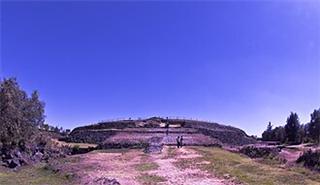
Teotihuacan grew out of farming villages in the Teotihuacan Valley, a side valley in the north-east of the Basin of Mexico, well watered by springs and close to major sources of obsidian. In the last centuries BCE it was one of several growing centres in the basin, with Cuicuilco in the south as its main rival. Volcanic activity helped to shift this balance: eruptions of Popocatépetl, probably in the first century CE, displaced communities to the east, and the eruption of Xitle buried Cuicuilco under lava, although the date of that eruption is debated and may be considerably later. Teotihuacan drew in much of the basin’s population, and during the Tzacualli phase (c. 1–150 CE) it grew with remarkable speed. The Pyramid of the Sun, some 65 metres high, and early stages of the Pyramid of the Moon were raised in this period, and the city was laid out along the Avenue of the Dead on a grid oriented about 15.5 degrees east of north. Around 200–250 CE the Feathered Serpent Pyramid was built inside the vast enclosure known as the Ciudadela. By about 250 CE the city covered some 20 square kilometres and housed perhaps 100,000 people, making it one of the largest cities in the world. Its original name is unknown; Teotihuacan is the Nahuatl name later given to it by the Aztecs.
Socioeconomy
Most Teotihuacanos lived in more than 2,000 walled, single-storey apartment compounds, each housing perhaps 60 to 100 people, probably related families who shared courtyards, altars and crafts. Some compounds were occupied by migrants: the Tlailotlacan district on the western edge housed people from the Valley of Oaxaca who kept Zapotec-style tombs and pottery for centuries, and the so-called Merchants’ Barrio in the east contained pottery from the Gulf Coast and the Maya lowlands. Farming of maize, beans, squash and amaranth, aided by spring-fed irrigation in the valley, fed the population, together with maguey cultivation and hunting. Craft production was central to the economy. Workshops turned obsidian from the nearby Otumba sources and the green obsidian of the Sierra de las Navajas near Pachuca into blades and points, and green Teotihuacan obsidian travelled widely across Mesoamerica. Potters produced cylindrical tripod vessels, while Thin Orange ware, made in southern Puebla, was distributed through the city’s networks. Religion pervaded urban life. Murals in compounds such as Tepantitla and Tetitla depict a storm god related to the later Tlaloc, the Feathered Serpent and a female deity often called the Great Goddess, and figurines and incense burners reveal household ritual. Teotihuacan used a system of glyphic signs, but whether it amounted to full writing is still debated.
Military
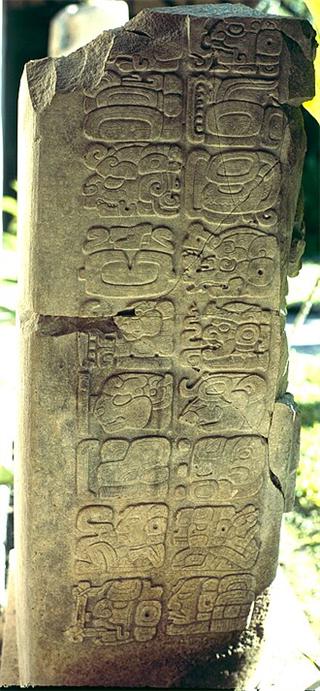
Teotihuacan art is full of warriors armed with the atlatl, or spear-thrower, darts and rectangular shields, and of goggle-eyed figures associated with war and the storm god. The Feathered Serpent Pyramid gives the clearest evidence of organised state violence: when it was built around 200–250 CE, well over a hundred sacrificial victims, many of them young men with their hands bound behind their backs and some wearing necklaces of real or imitation human jaws, were buried in its foundations, and the total is estimated at around 200. Such deposits show that a military ideology was embedded in the state from early on. How far Teotihuacan projected armed force beyond central Mexico is debated. Within the Basin of Mexico and neighbouring valleys it seems to have dominated settlement directly. At greater distances, the clearest case is the Maya city of Tikal, where inscriptions record the arrival in January 378 of a figure named Siyaj K’ak’, on the same day that the reigning king Chak Tok Ich’aak died. A new king, Yax Nuun Ayiin, son of a lord known as Spearthrower Owl, possibly a ruler of Teotihuacan itself, was installed soon afterwards and depicted in Teotihuacan-style dress. Many scholars read this as an intervention backed by Teotihuacan, though its scale and character remain contested. Kaminaljuyu in highland Guatemala also shows strong Teotihuacan connections.
Governance & Law

Teotihuacan’s political organisation is one of the great puzzles of Mesoamerican archaeology. Unlike the Maya cities, it left no inscribed monuments naming rulers, no portraits of kings and, so far, no securely identified royal tomb. In its early centuries, the scale of the Pyramid of the Sun and of the Feathered Serpent Pyramid, with its mass sacrifices, suggests powerful rulers able to command enormous amounts of labour. Some scholars, notably George Cowgill, have argued that strongly personal rule gave way after about 250 CE to a more collective form of government, perhaps a council drawn from elite lineages or a system of co-rulers. The covering of the Feathered Serpent Pyramid’s sculpted facade by a plain platform, the Adosada, has been read as a sign of such a political change. What is clear is that the city was administered with great capacity. Its grid plan, standard orientation and uniform construction of apartment compounds imply central planning and regulation over centuries, and the canalisation of the San Juan River to fit the urban grid shows control over the landscape itself. The Ciudadela, facing the Great Compound across the Avenue of the Dead, probably combined religious, political and economic functions, and the Great Compound may have held a central market. Neighbourhoods and apartment compounds probably served as intermediate units linking households to the state.
Global & Regional Impact

Teotihuacan was the first great metropolis of the Americas and set models that Mesoamerican peoples followed for more than a millennium. Its talud-tablero architecture, a sloping wall supporting a framed vertical panel, was copied at Kaminaljuyu, Tikal, Cholula and elsewhere, and Teotihuacan-style tripod vessels, green obsidian and images of the storm god and of goggled warriors appear across Mesoamerica. In Maya cities, links to Teotihuacan became a source of prestige: K’inich Yax K’uk’ Mo’, who founded the royal dynasty of Copán in 426, was later portrayed with Teotihuacan-style goggles. The Feathered Serpent, prominent at Teotihuacan, became central to later religion as Quetzalcoatl, and the storm god survived as Tlaloc. After its fall the ruined city kept an enormous hold on memory. The Aztecs gave it its Nahuatl name, believed that the gods had gathered there to create the present sun, the Fifth Sun, visited the site, and buried Teotihuacan masks and other objects in offerings at the Templo Mayor of Tenochtitlan. Modern excavation began in earnest with Leopoldo Batres, whose reconstruction of the Pyramid of the Sun was completed in 1910, and Manuel Gamio’s regional study followed in the 1910s. The site was inscribed on the UNESCO World Heritage List in 1987 and is now one of the most visited archaeological sites in the Americas.
Decline & Fall
Teotihuacan’s decline began before its final catastrophe. In its last phases its influence abroad weakened, links with the Maya region faded during the late fifth and sixth centuries, and the population may already have been falling. Then, at a date usually placed around 550 CE, though some scholars argue for a somewhat later date, the civic and religious centre was deliberately set on fire. Burning swept the temples and elite buildings along the Avenue of the Dead and in the Ciudadela, sculptures were smashed, and some bodies were left unburied. Because the destruction targeted the monuments and residences of the elite rather than ordinary apartment compounds, many archaeologists, following René Millon, interpret it as an internal uprising against the ruling class rather than a foreign conquest, although external pressure, drought and economic strain may also have played a part. The city did not vanish at once. Its population fell sharply, but a reduced settlement, marked by new Coyotlatelco pottery, continued among the ruins for centuries. Power in central Mexico fragmented among Epiclassic centres such as Xochicalco, Cacaxtla and Cholula, and later passed to Tula. No later city in the region matched Teotihuacan’s urban scale until the rise of Tenochtitlan, some nine centuries after its fall.
Teotihuacan was the largest and most influential city of the early Americas, a planned metropolis of perhaps 100,000 people whose pyramids, obsidian trade, art and religion shaped Mesoamerica from the Valley of Mexico to the Maya lowlands, and whose ruins the Aztecs later revered as the birthplace of the present sun.
References
- Berrin, K. and Pasztory, E. (eds) (1993) Teotihuacan: Art from the City of the Gods. New York: Thames and Hudson.
- Cowgill, G.L. (2015) Ancient Teotihuacan: Early Urbanism in Central Mexico. New York: Cambridge University Press.
- Millon, R. (1973) Urbanization at Teotihuacán, Mexico. Volume 1: The Teotihuacán Map. Austin: University of Texas Press.
- Pasztory, E. (1997) Teotihuacan: An Experiment in Living. Norman: University of Oklahoma Press.
- Sugiyama, S. (2005) Human Sacrifice, Militarism, and Rulership: Materialization of State Ideology at the Feathered Serpent Pyramid, Teotihuacan. Cambridge: Cambridge University Press.
Connections
Open the full connections map →