Americas
Tiwanaku
At a glance
- A ceremonial city at about 3,850 metres near Lake Titicaca, Tiwanaku dominated the southern Andes between about 500 and 1000.
- Raised fields, llama caravans and colonies in warm valleys sustained it, while its Staff God imagery spread across the southern Andes.
- The city was abandoned around 1010–1050; recent radiocarbon dating suggests this came before the great drought of the 1100s.
Rise & Fall
- c. 180Tiwanaku is founded in the southern Titicaca basin, according to recent radiocarbon modelling
- c. 580Work begins on the Pumapunku platform
- c. 600Tiwanaku draws migrants from across the region as its red-slipped pottery spreads
- c. 650Construction of the Akapana, the largest platform mound of the city, is under way
- c. 910Burials in the city’s tombs cease and a century of violent deaths begins
- c. 1010–1050Permanent residence ends and the city is rapidly abandoned
- 2000Tiwanaku is inscribed on the UNESCO World Heritage List
Foundation
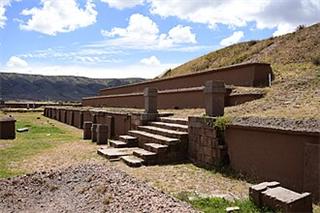
Tiwanaku lies in a broad valley some 15 kilometres south-east of Lake Titicaca, in present-day Bolivia, at about 3,850 metres above sea level. The site was settled in the early centuries CE: a 2023 Bayesian analysis of radiocarbon dates by Erik Marsh and colleagues places its founding around 180, and earlier claims of far greater antiquity have been abandoned. During the Late Formative period it was one of several ceremonial centres in the southern Titicaca basin, while Pukará, the leading centre of the northern basin, declined. Its early monuments included the Semi-Subterranean Temple, a sunken court whose walls are set with carved stone heads. From about 500 Tiwanaku drew ahead of its rivals, filling the space Pukará had left, and around 600 it became a destination for migrants from across the region, who built many new residences and used red-slipped pottery that soon spread widely. Monumental construction followed: work on the Pumapunku platform began around 580 and on the great Akapana in the mid-seventh century. The city’s original name is unknown. The seventeenth-century Jesuit chronicler Bernabé Cobo recorded a tradition that it had once been called Taypiqala, the stone in the centre, a reference to its place at the centre of the world.
Socioeconomy
Tiwanaku’s economy combined the three resources of the high plateau: farming, herding and the lake. On the flat, frost-prone plains near the shore, people built raised fields, platforms of earth separated by water-filled canals that stored the sun’s heat and reduced frost damage, allowing potatoes, quinoa and other hardy crops to be grown on a large scale; how far the state organised these fields is still debated. Herds of llamas and alpacas supplied wool, meat and dung, and llama caravans carried goods across the Andes. Lake Titicaca provided fish, birds and totora reeds. Maize and other warm-valley products came from lower zones: Tiwanaku settlers founded colonies in the Moquegua valley of southern Peru, Tiwanaku pottery spread into the valleys of Cochabamba, and snuff trays carved with Tiwanaku imagery appeared in burials at San Pedro de Atacama in northern Chile from the seventh century. The city itself was socially diverse. Isotope studies show that many residents had grown up elsewhere, and its neighbourhoods of walled compounds included groups of specialist potters. Feasting with maize beer drunk from flared cups called keros, and the taking of hallucinogenic snuff, were central to ritual and social life, and both appear on the great stone statues of the ceremonial core.
Military

Tiwanaku’s power rested more on religion, exchange and colonisation than on conquest, and evidence for organised warfare is limited. No defensive walls protected the city; its ceremonial core was instead enclosed by a moat, which Alan Kolata interpreted as turning the centre into a symbolic island. Violence was nevertheless part of its ideology. Stone sculptures of chachapumas, figures wearing feline masks, hold severed heads, and at the Akapana archaeologists have found dismembered human remains. The 2023 radiocarbon study of the city dates a series of violent deaths, whose victims were left in refuse deposits without proper burial, to the century between about 910 and 1020. Whether Tiwanaku expanded beyond the Titicaca basin by force is debated. In the Moquegua valley, Tiwanaku settlers lived for centuries below the Wari outpost on Cerro Baúl without clear evidence of fighting between them, and in regions such as Cochabamba and San Pedro de Atacama Tiwanaku influence appears to have spread through caravans, shrines and ties with local elites rather than through garrisons or conquest. Warfare became far more visible after Tiwanaku’s collapse, when communities across the plateau moved into hilltop forts, known as pukaras, during the age of the Aymara kingdoms.
Governance & Law

How Tiwanaku was governed is one of the central debates of Andean archaeology. Alan Kolata, who began excavating there with Oswaldo Rivera in 1978, argued for a centralised state ruled by a hereditary elite that managed raised-field agriculture and distant colonies. Others, working in the surrounding valleys, have described a looser order of nested communities and lineages, held together by shared religion, feasting and ritual rather than by a bureaucracy. Most scholars agree that political power was closely tied to religion. The ceremonial core was a planned landscape of platforms and courts: the Akapana, a terraced platform mound about 17 metres high with an internal drainage system; the Kalasasaya, a platform enclosure bounded by tall stone pillars that holds the Ponce Monolith; Pumapunku, faced with precisely cut blocks of andesite and sandstone; and elite residential compounds such as the Putuni. Great stone statues, among them the 7.3-metre Bennett Monolith excavated by Wendell Bennett in 1932, depict richly dressed figures holding a kero and a snuff tray, probably ancestors or rulers presiding over ritual. The Gateway of the Sun, carved from a single block of andesite, shows the Staff God with rows of winged attendants. Tiwanaku had no writing, and its leaders drew authority from these shrines and the ceremonies held in them.
Global & Regional Impact
Tiwanaku was the most influential city of the southern Andes in its time. Its Staff God and attendant figures, which also appear in the art of its contemporary Wari, became part of a widely shared religious vocabulary, and Tiwanaku styles of pottery, textiles, snuff trays and stone carving spread from southern Peru to northern Chile. Lake Titicaca kept its sacred status long after the city fell. The Incas placed their own origins at the lake and built shrines on the Island of the Sun and the Island of the Moon, and in some versions of the creation story recorded by the Spaniards the god Viracocha made the first peoples at Tiwanaku. Spanish chroniclers, among them Pedro Cieza de León, described its ruins in the sixteenth century. Divers working off the Island of the Sun have recovered Tiwanaku offerings of puma-shaped incense burners, gold ornaments and the bones of sacrificed young llamas, apparently sunk into the lake from boats. In modern Bolivia Tiwanaku is a national and indigenous symbol: Aymara communities greet the June solstice there, Evo Morales received indigenous symbols of authority at the site in 2006 before his inauguration as president, and it became a UNESCO World Heritage Site in 2000. Since the 1980s, rebuilt raised fields have also been tested as a way to improve farming on the plateau.
Decline & Fall
Tiwanaku’s end came quickly after a long period of strain. The 2023 radiocarbon study by Erik Marsh and colleagues found that the building of great monuments had stopped by about 720, that burials in tombs at the city ceased around 910, and that a century of violent deaths preceded the end of permanent residence around 1010. Within a few decades, by about 1050, the city had been abandoned, and Tiwanaku’s colonies in Moquegua came to an end at about the same time. For many years the collapse was attributed to a long drought that lowered Lake Titicaca and ruined the raised fields, and climate records do show severe drought in the region. The new chronology, however, places the onset of that drought in the twelfth century, after the city had already been abandoned, and its authors argue that social and political breakdown, not climate, brought Tiwanaku down. Small groups continued to visit the ruins, camp among them and bury their dead there for some time afterwards. The Titicaca basin broke up into rival Aymara-speaking polities, among them the Lupaca Kingdom, the Colla Kingdom and the Pacajes, which built hilltop forts and fought one another until the Incas conquered the region in the fifteenth century.
Tiwanaku, a ceremonial city near Lake Titicaca, dominated the southern Andes between about 500 and 1000 through religion, raised-field farming, llama caravans and colonies; its monuments and Staff God imagery made the Titicaca basin a sacred landscape that the Incas later claimed as their own place of origin.
References
- Goldstein, P.S. (2005) Andean Diaspora: The Tiwanaku Colonies and the Origins of South American Empire. Gainesville: University Press of Florida.
- Janusek, J.W. (2008) Ancient Tiwanaku. Cambridge: Cambridge University Press.
- Kolata, A.L. (1993) The Tiwanaku: Portrait of an Andean Civilization. Cambridge, MA: Blackwell.
- Stanish, C. (2003) Ancient Titicaca: The Evolution of Complex Society in Southern Peru and Northern Bolivia. Berkeley: University of California Press.
- Young-Sánchez, M. (2004) Tiwanaku: Ancestors of the Inca. Denver: Denver Art Museum; Lincoln: University of Nebraska Press.
Connections
Open the full connections map →