Europe
Dal Riata
At a glance
- A Gaelic kingdom straddling the North Channel, with lands in County Antrim and in Argyll, ruled from the rock fortress of Dunadd.
- Columba’s monastery on Iona, founded under its kings in 563, carried Christianity and learning to the Picts and Northumbria.
- Weakened by defeats and Pictish attack, it merged with Pictland in the ninth century, and its Gaelic speech became Scotland’s.
Rise & Fall
- 563Columba founds the monastery of Iona
- 574Áedán mac Gabráin becomes king, ordained by Columba according to Adomnán
- 603Æthelfrith of Northumbria defeats Áedán at the Battle of Degsastan
- 637Domnall Brecc is defeated at the Battle of Mag Rath in Ireland
- 736Óengus son of Fergus, king of the Picts, captures Dunadd
- 795Viking raids on the Hebrides and Iona begin
- c. 842Cináed mac Ailpín becomes king of the Picts
Foundation
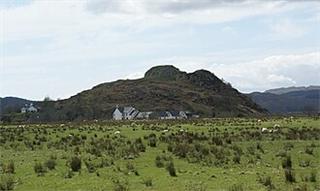
Dál Riata was a Gaelic kingdom that straddled the North Channel, with lands in the north-east of what is now County Antrim and, across the sea, in Argyll and the islands of the Inner Hebrides. Its name belonged originally to a population group in Antrim, and by around 500 its rulers held territory in Britain as well. Irish annals and later Scottish tradition record that Fergus Mór mac Eirc ‘took part of Britain’ with the people of Dál Riata and died there, an event entered under about 501, and medieval writers presented the kingdom as the product of a migration from Ireland. Many historians and archaeologists now doubt that a large-scale movement took place, noting that Argyll and Antrim had long been linked by the sea and that Gaelic speech may already have been established in Argyll; the Fergus story was shaped by later dynasties seeking a founding hero. What is clear is that by the sixth century a Gaelic-speaking kingdom existed on both sides of the channel, its British part a mountainous coastland of sea lochs and islands where travel by boat was easier than by land. Its chief centre became the fortified rock of Dunadd, rising from the bog of the Moine Mhor near Kilmartin, while in Ireland its lands lay along the north Antrim coast.
Socioeconomy
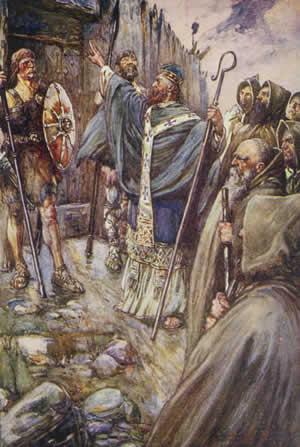
The kingdom was a land of small farms, cattle and the sea. Most people lived in scattered homesteads, raising cattle, sheep and pigs and growing oats and barley on the limited arable ground, and wealth and status were measured above all in cattle. Society was arranged in kindreds, and the free population owed tribute and service to their lords and kings. The Senchus fer nAlban, a text whose core probably dates from the seventh century, lists the households of the main kindreds and their obligations to provide oarsmen for sea levies, a rare glimpse of the resources of an early medieval kingdom. Excavations at Dunadd have revealed workshops for fine metalwork, including moulds for brooches, together with pottery and glass imported from the Continent, showing that luxury goods reached the kingdom along Atlantic sea routes. The rock bears carvings of a human footprint, a basin, a boar and an ogham inscription. Christianity shaped the kingdom deeply. In 563 the Irish monk Columba founded a monastery on the island of Iona, and according to Adomnán’s Life of Columba his community kept close ties with the kings of Dál Riata. Iona grew into the head of a family of monasteries in Ireland and Britain and a centre of learning, manuscript production and sculpture, including its great high crosses.
Military

Dál Riata fought on land and sea. Its kings commanded war bands of noble warriors and levies of free men, and the Senchus fer nAlban shows that military obligation was reckoned in boats and crews as well as men, reflecting a kingdom whose communities were linked by water. Áedán mac Gabráin, who according to Adomnán was ordained king by Columba, campaigned widely: the annals record his expedition to Orkney around 580 and a battle around 582 in Manann, either the Isle of Man or Manaw on the Forth, and Adomnán describes his battle against the Miathi. In 603, however, his large army was crushed by Æthelfrith of Northumbria at the Battle of Degsastan, after which, Bede wrote, no king of the Scots in Britain dared to make war on the English. Domnall Brecc joined Congal Cáech of the Ulaid in his war against the Irish high king and was defeated at the Battle of Mag Rath in 637, which weakened Dál Riata’s position in Ireland; he was killed fighting the Britons of Strathclyde at Strathcarron in 642. Rivalry between the kindreds led to internal warfare, including a sea battle in 719 between Cenél nGabráin and Cenél Loairn, among the earliest naval battles recorded in the British Isles. In the 730s and 740s the Pictish king Óengus son of Fergus attacked Dál Riata, capturing Dunadd in 736.
Governance & Law
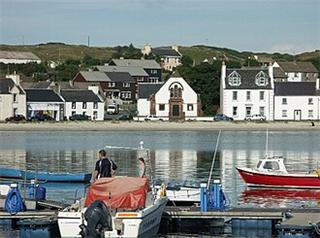
Dál Riata was less a unified state than a federation of kindreds, each ruled by its own leading family, under an over-king drawn from one of them. The Senchus fer nAlban names three main kindreds in Britain: Cenél nGabráin, centred in Kintyre; Cenél Loairn, in Lorn to the north; and Cenél nÓengusa on Islay, while Cenél Comgaill in Cowal appears in the annals as a further group. The kingship was most often held by Cenél nGabráin, the line of Áedán mac Gabráin, but from the late seventh century Cenél Loairn kings such as Ferchar Fota and his son Selbach challenged and sometimes held it. Kings ruled through the personal loyalty of their kin and clients, collecting tribute in food and service and calling out levies for war. Law and custom followed Irish models, and the kingdom’s Irish lands tied its rulers into the politics of the northern Irish over-kingships. Adomnán records the Convention of Druim Cett, at which Áedán mac Gabráin and the Uí Néill king Áed mac Ainmuirech met in the presence of Columba, around 575 or perhaps later; its terms are uncertain, but they appear to have settled the obligations of the Irish part of Dál Riata. Inauguration of kings probably took place at Dunadd, where the carved footprint may have played a part in the ceremony.
Global & Regional Impact
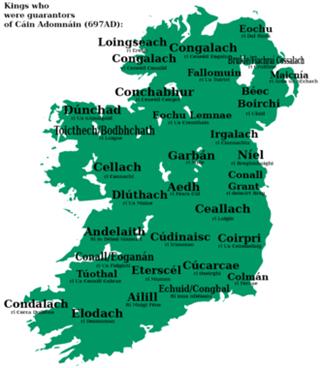
Dál Riata’s greatest legacy was the spread of Gaelic language and culture across what became Scotland. When its royal and noble families merged with the Pictish elite in the ninth century, it was Gaelic, not Pictish, that became the language of the new kingdom of Alba, and the name Scotland itself derives from Scoti, the Latin name for the Gaels. The community of Iona, founded under the kingdom’s protection, carried Christianity to the Picts and to the English: in 635 the Iona monk Aidan founded Lindisfarne at the invitation of King Oswald of Northumbria, who had spent his exile among the Gaels, and bishops trained in the Iona tradition led the Northumbrian church until the Synod of Whitby in 664. Iona’s abbot Adomnán wrote the Life of Columba around 700 and in 697 promulgated the Law of the Innocents, which sought to protect women, children and clergy in war. The Book of Kells, a masterpiece of insular manuscript art, was probably made at least in part on Iona around 800. Later kings of Scots traced their descent through the Cenél nGabráin line to Fergus Mór, and medieval tradition held that many early Scottish kings were buried on Iona. The Gaelic culture of the western Highlands and islands has its roots in the kingdom.
Decline & Fall

Dál Riata lost its Irish lands and then its independence. After the defeat at Mag Rath in 637 its kings appear to have lost much of their influence in Antrim, and the Irish part of the kingdom faded from the record, while the British part was weakened by rivalry between Cenél nGabráin and Cenél Loairn. In 736 the Pictish king Óengus son of Fergus invaded, captured Dunadd and seized two sons of Selbach, and in 741 the annals record the ‘smiting’ of Dál Riata by Óengus. For several decades the kingdom seems to have been under Pictish overlordship, although Áed Find, who fought the Picts in 768 and died in 778, restored a measure of independence. From 795 Viking raids struck the Hebrides, and Iona was attacked repeatedly; in 806 sixty-eight members of the community were killed, and a new monastery was built at Kells in Ireland. In the early ninth century kings of the Pictish line of Fergus, such as Constantín son of Fergus, appear to have ruled Dál Riata as well as Pictland. The final union came under Cináed mac Ailpín, Kenneth MacAlpin, who became king of the Picts around 842 and was later remembered as a king of Dál Riata, although his origins are debated. Around 849 relics of Columba were moved to Dunkeld, and by about 900 the merged kingdom was called Alba.
Dál Riata was the Gaelic sea-kingdom of Antrim and Argyll whose kings sheltered Columba’s monastery of Iona, centre of the conversion of the Picts and Northumbria, and whose merger with Pictland in the ninth century made Gaelic the language of the kingdom of Alba, the core of medieval Scotland.
References
- Bannerman, J. (1974) Studies in the History of Dalriada. Edinburgh: Scottish Academic Press.
- Campbell, E. (1999) Saints and Sea-Kings: The First Kingdom of the Scots. Edinburgh: Canongate.
- Lane, A. and Campbell, E. (2000) Dunadd: An Early Dalriadic Capital. Oxford: Oxbow Books.
- Fraser, J.E. (2009) From Caledonia to Pictland: Scotland to 795. Edinburgh: Edinburgh University Press.
- Woolf, A. (2007) From Pictland to Alba, 789–1070. Edinburgh: Edinburgh University Press.
- Adomnán of Iona (1995) Life of St Columba, trans. R. Sharpe. Harmondsworth: Penguin.
Connections
Open the full connections map →