Culture · Oceania
Aboriginal Australians
The story of Aboriginal Australians
The ancestors of Aboriginal Australians arrived in Australia more than 50,000 years ago.
Back then Australia was joined to New Guinea by land, but they still had to cross the sea.

Aboriginal Tasmanians Benjamin Duterrau (1768–1851), Public domain Over time they became hundreds of peoples, each with its own language and its own land, called Country.
They pass down stories of creation, called the Dreaming, through dance, songs, stories and art.
About 4,000 years ago their stone tools grew smaller, and new languages spread across the land.
Aboriginal peoples traded goods with each other across the whole continent.
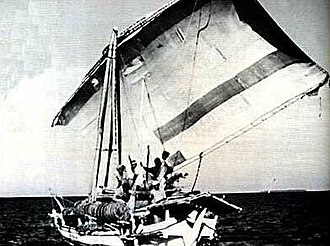
Makassan contact with Australia Unknown author, Public domain More than 350 years ago, fishers from Indonesia sailed to the north coast and brought dugout canoes.
From 1788 settlers from Britain took the land, and disease and fighting killed many Aboriginal people, who fought back.
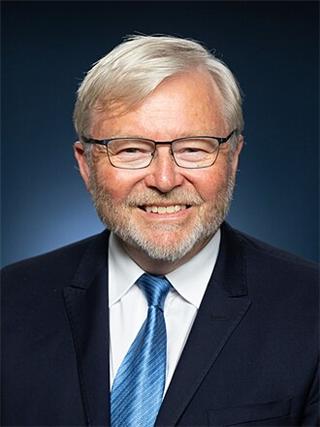
Kevin Rudd Department of Foreign Affairs and Trade, CC BY 4.0 Many Aboriginal children were taken from their families, and in 2008 Prime Minister Kevin Rudd said sorry for this.
Today Aboriginal people have won back many rights, and they own or share about half of Australia's land.
At a glance
- The ancestors of Aboriginal Australians reached Sahul, the land that joined Australia and New Guinea, 50,000 to 65,000 years ago, and may have settled across the continent within 6,000 years of landing.
- More than 400 distinct peoples, each with its own language and Country, pass down their beliefs through dance, stories, songlines and art, which together tell of creation in the Dreaming.
- From 1788 British colonisation brought disease, frontier war and dispossession: in the 150 years that followed, 90% of Indigenous Australians died, and between 1910 and 1970 between 10 and 33 percent of Aboriginal children were removed from their families.
Timeline
- 1788British colonisation begins at Port Jackson with the arrival of Governor Arthur Phillip and the First Fleet
- 1790Pemulwuy begins a guerrilla war against the settlers around Sydney, carried on by his son Tedbury until 1810
- 1939About 200 people leave Cummeragunja Station in protest at their treatment, in the Cummeragunja walk-off
- 1966The Wave Hill Walk-Off begins, a strike over working conditions that grows into a claim to the land
- 1967A referendum passed by a 90% majority gives Aboriginal affairs to the federal government and removes discriminatory census provisions from the Constitution
- 1976The Aboriginal Land Rights Act lets Aboriginal people in the Northern Territory claim land by traditional association
- 1992In the Mabo Case the High Court declares terra nullius invalid and recognises native title
- 2008Prime Minister Kevin Rudd makes a formal apology for the Stolen Generations
Origins
Aboriginal Australians are the Indigenous peoples of the Australian mainland and many of its islands, apart from the distinct Torres Strait Islanders. Archaeology shows that their ancestors arrived 50,000 to 65,000 years ago; some genomic studies place arrival as late as 43,000 years ago, while a 2025 study argues for about 60,000 years ago, by two routes. They came when Australia was part of Sahul, joined to New Guinea by land, but still had to cross the sea beyond the Wallace Line, perhaps island-hopping from Sulawesi or by way of Timor. A 2021 model suggests that the first people landed in the Kimberley about 60,000 years ago and had settled across the continent within 6,000 years.
Genetically they belong with Papuans and Melanesians to a deeply branching East Eurasian lineage. Aboriginal Australians and Papuans became distinct about 37,000 years ago, and both carry traces of Denisovan ancestry. Rising seas at the start of the Holocene, about 11,700 years ago, isolated the mainland and cut off Tasmania. About 4,000 years ago the dingo arrived, the Pama-Nyungan languages spread and stone tools grew smaller; some studies proposed gene flow from India, but a 2016 study found none and pointed to Indigenous origins for these changes.
Over time the people formed as many as 500 linguistic and territorial groups. Only in the last 200 years have they been defined by others, and come to identify themselves, as a single group.
Society
More than 400 distinct Aboriginal peoples have been identified, named after their ancestral languages, dialects or ways of speech, from the Yolngu of eastern Arnhem Land and the Arrernte of central Australia to the Noongar of southern Western Australia. Wider names are also used: Koori in New South Wales and Victoria, Murri in Queensland, Anangu in the central deserts, Palawa in Tasmania. Some identify as saltwater, freshwater, rainforest or desert peoples. Harry Lourandos describes three main cultural areas, Northern, Southern and Central; the first two, richer in marine and woodland resources, were more densely populated.
At the time of European colonisation they spoke more than 250 languages, used varying degrees of technology and lived in many kinds of settlement. Each language and its people are connected with a stretch of territory known as Country, with which they have a profound spiritual connection, and over the millennia law and religion developed alongside complex trade networks and relations between groups. Knowledge of pre-colonial societies still depends largely on outside observers, whose views were filtered through colonial ways of seeing.
Desert peoples such as the Pitjantjatjara have inherited adaptations to cold nights and to fever. Today remote communities on traditionally owned land, of 20 to 300 people, are often closed to outsiders for cultural reasons.
Beliefs & Worldview
Beliefs are particular to each mob, or people, and rest on a strong connection to the land. Traditional beliefs are passed down and shared through dance, stories, songlines and art, which together tell of creation in the Dreaming, or Dreamtime, and weave daily life and ancient creation into one understanding of the world. Core themes are shared across the continent, with details varying between language and cultural groups. In most regions a spirit creates the earth and tells humans to treat the animals and the land with respect; in the Northern Territory this spirit is often a huge snake or snakes that wove through earth and sky making the mountains and oceans, while elsewhere the creators are the wandjina, rain and water spirits.
Major ancestral spirits include the Rainbow Serpent, Baiame, Dirawong and Bunjil. The Arrernte of central Australia believed that humanity came from great superhuman ancestors who brought the sun, wind and rain as they broke through the surface of the earth on waking from their slumber. Traditional healers such as the ngangkari of the Western Desert are also custodians of important Dreaming stories, and many Dreamtime stories are still believed today.
Belief has also changed with colonisation and the religions that later migrants brought. In 2021, 41% of Indigenous people were affiliated with Christianity, 1% with a traditional Aboriginal religion, and 51% held secular or other spiritual beliefs or none.
Arts & Knowledge
Aboriginal art carries the oldest of traditions. Rock art, dated by modern techniques, shows that the culture has continued from ancient times, and painting, especially the dot painting of Papunya Tula, belongs with dance, stories and songlines among the ways in which traditional beliefs are passed on and shared.
Oral literature runs deep: in Arnhem Land the Yolngu have passed down complex narrative histories through hundreds of generations. Language is itself a heritage. More than 250 languages were spoken at the time of European contact, and perhaps five to sixteen in Tasmania, possibly in four families; their common ancestor may be as recent as 12,000 years old. Many languages also had sign systems, used with the hearing impaired, alongside speech, or in place of speech when it was forbidden for cultural reasons, and many of these are still in use.
Much of this heritage is under strain and in revival. In 2021, 167 Indigenous languages were spoken at home by 76,978 people, the largest being Kriol, Djambarrpuyngu, Pitjantjatjara, Warlpiri, Murrinh Patha and Tiwi, and a survey of 2018–19 found more than 120 language varieties in use or being revived, 70 of those in use endangered. Kriol, an English-based creole, is among the strongest and fastest-growing Aboriginal languages. In Tasmania, where the last speaker of a traditional language, Fanny Cochrane Smith, died in 1905, palawa kani is being built from surviving words.
Contact & Exchange
Long before Britain came, Aboriginal peoples traded across the continent, and from the mid-1660s Indonesian fishing vessels visited the north coast for trepang, bringing dugout canoes and metal harpoon heads. British colonisation began at Port Jackson in 1788 with the First Fleet. In April 1789 a disease, probably smallpox, struck the peoples around Port Jackson; smallpox alone killed more than half the Aboriginal population, and in the 150 years after 1788, 90% of Indigenous Australians died from introduced disease and violent conflict with the colonists.
Settlers claimed the land as their exclusive possession, their stock ate the grasses and trampled the waterholes, and many dispossessed people were driven by hunger onto stations, missions and towns. Aboriginal people fought back: Pemulwuy waged guerrilla war around Sydney from 1790, the Wiradjuri fought the Bathurst War, and in Van Diemen’s Land the Black War killed 600 to 900 Aboriginal people and more than 200 colonists and nearly annihilated the island’s Indigenous people. Broome estimates that 17–20,000 Aboriginal people and 1,700 settlers died in frontier conflict from 1788 to 1928; a University of Newcastle project has a preliminary count of 8,270 Aboriginal deaths in frontier massacres from 1788 to 1930, and the native police killed hundreds more.
Legacy
Protection laws, from Victoria’s board of 1869 and Queensland’s Act of 1897, put Aboriginal people’s work, wages, movement and marriages under officials’ control and let them take children: between 1910 and 1970 between 10 and 33 percent of Aboriginal children were removed from their families, perhaps more than 70,000. Aboriginal people organised, from the Australian Aboriginal Progressive Association of 1924 to the Cummeragunja walk-off of 1939 and the Pilbara strike of 1946.
The first federal election in which all Aboriginal Australians could vote came in 1963, and the 1967 referendum, passed by a 90% majority, removed discriminatory census provisions from the Constitution. The Yolngu Bark Petition of 1963 and the Wave Hill Walk-Off of 1966 began the land rights movement; the Aboriginal Land Rights Act followed in 1976, the Aboriginal Tent Embassy was set up in Canberra in 1972 to demand sovereignty, and in 1992 the Mabo Case declared terra nullius invalid and recognised native title, which the Native Title Act of 1993 put into statute. By 2021 Indigenous Australians held exclusive or shared title to about 54% of the land. After the 1997 Bringing Them Home report on the forced removal of children, Prime Minister Kevin Rudd made a formal apology for the Stolen Generations in 2008.
Inequality remains entrenched, and in October 2023 Australians voted against a constitutional Indigenous Voice to Parliament.
Aboriginal Australians are the Indigenous peoples of mainland Australia and many of its islands, whose ancestors arrived 50,000 to 65,000 years ago and formed hundreds of peoples bound to Country and the Dreaming. British colonisation from 1788 brought disease, frontier killings, dispossession and the removal of children; Aboriginal people resisted and survived, and since 1967 and the Mabo decision have won back rights and much of their land.
Test yourself
5 questions on this page, from its key events and facts.
The questions open here once the page has loaded.
References
- Australian Institute of Aboriginal, and Torres Strait Islander Studies. The Encyclopaedia of Aboriginal Australia: Aboriginal and Torres Strait Islander history, society and culture Ed. David Horton. (2 Vol. Aboriginal Studies Press, 1994).
- Reynolds, Henry. The other side of the frontier: Aboriginal resistance to the European invasion of Australia (UNSW Press, 2006).
- Lourandos, H. Continent of Hunter-Gatherers: New Perspectives in Australian Prehistory (1997)
- Gammage, Bill. The Biggest Estate on Earth: How Aborigines Made Australia (2011).
- Hannah, Mark; Macfarlane, Ingereth, eds. (December 2007). Transgressions: Critical Australian Indigenous histories. Aboriginal History Monographs 16. ANU Press.
- Stone, Sharman N., ed. Aborigines in white Australia: a documentary history of the attitudes affecting official policy and the Australian Aborigine, 1697–1973 (Heinemann Educational Publishers, 1974).