
Culture · Ancient Near East
Natufians
At a glance
- The Natufians lived by hunting and gathering, yet their settlements were larger and more permanent than any before them, some with round stone houses and the first known food stores.
- They cut wild cereals with stone sickles and made a bread-like food thousands of years before farming, and they may be the ancestors of the builders of the Levant’s first Neolithic settlements.
- Dorothy Garrod named the culture in 1929 after the Wadi Natuf; ancient DNA shows that later Levantines descend mainly from the Natufians.
Timeline
- c. 12,500 BCEA pita-like bread of wild cereal seeds and tubers is made, among the oldest known bread-like foods
- c. 12,400–12,000 BCEA woman of apparent importance is buried in a ceremonial pit in Hilazon Tachtit cave
- c. 12,000 BCEAt ʿAin Mallaha an elderly person is buried with a puppy
- c. 10,800 BCEThe Late Natufian begins, in step with the cold, dry Younger Dryas
- c. 9,500 BCEThe Natufian period ends at the very beginning of the Holocene
- 1928Dorothy Garrod excavates Shuqba Cave and finds a layer of microliths between Upper Palaeolithic and Bronze Age deposits
- 1929After finding similar material at el-Wad, Garrod names the Natufian culture after the Wadi Natuf
- 2018Residues of 13,000-year-old beer are reported from a cave near Haifa
Origins

The Natufian culture grew up in the Levant at the end of the last Ice Age, in the late Epipalaeolithic, in the same region as the earlier Kebaran culture. It is generally seen as the Kebaran’s successor, evolving out of elements within it, and other industries of the region, such as the Mushabian culture of the Negev and the Sinai Peninsula, may also have played a part. Ofer Bar-Yosef and Anna Belfer-Cohen argued that traits already developed by Kebaran and Geometric Kebaran groups in the Mediterranean park forest helped the new way of life to emerge. Bar-Yosef also saw influences from North Africa in certain stone-working techniques, but these were already present in the Nebekian industry of the eastern Levant, and many supposedly Natufian innovations had appeared earlier in the Epipalaeolithic.
Radiocarbon dating places the culture between the end of the Pleistocene and the very start of the Holocene, about 12,500–9,500 BCE. It is usually split into an Early Natufian (c. 12,000–10,800 BCE) and a Late Natufian (c. 10,800–9,500 BCE), the latter most likely in step with the cold spell known as the Younger Dryas. The Levant was then woodland, not the dry, barren and thorny landscape of today, and it offered more than a hundred kinds of edible cereals, fruits, nuts and other plants.
The English archaeologist Dorothy Garrod discovered the culture. Invited by the British School of Archaeology in Jerusalem, she excavated Shuqba Cave in the Judaean Mountains in 1928 and found a layer marked by microliths between Upper Palaeolithic and Bronze Age deposits. A year later, after finding similar material at el-Wad, she named it after the nearby Wadi Natuf. Over the next two decades Garrod, at el-Wad, Kebara and Tabun, and the French archaeologist René Neuville firmly placed the Natufian in the region’s prehistory.
Society
The Natufian culture was unusual in supporting a sedentary or semi-sedentary population before agriculture, and its settlements were larger and more permanent than earlier ones. Most known sites lie in Israel and the Palestinian territories, although this partly reflects how much more excavation has taken place there; others reach into Syria, Lebanon, Jordan, the Sinai Peninsula and the Negev. Around 90 sites have been excavated. Some had stone-built architecture, such as the round stone structures of Ain Mallaha, while others were caves, like el-Wad, where people lived on the terrace at the front. Natufian sites are the first to show evidence of food storage, although not every site had stores.
The Natufians lived by hunting and gathering. They collected wild cereals, legumes, almonds, acorns and pistachios, and hunted mountain and goitered gazelles above all, as well as deer, aurochs, wild boar, onagers and ibex in the steppe; in the Jordan Valley they also ate waterfowl and freshwater fish. One third of the animal remains linked to their meals came from lizards and snakes. Plant remains survive poorly in the soil, but flotation at Tell Abu Hureyra recovered large amounts.
Animal bones from Salibiya I were once read as evidence of communal hunting with nets, but the radiocarbon dates proved far too old for the site’s finds, a sign of contaminated samples. Ground-stone shaft straighteners show that people practised archery, and heavy stone mortars were used to grind food.
Beliefs & Worldview
No Natufian writing survives, so their beliefs are inferred from burials and art. Grave goods were typically made of shell, red-deer teeth, bone and stone, and the dead were given pendants, bracelets, necklaces, earrings and belt ornaments. At ʿAin Mallaha, about 12,000 BCE, an elderly person was buried with a puppy four to five months old, and in Hayonim Cave people were buried with two canids.
The most elaborate known grave was found in 2008 in Hilazon Tachtit cave in northern Israel. Dated to about 12,400–12,000 BCE, it held a woman who seems to have been important, laid in a ceremonial pit; media reports called her a “shaman” or “witch doctor”. The remains of at least three aurochs and 86 tortoises lay in the grave, thought to have been brought for a funeral feast, and her body was surrounded by tortoise shells, the pelvis of a leopard, the forearm of a boar, the wingtip of a golden eagle and the skull of a beech marten.
Art gives further hints. A clay figurine from Nahal Ein Gev II shows intertwined bodies, and has been read as showing that artists used such images to express spiritual beliefs and the bonds between humans and animals. A cemetery at the same site, about 12,000 years old, reveals advanced knowledge of making lime plaster, once thought to have been reached some 2,000 years later. The few human figurines of limestone, from el-Wad, Ain Mallaha and Ain Sakhri, are outnumbered by animals, which seem to have been the favourite subject of Natufian art.
Arts & Knowledge

Natufian stone-working centred on short blades and bladelets, made with the microburin technique and shaped into geometric microliths, lunates, trapezes and triangles, along with backed blades. A particular kind of edge-working, Helwan retouch, is typical of the Early Natufian. In the Late Natufian the Harif point, an arrowhead made from a regular blade, became common in the Negev, and some scholars use it to define a separate culture, the Harifian.
Sickle blades appear for the first time in the Natufian. Their characteristic gloss shows that they cut the silica-rich stems of cereals, indirect evidence for the beginnings of agriculture, and as early as 1931 Garrod and Neuville pointed to them as a possible sign of very early farming. A pita-like bread of wild cereal seeds and tubers related to papyrus, ground into flour, dates to about 12,500 BCE, and Shubayqa 1, a site in north-eastern Jordan 14,400 years old, has the oldest known evidence of bread-like food. In Raqefet Cave on Mount Carmel, residues of about 13,000 years ago point to possible beer-brewing, although they may come from spontaneous fermentation. Some evidence also suggests the deliberate cultivation of rye at Tell Abu Hureyra.
Bone was worked into harpoons, fish hooks, pendants and other ornaments, and ostrich-shell containers have been found in the Negev. The Ain Sakhri lovers, a carved stone found in a cave in the Judean desert and now held at the British Museum, is the oldest known depiction of a couple making love.
Contact & Exchange
Goods travelled far. At Ain Mallaha in northern Israel archaeologists have found obsidian from Anatolia and shellfish from the Nile valley; the source of its malachite beads is still unknown. Around 10,000 BCE Natufians carried parthenocarpic figs from Africa to the south-eastern corner of the Fertile Crescent, and they may have visited Cyprus, which would have meant crossing considerable stretches of open water.
Links with North Africa are much discussed. Natufians sometimes removed their upper front teeth, a custom also practised by the makers of the Iberomaurusian and Capsian cultures. Graeme Barker has noted similarities between the Natufian record and that of foragers on the North African coast at the same time. Christopher Ehret has proposed that intensive plant use first built up in North Africa, but such ideas are considered highly speculative, and the earliest known intensive plant use is at Ohalo II on the Sea of Galilee, 23,000 years ago.
Ancient DNA has been read in several ways. Lazaridis and colleagues (2016) modelled Natufian ancestry as about half “Basal Eurasian” and half from an unknown hunter-gatherer group related to the hunter-gatherers of western Europe, while Vallini and colleagues (2024) put the Basal Eurasian share at roughly 15%. Iosif Lazaridis later estimated 9.1% non-Eurasian ancestry in the Natufians, which he explained by partial descent from the Iberomaurusians of the Maghreb. Language is still less certain: Alexander Militarev and others link the Natufians to Proto-Afroasiatic, which they place in the Levant, while Ehret, Roger Blench and others place the Afroasiatic homeland in North or Northeast Africa, and Ehret would link the Natufians only with its Proto-Semitic branch.
Legacy
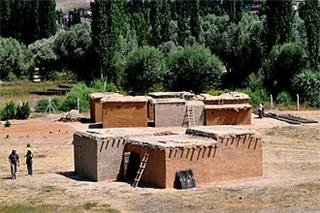
The Natufian ended about 9,500 BCE, at the very beginning of the Holocene. Natufian communities may be the ancestors of the builders of the region’s first Neolithic settlements, which may have been the earliest in the world. One theory holds that the Younger Dryas, a 1,000-year interruption of the warmer conditions that had followed the Last Glacial Maximum, brought sudden drought to the Levant and endangered the wild cereals on which a large settled population depended, so that people began to clear scrub and plant seeds obtained from elsewhere. This theory of the origin of agriculture is controversial among scientists.
Ancient DNA shows that later Levantines, from the Neolithic to the Bronze Age, descended mainly from the Natufians, with substantial later gene flow from Anatolia. A 2017 analysis placed Natufian samples close to modern Palestinians and Bedouins, studies of 2021 found that ancient Natufians cluster with modern Arabian groups such as Saudi Arabians and Yemenis, and a 2024 study found that Arabian populations carry a majority component that is highest in the Natufian hunter-gatherers. The Natufians also share a genetic component with the Iberomaurusian people of Taforalt in Morocco and with Neolithic North Africans, although the direction of gene flow between these groups is debated.
The culture changed how the region’s past is understood. Before the 1930s most archaeology in Palestine was biblical archaeology focused on historic periods, and little was known of its prehistory. Garrod’s excavations opened that prehistory up; el-Wad now lies within the Nahal Me’arot Nature Reserve.
In the Research Series
The Natufian culture flourished in the Levant from about 13,000 to 9,500 BCE, at the end of the last Ice Age. Its people hunted gazelles and gathered wild cereals, yet lived in larger, more permanent settlements than any before them, with the first known food stores. Sickle blades, early bread and possible beer show how much they relied on wild grains, and they may be the ancestors of the region’s first farmers.
References
- Bar-Yosef, O. (1998) The Natufian Culture in the Levant, Threshold to the Origins of Agriculture. Evolutionary Anthropology 6 (5): 159–177.
- Bar-Yosef, O. and Valla, F. R. (eds) (1992) The Natufian Culture in the Levant. Ann Arbor: International Monographs in Prehistory.
- Bar-Yosef, O. and Belfer-Cohen, A. (1999) Encoding information: unique Natufian objects from Hayonim Cave, Western Galilee, Israel. Antiquity 73 (280): 402–409.
- Dubreuil, L. (2004) Long-term trends in Natufian subsistence: a use-wear analysis of ground stone tools. Journal of Archaeological Science 31 (11): 1613–1629.
- Munro, N. D. (2004) Zooarchaeological measures of hunting pressure and occupation intensity in the Natufian: implications for agricultural origins. Current Anthropology 45: S5–S33.
- Simmons, A. H. (2007) The Neolithic Revolution in the Near East: Transforming the Human Landscape. University of Arizona Press.