People / group
Corded Ware culture
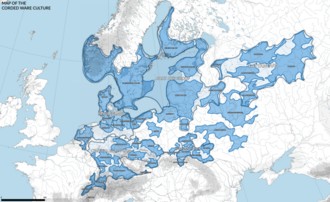
The Corded Ware culture was a broad archaeological horizon of Europe between c. 2900 and 2300 BCE, from the Late Neolithic to the early Bronze Age, reaching from the Rhine in the west to the Volga in the east. Friedrich Klopfleisch named it in 1883 after the cord-like impressions on its pottery; it is also called the Single Grave culture, after its burials under tumuli in a crouched position, and the Battle Axe culture, after the stone axe placed in men's graves. Genetic studies suggest that it arose from the westward migration of Yamnaya-related people from the steppe, and it is considered a likely vector for the spread of many Indo-European languages.
Mentioned in 2 profiles
See also






Cite this entry
- APA
- The Epoch Institute. (2026). Corded Ware culture. In The Epoch Institute Encyclopedia. https://the-epoch-institute.org/encyclopedia/corded-ware-culture
- MLA
- “Corded Ware culture.” The Epoch Institute Encyclopedia, The Epoch Institute, 2026, https://the-epoch-institute.org/encyclopedia/corded-ware-culture. Accessed .
- Chicago
- The Epoch Institute. “Corded Ware culture.” The Epoch Institute Encyclopedia. 2026. https://the-epoch-institute.org/encyclopedia/corded-ware-culture.
- Harvard
- The Epoch Institute (2026) ‘Corded Ware culture’, The Epoch Institute Encyclopedia. Available at: https://the-epoch-institute.org/encyclopedia/corded-ware-culture (Accessed: ).
Last reviewed October 2026Random entry ↻