Work / monument · text
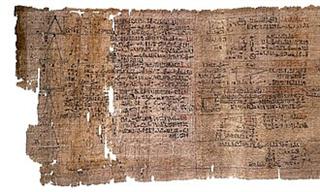
Rhind Mathematical Papyrus
The Rhind Mathematical Papyrus is the largest surviving mathematical text from ancient Egypt, copied by the scribe Ahmose in the 33rd year of the Hyksos king Apepi from an original of the Twelfth Dynasty. It contains over eighty worked problems on fractions, arithmetic, areas, volumes and the division of goods. Bought at Luxor in 1858 by the Scottish antiquarian Alexander Henry Rhind, it is now in the British Museum.
Mentioned in 2 profiles
Mentioned in 1 state history
See also


Cite this entry
- APA
- The Epoch Institute. (2026). Rhind Mathematical Papyrus. In The Epoch Institute Encyclopedia. https://the-epoch-institute.org/encyclopedia/rhind-mathematical-papyrus
- MLA
- “Rhind Mathematical Papyrus.” The Epoch Institute Encyclopedia, The Epoch Institute, 2026, https://the-epoch-institute.org/encyclopedia/rhind-mathematical-papyrus. Accessed .
- Chicago
- The Epoch Institute. “Rhind Mathematical Papyrus.” The Epoch Institute Encyclopedia. 2026. https://the-epoch-institute.org/encyclopedia/rhind-mathematical-papyrus.
- Harvard
- The Epoch Institute (2026) ‘Rhind Mathematical Papyrus’, The Epoch Institute Encyclopedia. Available at: https://the-epoch-institute.org/encyclopedia/rhind-mathematical-papyrus (Accessed: ).
Last reviewed October 2026Random entry ↻