
Sub-Saharan Africa
Mutapa Empire
At a glance
- The Mutapa Empire was a Shona state between the Zambezi and Limpopo, founded c. 1430 as Great Zimbabwe declined.
- Its gold, traded via Swahili merchants at ports such as Sofala, tied the African interior to the Indian Ocean economy.
- Succession disputes, Portuguese meddling and the rise of the Rozvi broke its power, though a remnant survived until 1917.
Rise & Fall
- c. 1430Nyatsimba Mutota traditionally founds the state on the northern Zimbabwe plateau
- 1561Jesuit Gonçalo da Silveira converts the Mwene Mutapa and is then killed at court
- 1571–1573A large Portuguese expedition under Francisco Barreto fails, largely through disease
- 1607Gatsi Rusere cedes mining rights to the Portuguese in return for military help
- 1629The Portuguese depose Kapararidze and install Mavura as a vassal ruler
- 1680s–1690sThe Rozvi under Changamire Dombo supplant Mutapa authority across the plateau
- 1917The Portuguese suppress the last reduced Mutapa kingdom in the Zambezi valley
Foundation

The Mutapa Empire, also known as the state of the Mwene Mutapa, emerged in the mid-fifteenth century in the region between the Zambezi and Limpopo rivers in present-day Zimbabwe and Mozambique. According to tradition, it was founded around 1430 by Nyatsimba Mutota, a prince associated with the declining Kingdom of Zimbabwe, centred on Great Zimbabwe, who moved northward in search of new sources of salt and fertile land. Mutota established authority over Shona-speaking communities in the northern plateau and laid the foundation for a centralised polity based on control of key resources. His successor, Matope, expanded the state considerably, extending its reach eastward towards the coast through conquest and alliances while developing a system of tribute from subordinate chiefs. The rise of Mutapa was facilitated by the decline of Great Zimbabwe, shifts in regional trade routes and growing demand for gold along the Indian Ocean coast, which allowed the new polity to position itself as the dominant inland power within lucrative commercial networks.
Socioeconomy
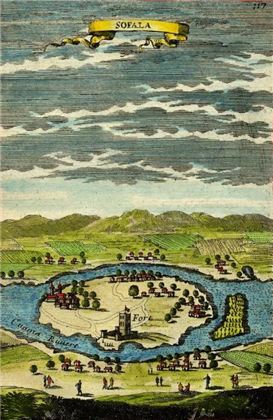
The socioeconomy of the Mutapa Empire was primarily agrarian, supported by mixed farming that combined the cultivation of sorghum and millet with cattle herding, cattle also serving as a key measure of wealth. Society was organised hierarchically, with the Mwene Mutapa (king) at the apex, followed by nobles, spirit mediums and commoners, reflecting both political authority and religious influence. The empire’s economic strength derived largely from gold, mined and panned by local communities and traded through intermediaries linking the interior to Swahili merchants on the Indian Ocean coast. Tribute formed a central component of the economy, with subordinate chiefs providing ivory, gold and agricultural produce to the court. Trade networks extended to coastal settlements such as Sofala and, later, to Portuguese-controlled inland markets, where Swahili and Arab merchants and subsequently Europeans exchanged cloth, glass beads and other imports for African commodities. This integration into long-distance trade commercialised certain sectors of the economy while traditional subsistence practices continued among most of the rural population.
Military

The military organisation of the Mutapa Empire was relatively decentralised but effective within its regional context, relying on the mobilisation of local forces under the authority of the king and subordinate chiefs. Armies consisted primarily of infantry armed with spears, bows and shields, reflecting indigenous warfare traditions rather than the gunpowder-based systems of contemporary Eurasian empires. Campaigns were often aimed at securing trade routes, resource-rich territories and tributary communities rather than territorial expansion in the conventional sense. Displays of military power reinforced the authority of the Mwene Mutapa, helping to secure the loyalty of vassal chiefs and deter rebellion. The arrival of the Portuguese in the sixteenth century began to shift regional military dynamics: a large Portuguese expedition under Francisco Barreto in 1571–1573 failed, largely through disease, but firearms and armed Portuguese adventurers gradually became a factor in local politics. The Mutapa state struggled to adapt to these changes, and its military system remained less centralised than those of its external rivals.
Governance & Law
Governance in the Mutapa Empire was centred on the sacred kingship of the Mwene Mutapa, whose authority combined political, economic and religious functions. The ruler was regarded as a semi-divine figure mediating between the spiritual and material worlds, a role that legitimised his control over land and resources. Administrative authority was exercised through a network of court officials and subordinate chiefs who governed local territories while acknowledging the supremacy of the central ruler. Tribute collection and redistribution formed the basis of political cohesion, reinforcing loyalty to and dependence on the court. Legal practice was rooted in customary law, adjudicated by local leaders and guided by ancestral tradition and spiritual belief. Spirit mediums (mhondoro), believed to speak for royal ancestors, played a crucial role by interpreting the will of the ancestors and influencing political decisions, including matters of succession. While this system allowed the integration of diverse communities, it also limited the development of a centralised bureaucracy, leaving governance dependent on personal authority and local alliances.
Global & Regional Impact
The Mutapa Empire played a significant role in shaping the economic and cultural landscape of south-eastern Africa as a key intermediary in regional and transoceanic trade. Its control over gold resources made it an important supplier to the Indian Ocean trade system, linking the African interior with coastal and international markets. Contact with Swahili merchants, some of whom resided at the royal court, brought foreign goods and ideas into local society, although Islam made little headway among the Shona. The arrival of the Portuguese in the early sixteenth century marked a new phase of external engagement, as European traders sought direct access to gold and attempted to exert political influence over the Mutapa state; in 1561 the Jesuit missionary Gonçalo da Silveira briefly converted the reigning Mwene Mutapa before being killed at court. These interactions shifted regional power dynamics and drew south-eastern Africa into the emerging global economy. The legacy of Mutapa endures in Shona political traditions and in the enduring importance of trade to regional identities.
Decline & Fall

The decline of the Mutapa Empire began in the late sixteenth and seventeenth centuries as a result of internal fragmentation and external pressure. Succession disputes weakened central authority, producing rival claimants and breaking political unity. Portuguese involvement further destabilised the state: in 1607 Mwene Mutapa Gatsi Rusere ceded mining rights in return for Portuguese military help, and in 1629 the Portuguese deposed Kapararidze and installed Mavura as a vassal ruler. The spread of prazos, Portuguese crown land grants in the Zambezi valley, undermined traditional authority and fostered the rise of autonomous warlords. The shifting of trade routes and the exhaustion of easily accessible gold deposits further eroded the empire’s economic base. In the 1680s and 1690s the Rozvi state under Changamire Dombo supplanted Mutapa authority across much of the plateau and drove the Portuguese from their inland trading posts. A much reduced Mutapa kingdom survived in the Zambezi valley until the Portuguese suppressed it in 1917, but it had long ceased to be a dominant regional power.
The Mutapa Empire represents a significant example of an African inland trading state whose integration into regional and global economic networks shaped both its rise and its eventual transformation.
References
- Beach, D.N. (1980) The Shona and Zimbabwe, 900–1850: An Outline of Shona History. London: Heinemann.
- Bhila, H.H.K. (1982) Trade and Politics in a Shona Kingdom: The Manyika and Their Portuguese and African Neighbours, 1575–1902. London: Longman.
- Connah, G. (2001) African Civilizations: An Archaeological Perspective. 2nd edn. Cambridge: Cambridge University Press.
- Mudenge, S.I.G. (1988) A Political History of Munhumutapa c. 1400–1902. Harare: Zimbabwe Publishing House.
- Newitt, M. (1995) A History of Mozambique. London: C. Hurst.
- Pikirayi, I. (2001) The Zimbabwe Culture: Origins and Decline of Southern Zambezian States. Walnut Creek: AltaMira Press.
Connections
Open the full connections map →