Event
Herero and Nama genocide
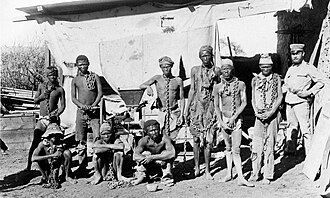
The Herero and Nama genocide was the extermination of the Herero and Nama peoples in German South West Africa (now Namibia) by the German Empire between 1904 and 1908. After the Herero chief Samuel Maharero launched an uprising on 12 January 1904, German forces under Lothar von Trotha routed the Herero at the Battle of Waterberg and drove them into the Omaheke Desert, where a majority died of thirst and starvation; on 2 October Trotha issued an extermination order. The surviving Herero were held in concentration camps, where around half of those captured died, as did most Nama who surrendered. Around 40,000 to 80,000 Herero and 10,000 Nama died. Germany acknowledged the genocide in 2015.
Mentioned in 1 profile
See also





Cite this entry
- APA
- The Epoch Institute. (2026). Herero and Nama genocide. In The Epoch Institute Encyclopedia. https://the-epoch-institute.org/encyclopedia/herero-and-nama-genocide
- MLA
- “Herero and Nama genocide.” The Epoch Institute Encyclopedia, The Epoch Institute, 2026, https://the-epoch-institute.org/encyclopedia/herero-and-nama-genocide. Accessed .
- Chicago
- The Epoch Institute. “Herero and Nama genocide.” The Epoch Institute Encyclopedia. 2026. https://the-epoch-institute.org/encyclopedia/herero-and-nama-genocide.
- Harvard
- The Epoch Institute (2026) ‘Herero and Nama genocide’, The Epoch Institute Encyclopedia. Available at: https://the-epoch-institute.org/encyclopedia/herero-and-nama-genocide (Accessed: ).
Last reviewed October 2026Random entry ↻