Work / monument · artifact
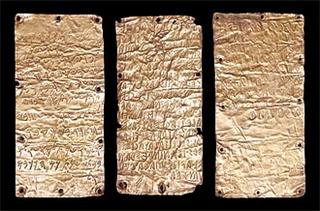
Pyrgi Tablets
The Pyrgi Tablets are three gold plates of about 500 BCE, two inscribed in Etruscan and one in Phoenician, found in 1964 at ancient Pyrgi, on the Tyrrhenian coast of Lazio. They record the dedication of a temple by Thefarie Velianas, ruler of nearby Caere, to the goddess called Astarte in the Phoenician text and Uni in the Etruscan. Though not a word-for-word translation, the bilingual text helps scholars interpret Etruscan and shows Phoenician or Punic influence in the western Mediterranean. They are in the National Etruscan Museum, Villa Giulia, Rome.
Mentioned in 2 profiles
See also



Cite this entry
- APA
- The Epoch Institute. (2026). Pyrgi Tablets. In The Epoch Institute Encyclopedia. https://the-epoch-institute.org/encyclopedia/pyrgi-tablets
- MLA
- “Pyrgi Tablets.” The Epoch Institute Encyclopedia, The Epoch Institute, 2026, https://the-epoch-institute.org/encyclopedia/pyrgi-tablets. Accessed .
- Chicago
- The Epoch Institute. “Pyrgi Tablets.” The Epoch Institute Encyclopedia. 2026. https://the-epoch-institute.org/encyclopedia/pyrgi-tablets.
- Harvard
- The Epoch Institute (2026) ‘Pyrgi Tablets’, The Epoch Institute Encyclopedia. Available at: https://the-epoch-institute.org/encyclopedia/pyrgi-tablets (Accessed: ).
Last reviewed October 2026Random entry ↻