Social ladder · 1929–1941 (from collectivization to the German invasion)
Social Hierarchy of Stalin's Soviet Union
From Party Elite to Gulag
Soviet law and ideology described society by class. The party counted the working class as its social base, and in Marxist–Leninist theory the better-off peasants, the kulaks, were class enemies of the poor. Under Stalin these categories became a ladder of rights. At the top a party elite, the nomenklatura, held every key post by the party’s approval. From 1932 townspeople were given internal passports and residence permits, which peasants could obtain only by special application, and collectivization bound the peasants to farms they had no right to leave. Below them stood those the state excluded: the disenfranchised (lishentsy), until 1936; the peasants deported as kulaks; and the prisoners of the Gulag, whose camps and colonies held more than a million people by the late 1930s. In the famine of 1932–1933 some six to seven million people starved to death.
Period 1929–1941 (from collectivization to the German invasion)People c. 150–180 million (est.)Ranks 7Profile Soviet Union
The ladder
By rank, the ladder is drawn as a pyramid. To scale, each bar is as wide as that rank’s share of the people. Shares marked est. are estimates where no count survives; their boxes and bars are dashed.

Ruler · One ruler
The general secretary
-
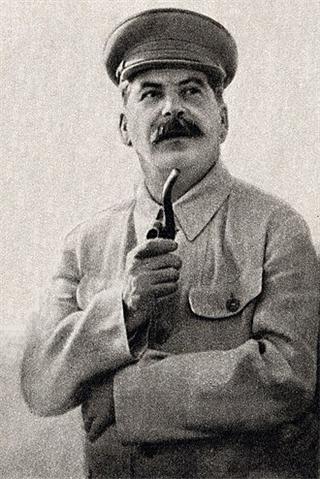
Joseph Stalin led the Communist Party and ruled the Soviet Union; his orders sent millions of people to prison camps.
Joseph Stalin, the first general secretary of the Communist Party, ruled through the Politburo and the party apparatus he had built. His close attention to the party’s appointments earned him the nickname “Comrade File Cabinet”, and he placed his clients throughout the party’s bureaucracy; after Lenin’s death in 1924 he took control of the government. The great measures of the period bore his mark: the system of camps (June 1929), the order to “eliminate the kulaks as a class” (1929–1930), the Law of Spikelets, which he drafted, in August 1932, and the internal passport decree of December 1932. Under the tsars he had himself been sent into exile four times, and escaped three times.
Moving in or out. Stalin reached the top through the party’s apparatus, by controlling its appointments. In 1922 Lenin allied with Leon Trotsky against the party’s growing bureaucracy and Stalin’s influence, but after Lenin’s death Stalin took control.
How many? One man, Joseph Stalin, with the Politburo of the party.
Nobility and officials · c. 0.3–1% (est.)
Nomenklatura
osnovnoi spisok (basic list), uchyotny spisok (registration list)
Party officials ran the factories, farms, schools and offices, and the Communist Party chose every one of them.
The nomenklatura were the people who held, or were listed as fit to hold, the key posts in government, industry, agriculture and education, posts filled only with the party’s approval. Every party committee, from the all-union level in Moscow down to the districts and towns, kept two lists: a basic list (osnovnoi spisok) of the posts it filled and a registration list (uchyotny spisok) of people suitable for them; the Politburo filled the ministerial and ambassadorial posts. Lenin had named the criteria: reliability, political attitude, qualifications and administrative ability. Virtually all were party members. The Yugoslav politician Milovan Đilas, a critic of Stalin, called them a “new class”, seen by ordinary citizens as a privileged bureaucratic elite that had replaced the old capitalist one.
Moving in or out. No one was born into it: a party member entered by being placed on a committee’s list and appointed to a post. Richard Pipes argued that the system continued the tsarist regime, as many former tsarist officials and careerists joined the Bolshevik government.
How many? Estimate: the holders of the posts on the party committees’ basic lists, from the Politburo’s ministers and ambassadors down to the districts and towns, with their families; the articles give no count for the 1930s.
Free commoners · c. 20–30% (est.)
Workers and townspeople
propiska, postoyannaya propiska, vremennaya propiska
Workers in the towns carried passports that said where they were allowed to live.
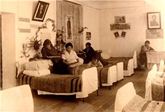
The party counted the working class as its social base, and millions moved through the country to train, take new jobs or escape repression as supposed kulaks. In December 1932 a decree of the Central Executive Committee and Sovnarkom brought back the internal passport, required mainly in the largest cities and the border zones. Into it the police wrote a residence permit, the propiska; a permanent propiska confirmed its holder’s right to a dwelling. Passports and “labour books” recording work discipline were meant to restore order and, above all, keep peasants fleeing the famine out of the towns. In 1940 alone 1.8 million workers were sentenced to six months of forced labour at a quarter of their pay, and 60,000 were imprisoned for absence from work.
Moving in or out. A peasant could settle in a town only with a passport, which peasants could obtain only by special application; the towns’ growth stopped once the restrictions began.
How many? Estimate: peasants had been 80 per cent of the people when the Bolsheviks took power; the towns grew as millions moved for training and new jobs, until the passport restrictions of 1932 stopped their growth (R. W. Davies and Stephen Wheatcroft).
Picture: The women's dormitory of the builders of the Ural aluminium plant, 1935 · Unknown author · Public domain · Wikimedia Commons
Serfs and dependants · About 71% (the rest, est.)
Kolkhozniki (Collective farmers)
kolkhoznik, kolkhoznitsa, kolkhoz, brigadir
Farmers had to join big collective farms run by the state, and they were not free to leave them.
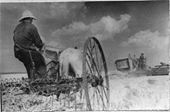
Collectivization made the peasants members of collective farms (kolkhozy). The Standard Charter, law from the early 1930s, called the kolkhoz a cooperative of peasants who “voluntarily unite” and manage it democratically. In practice membership was forced, members had no right to leave and could take nothing with them if they did, and the farm’s assembly rubber-stamped the plans of district and provincial officials. Members worked in brigades and were paid a share of the harvest by labour days, often with no cash; the state bought the grain at low fixed prices that hardly changed between 1929 and 1953. Private plots of about an acre, 3.9 per cent of the sown land in 1938, gave 21.5 per cent of farm output in 1937.
Moving in or out. Members had no right of free exit, and the passport that a move to town required was given to peasants only on special application; a capable member could become a brigade leader (brigadir), usually a local man.
How many? Everyone else: the peasants, four in five of the people when the Bolsheviks took power, who by the late 1930s worked mostly in collective farms, and the salaried workers of the state farms. The other shares are estimates, so this one is too.
Picture: A collective farmer raking straw with a horse rake, 1939 · Unknown author · Public domain · Wikimedia Commons
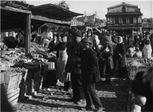
Outcast groups · c. 1–3% (est.)
Lishentsy (The disenfranchised)
lishenets
People the government called its enemies, such as priests and private traders, lost the right to vote, to study and to join a farm.
The constitutions of 1918 and 1924 deprived whole categories of people of the right to vote or to be elected: those who hired labour for profit or lived on unearned income, private merchants and brokers, monks and clergy of all denominations, and the policemen and military officers of the old regime. The Bolsheviks used disenfranchisement as repression against those they classed as “enemies of the working people”, and decrees added new categories. A lishenets (plural lishentsy) lost far more than the vote: he could hold no government post, receive no higher or technical education, join no collective farm or other cooperative, and was denied the help others had for jobs, housing and pensions. The Constitution of 1936 brought universal suffrage and abolished the category.
Moving in or out. Local election commissions could restore a lishenets’s rights on proof of productive labour and loyalty to the Soviets; the Central Election Commission and the Presidium of the Central Executive Committee had the final word.
How many? Estimate: the categories the constitutions of 1918 and 1924 named, among them employers of hired labour, private traders, clergy and the old regime’s police and officers, and those added by later decrees; the articles give no count.
Picture: Vendors at the Apraksin Dvor market, Leningrad, 1924 · Unknown author · Public domain · Wikimedia Commons
Outcast groups · c. 0.5–1% (est.)
Spetspereselentsy (Deported peasants)
kulak, podkulachnik, raskulachivanie (dekulakization)
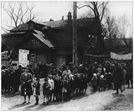
The government called better-off farmers its enemies, took their farms and sent many far away to cold, hungry settlements.
In Marxist–Leninist theory the kulaks, the better-off peasants, were class enemies of the poor. A decree of May 1929 defined a kulak household by hired labour, machinery, renting out equipment or trade; in Robert Conquest’s words, peasants with “a couple of cows or five or six acres more than their neighbors” were labelled kulaks. On 30 January 1930 the Politburo approved the dissolving of the kulaks as a class, sending them to the camps, to distant regions such as the north Urals and Kazakhstan, or elsewhere in their home provinces. In 1930 and 1931 alone 1,803,392 people were sent to labour colonies and camps. The deported and their families, “special settlers” as the government called them, lived on starvation rations, and many tried to escape.
Moving in or out. The OGPU told the deported that they would regain their rights in five years. Former kulaks and their families went on to make up the majority of the victims of the Great Purge of the late 1930s, with 669,929 people arrested and 376,202 executed.
How many? Estimate: 1,317,022 of the people deported as kulaks in 1930–1931 reached their destinations, 389,521 died in the colonies in 1932–1940, and deportations went on on a smaller scale; perhaps 1 to 1.5 million at mid-decade, of an estimated 150–180 million.
Picture: Dekulakization: a parade under the banner "We will liquidate the kulaks as a class", 1929–1934 · Unknown author · GFDL · Wikimedia Commons


Outcast groups · c. 0.7–1% (est.)
Prisoners of the Gulag
lagerya (the camps), zona (the zone)
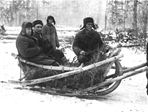
Millions of people were sent to the Gulag, prison camps in cold, faraway places, where they were forced to work very hard.
The Gulag, the Main Directorate of Correctional Labour Camps, was set up under the OGPU in 1930 and run by the NKVD from 1934. Its camps held ordinary criminals and political prisoners, many sentenced without trial by NKVD troikas; petty crimes and jokes about the government could bring a term, and Article 58 punished “counterrevolutionary activities”. Most camps lay in remote north-eastern Siberia, the far north and the steppes of Kazakhstan, where prisoners felled timber, mined, and built canals and railways. Naftaly Frenkel’s “nourishment scale”, which tied food to output, often killed weaker prisoners within weeks. From 1934 to 1940 deaths in the camps ran four to six times the Soviet average, and under NKVD Order No. 00447 tens of thousands of inmates were executed in 1937–1938.
Moving in or out. Between 1934 and 1953, 20 to 40 per cent of the prisoners were released each year, and good workers could earn early release; Naftaly Frenkel himself went from inmate to camp commander. On release many political prisoners were barred from the big cities and sent into exile in remote regions.
How many? Estimate: the camps and colonies held 1,196,369 people at the end of 1936 by the archival count and upwards of 1.6 million in 1939 (V. P. Kozlov), of an estimated 150–180 million.
Picture: Gulag prisoners at work, 1936–1937 · Unknown author · Public domain · Wikimedia Commons

Born into history
Where would you have stood? Chance places you on the ladder, as birth placed most people: weighted by how many each rank held.
Moving up and down
The state decided who stood where. The top was open only through the party: a member placed on a committee’s list could be appointed to a post, and, as Richard Pipes noted, many former tsarist officials and careerists had joined the Bolshevik government. Labels could fall on anyone. Officials applied the definition of a kulak arbitrarily and settled personal rivalries with it; in 1932 and 1933 it was stretched to anyone who resisted the grain procurements, and the term came to be used for anyone who opposed or even seemed dissatisfied with the government. The party activists who helped the secret police with the arrests and deportations were, in Vasily Grossman’s words, “all people who knew one another well, and knew their victims”. Between 1934 and 1941 the number of prisoners with higher education rose more than eightfold. A few ways led back: local commissions could restore a lishenets’s rights, and the 1936 Constitution ended the category; the Gulag released 20 to 40 per cent of its prisoners each year, though many were kept out of the big cities afterwards. The passport system kept most peasants in the countryside.
Women on the ladder
Women belonged to every rank, and the regime’s categories reached them through their families. On the collective farms a woman member was a kolkhoznitsa; in one farm the minimum was 130 labour days a year for every able-bodied adult and 50 for boys aged 12 to 16, and a few women became brigade leaders. The repression struck families: the deported kulaks were sent away with their relatives, and the family members of those condemned as “traitors of the Motherland” were placed under a special category of repression (ChSIR). The camps had separate zones for mothers with babies (mamki) and for juveniles. Women were among the prisoners: Yevgenia Ginzburg recalled that the inmates could tell when Nikolai Yezhov no longer headed the NKVD, because one day conditions eased. The propiska too followed family ties: spouses could always give one another a permanent propiska, and children received theirs at a parent’s address.
Compare with another society
Test yourself
4 questions on the ladder of the Soviet Union under Stalin.
The questions open here once the page has loaded.
Sources and further reading
- Applebaum, A. (2003) Gulag: A History. New York: Broadway Books.
- Conquest, R. (1987) The Harvest of Sorrow: Soviet Collectivization and the Terror-Famine.
- Figes, O. (2007) The Whisperers: Private Life in Stalin's Russia. London: Allen Lane.
- Getty, J. A. and Naumov, O. V. (1999) The Road to Terror: Stalin and the Self-Destruction of the Bolsheviks, 1932–1939. New Haven: Yale University Press.
- Gregory, P. R. and Lazarev, V. (eds) (2003) The Economics of Forced Labor: The Soviet Gulag. Stanford: Hoover Institution Press.
- Khlevniuk, O. V. (2004) The History of the Gulag: From Collectivization to the Great Terror. New Haven: Yale University Press.
- Lewin, M. (1966) "Who was the Soviet kulak?", Europe-Asia Studies 18(2): 189–212.
- Voslensky, M. (1984) Nomenklatura: The Soviet Ruling Class. Garden City, NY: Doubleday.
The shares are of the whole population, children included. Where a scholar has counted or estimated a rank, its share follows that work, named on the rank; where no count survives, the share is an estimate, marked est. and drawn dashed, made from what the rank was and did, from related figures and from the same rank in comparable societies, and its note says what it rests on. Population: Estimate: the articles used give no total for the 1930s (the 1937 census is named without its count); the range is kept wide for that reason.
Cite this page
- APA
- The Epoch Institute. (2026). Social Hierarchy of the Soviet Union under Stalin. In Social Ladders. https://the-epoch-institute.org/societies/soviet-union
- MLA
- “Social Hierarchy of the Soviet Union under Stalin.” Social Ladders, The Epoch Institute, 2026, https://the-epoch-institute.org/societies/soviet-union. Accessed .
- Chicago
- The Epoch Institute. “Social Hierarchy of the Soviet Union under Stalin.” Social Ladders. 2026. https://the-epoch-institute.org/societies/soviet-union.
- Harvard
- The Epoch Institute (2026) ‘Social Hierarchy of the Soviet Union under Stalin’, Social Ladders. Available at: https://the-epoch-institute.org/societies/soviet-union (Accessed: ).