Social ladder · 1801–1861 (from the accession of Alexander I to the emancipation of the serfs)
Social Hierarchy of the Russian Empire
From Emperor to Serf

Imperial Russia sorted its people by law into estates (sosloviya), and the Code of Laws of 1832 named four: the nobility, the clergy, the town-dwellers and the rural people. The first two paid no poll tax and gave no recruits to the army; the townspeople and the peasants paid the tax and filled the ranks. Above them all stood the emperor, an autocrat. State service could lift a man: Peter the Great’s Table of Ranks of 1722 made officers and officials noble once they reached a set grade. The deepest divide ran through the peasantry, more than four people in five. In the official count of 1857–1859 some 23 million were serfs on private estates, bound to the land and to their lords’ will, while about as many state peasants were personally free but tied to their communes. Serfdom ended only in 1861.
Period 1801–1861 (from the accession of Alexander I to the emancipation of the serfs)People 61–62.5 millionRanks 10Profile Russian Empire
The ladder
By rank, the ladder is drawn as a pyramid. To scale, each bar is as wide as that rank’s share of the people. Shares marked est. are estimates where no count survives; their boxes and bars are dashed.
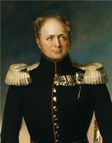
Ruler · One ruler
Imperator (The emperor)
tsar, samoderzhets
The emperor, or tsar, ruled Russia alone, with no parliament to share his power.
The emperor was an autocrat: no assembly shared his power, and titles, ranks and privileges were his to grant. Three emperors ruled in these decades: Alexander I (1801–1825), who drove Napoleon’s army out of Russia in 1812; his brother Nicholas I (1825–1855), who began his reign by crushing the Decembrist revolt of noble officers; and Nicholas’s son Alexander II (1855–1881), who freed the serfs. The emperor governed through ministers, the State Council and a bureaucracy graded by the Table of Ranks, and through the Holy Synod, overseen by his lay procurator, he directed the Orthodox Church. Emperors lived in Saint Petersburg but were crowned in the Dormition Cathedral of the Moscow Kremlin. Even an autocrat moved carefully: fearing unrest and the landlords’ resistance, Alexander I and Nicholas I studied emancipation in secret committees, and in a speech of 30 March 1856 Alexander II said: “It is better to abolish serfdom from above, than to wait for that time when it starts to abolish itself from below.”
Moving in or out. The throne passed to the emperor’s eldest son or, failing sons, to a brother: Alexander I left no son and was succeeded by his younger brother Nicholas I, after their brother Constantine had given up his claim.
How many? One man, with the imperial family.

Nobility and officials · c. 1–1.5% (est.)
Dvoryanstvo (Nobles)
potomstvennye dvoryane, lichnye dvoryane
Many nobles owned large country estates and the serfs who farmed them.
The nobility (dvoryanstvo) was the first estate. It included old princely families, Baltic German barons and, after the partitions of Poland, a mass of Polish gentry, 62.8 per cent of the empire’s nobles in 1858. Nobility was hereditary or personal: Peter the Great’s Table of Ranks granted personal nobility in its lower grades and hereditary nobility higher up, until 1845 at the eighth civil grade. Since 1762 nobles had been free of compulsory service, and the Charter to the Gentry of 1785 confirmed their privileges: freedom from the poll tax and corporal punishment, full rights over their estates and serfs, and assemblies of the nobility in every province. Most still served for some years as officers or officials. Wealth was very unequal: in 1858 some 1,400 great landowners held three million serfs, while 79,000 small ones held two million between them, and by 1859 two-thirds of all serfs were mortgaged to banks or the state. In 1825 noble officers, the Decembrists, rose for a constitution and were crushed.
Moving in or out. Nobility came by birth, by imperial grant, or by rising through the Table of Ranks: Mikhail Speransky, a village priest’s son, rose through the civil service to become Alexander I’s leading adviser and was made a count in 1839.
How many? Estimate: the hereditary and personal nobles of the empire, including the Polish gentry of the western provinces (62.8 per cent of its nobles in 1858), perhaps 600,000–900,000 people.

Religious and learned · c. 0.8–1.2% (est.)
Dukhovenstvo (Orthodox clergy)
beloe dukhovenstvo (white clergy), chernoe dukhovenstvo (black clergy)
Orthodox parish priests could marry, and their sons were expected to become priests too.
The Orthodox clergy was the second estate free of the poll tax and of the recruit levy, but it was divided. The black (monastic) clergy lived in monasteries under vows of celibacy, and all bishops were drawn from them. The white clergy were the parish priests and deacons, who were expected to marry and could do so only before ordination. In practice they formed a hereditary class, whose sons trained in the seminaries and were expected to become priests. Most parish priests were poor and closer to the peasants than to the bishops. Since Peter the Great the church had been governed by the Holy Synod, under a lay procurator who answered to the emperor; in 1764 Catherine II took most of its lands and closed 569 of its 954 monasteries, and from 1797 bishops, not parishioners, chose parish priests. Philaret Drozdov, a cleric’s son who became a monk in 1808, headed the see of Moscow from 1821 to 1867 and was the church’s leading figure.
Moving in or out. Priests’ sons usually followed their fathers, but the seminaries also fed the civil service: Mikhail Speransky, a village priest’s son, taught at the seminary in Saint Petersburg before entering state service and rising to the top.
How many? Estimate: the Orthodox clergy with their wives and children, who belonged to the estate: parish priests married.
Picture: A deacon, painting by Andrei Ryabushkin, 1888 · Andrei Petrovich Ryabushkin · Public domain · Wikimedia Commons
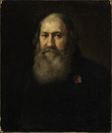
Soldiers, merchants and craftsmen · c. 0.3–0.6% (est.)
Kupechestvo (Merchants)
kuptsy
Merchants were traders who paid to join a merchant guild, which gave them the right to trade.
The merchants (kupechestvo) were enrolled in three guilds according to the capital they declared, under Catherine II’s rules of 1775, each guild with its own trading rights. Membership was paid for and not simply inherited: a merchant registered with the state for a fee, his relatives could trade on his behalf, but his grown sons had to qualify on their own, so a family that could no longer meet the requirements fell back among the townspeople. Rich merchants founded factories, and the law let them buy serfs to work in them from 1721 to 1762 and again from 1798 to 1816; in 1825 about half of all factory workers were serfs. From 1832 the most distinguished could become honorary citizens, ranking between the merchants and the nobles, free of the poll tax, the recruit levy and corporal punishment. Yet the merchants had little political weight and were looked down on by the nobility, though only the nobles were more literate.
Moving in or out. Anyone who could declare enough capital and pay the fees could enrol in a guild, and some merchants began as townspeople or even serfs: Savva Morozov, a serf, bought freedom for himself and his sons in 1820, and the family went on to found the Morozov textile companies.
How many? Estimate: the merchants of the three guilds with their families; as late as 1851 only 8 per cent of Russians lived in towns.
Picture: Portrait of a Merchant, by Dmitry Antonelli, 1829 · Dmitry Antonelli · Public domain · Wikimedia Commons
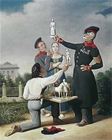
Free commoners · c. 4–7% (est.)
Meshchane (Townspeople)
tsekhovye
Townspeople ran small shops and workshops in Russia’s towns and paid taxes to the government.
The meshchane were the lower urban estate, ranked above the peasants and below the merchant guilds: small traders, artisans, shopkeepers and urban workers who were registered in a town but could not meet the merchants’ requirements. Craftsmen could also enrol in craft guilds (tsekhi). The status was hereditary, but a man who owned some property in a town, worked there at a trade, a craft or a service and paid the taxes could enrol himself, and the townspeople’s own board (meshchanskaya uprava) could expel members. Like the peasants, the meshchane paid the poll tax and gave recruits to the army, and they were not spared corporal punishment. Towns were few and small: as late as 1851 only 8 per cent of Russians lived in them, and some of those who did were registered as “urban peasants” rather than townspeople. Unlike Western Europe’s, Russia’s towns had produced no strong middle class.
Moving in or out. A townsman who gathered enough capital could enrol as a merchant, and peasants allowed to settle in a town could join the meshchane if they owned property and worked there.
How many? Estimate: the meshchane and guild craftsmen of the towns; as late as 1851 only 8 per cent of Russians lived in towns, and some town-dwellers were registered as peasants.
Picture: A street seller of plaster figurines, drawn by Karl Hampeln (1794–1880) · Karl Hampeln · Public domain · Wikimedia Commons

Soldiers, merchants and craftsmen · c. 2–4% (est.)
Kazaki (Cossacks)
kazachye voisko
Cossacks were horsemen of the frontier who were given land in return for serving in the army.
The Cossacks, once free frontier communities of runaway serfs, adventurers and steppe warriors, had become a hereditary military estate of the empire by the end of the 18th century. They lived in hosts, the Don, the Black Sea, the Ural, the Terek and others, settled in villages (stanitsas) along the southern and eastern frontiers, and kept a degree of self-government. Every Cossack family held land free of taxes, and in return its men owed military service for many years, bringing their own horses and equipment; they were spared the ordinary recruit levy. Cossack regiments scouted, raided and patrolled the frontiers for the army: in 1812 Matvei Platov, ataman of the Don Host, led his Cossacks against Napoleon’s retreating army. The elite of the hosts was admitted to the nobility, and some rich Cossacks owned serfs. Many Cossacks of the Ural and the Terek were Old Believers. The government remembered the risings of Stenka Razin and Yemelyan Pugachev and kept the hosts loyal with land and privileges.
Moving in or out. Cossack status passed from father to son, and the officers of the hosts could be admitted to the nobility.
How many? Estimate: the Don Host alone, the largest of ten, had 425,000 male members in 1884, and the Cossacks numbered 4.5 million at the start of the 20th century, about 3 per cent of the empire’s people.
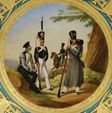
Soldiers, merchants and craftsmen · 1.5–2%
Soldaty (Soldiers)
rekruty, nizhnie chiny
Russian soldiers were taken from their villages and served in the army for many years.
The army’s rank and file were recruits drawn from the estates that paid the poll tax, above all the peasants. Each levy demanded a quota of men aged about twenty; village elders or landlords chose whom to send, often by lot, and landlords used the levy to rid themselves of troublesome serfs. From 1793 a recruit served for 25 years; in 1834 the term was cut to 20 years with 5 more in the reserve, and in 1855 to 12 years with 3 in the reserve. A serf taken as a recruit left his master’s power, and a soldier who survived his service was a free man, but the service was long and harsh, far from home. Literate recruits might become clerks, and good soldiers non-commissioned officers, while officers’ commissions went overwhelmingly to nobles: in the Crimean War nine officers in ten were noble. Some villages of state peasants were turned into military settlements, where the men were soldiers and farmers at once.
Moving in or out. A few soldiers of humble birth rose to officer’s rank, which brought nobility under the Table of Ranks.
How many? Over one million men under arms in the decades after the Napoleonic Wars (E. Willis Brooks’s figure), roughly 1.5–2 per cent of the people.
Picture: Infantrymen of the 5th Infantry Corps, painted on a plate of the Imperial Porcelain Manufactory, 1840 · S. Daladugin · Public domain · Wikimedia Commons

Free commoners · 43–44%
Gosudarstvennye krestyane (State and crown peasants)
udelnye krestyane
State peasants farmed land that belonged to the government, and unlike serfs they could not be sold.
About as many peasants lived on the land of the state as on private estates. In law the state peasants were “free rural inhabitants”: no one could sell them or interfere in their family life, and they could go to court, trade, own property and, from 1801, buy land of their own. They lived in village communes on state land, paid the poll tax and a quit-rent (obrok) to the treasury and gave recruits to the army. They were attached to their communes, and their freedom of movement was restricted. Their numbers grew as church lands were secularised and new lands conquered, from 19 per cent of the people in 1724 to 45 per cent by 1858 in the same territory. Shrinking allotments and heavier dues led to unrest, such as the potato riots of 1834 and 1840–1841, and from 1837 Pavel Kiselyov’s new Ministry of State Property reformed their administration and dues. The appanage peasants, who belonged to the imperial family, were likewise personally free.
Moving in or out. A state peasant who prospered could buy land and could leave for a town or a merchant guild if he met their requirements; in the 18th century, however, the crown had given hundreds of thousands of state peasants to nobles as serfs.
How many? In the official count of 1857–1859, 23.1 million state peasants and 3.3 million peasants of the imperial family’s appanages and other departments: together about 43.5 per cent of 60.9 million people.
Picture: A state peasant woman of the Novosil district, Tula province, in festive dress, 1795 · Unknown author · Public domain · Wikimedia Commons
Serfs and dependants · 35–36%
Krepostnye krestyane (Serfs)
pomeshchichi krestyane
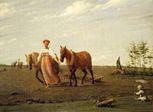
Serfs were farmers who belonged to a landowner and were not allowed to leave his estate.
Serfs were peasants owned, with the land they lived on, by noble landlords, and bound to it since the Law Code of 1649. Most lived in villages whose commune (mir) shared out the strips of land among households, while the lord answered to the state for their poll tax. They served their lord by labour on his fields (barshchina), commonly three days a week, which Paul I’s decree of 1797 called normal, or by a quit-rent (obrok) in money or kind, often earned away from home. Landlords took at least a third of their peasants’ income. The lord judged and punished his serfs, had to approve their marriages, could send them into the army or at times into Siberian exile, and could sell them with or without land. The law forbade him to kill them; Alexander I banned advertising serfs for sale without land (1801) and selling them at fairs (1808), and from 1833 families could not be split at public sales. Serfs resisted by flight and revolt.
Moving in or out. A serf could be freed by his master, buy his freedom if the master agreed, or leave serfdom as a recruit. From 1803 lords could free whole villages as “free agriculturalists”, but by 1858 only about 152,000 male serfs, 1.5 per cent, had been freed that way.
How many? The official count of 1857–1859 gave 23.0 million peasants on proprietors’ lands, 37.8 per cent of 60.9 million people; less the household serfs, about 6.8 per cent of them, roughly 35 per cent.
Picture: In the Ploughed Field: Spring, a peasant woman at work, by Alexey Venetsianov, early 1820s · Alexey Venetsianov · Public domain · Wikimedia Commons


Serfs and dependants · 2–3%
Dvorovye lyudi (Household serfs)
Household serfs worked as servants in a landowner’s house and had no land of their own.
Beside the field serfs lived the household serfs (dvorovye), who had no land and served in their master’s house and stables as cooks, coachmen, grooms, maids, footmen, nurses and stewards. Having no land, they could be sold on their own. Their share of the serfs grew from 4.14 per cent in 1835 to 6.79 per cent by 1858, as landlords who expected emancipation turned field serfs into servants. Great households kept many of them, and some were trained as musicians, painters, singers or actors: the Sheremetev counts ran a serf theatre whose star, the soprano Praskovia Zhemchugova, was a serf blacksmith’s daughter. Household serfs lived closest to their owners, which could bring favour or cruelty. Taras Shevchenko, born a serf in 1814, was made a house servant of his lord at fourteen and whipped for drawing at night; his talent won him friends in Saint Petersburg, who raised 2,500 roubles in 1838 to buy his freedom. At emancipation in 1861 household serfs were freed, but received no land.
Moving in or out. Freedom came by an owner’s grace or by purchase: Count Nikolai Sheremetev freed Praskovia Zhemchugova in 1798 and married her in secret in 1801.
How many? 6.79 per cent of the serfs on the eve of emancipation, up from 4.14 per cent in 1835: about 1.5 million people in the count of 1857–1859, roughly 2.5 per cent of the population.
Picture: Self-portrait of Grigory Soroka, a serf painter in his landowner's household, 1840s–50s (Russian Museum) · Grigory Soroka · Public domain · Wikimedia Commons

Born into history
Where would you have stood? Chance places you on the ladder, as birth placed most people: weighted by how many each rank held.
Moving up and down
The estates were fixed in law, but the state opened some doors. The Table of Ranks turned officers and officials into nobles, and by the 1850s fewer than half of all civil servants were nobles: Mikhail Speransky, a village priest’s son, became Alexander I’s leading adviser and a count. Trade lifted others: Savva Morozov, a serf, bought freedom for himself and his sons in 1820, and the family went on to found the Morozov textile companies. Serfs left bondage as recruits, by purchase or through talent: Taras Shevchenko, a household serf bought free in 1838, wrote the poetry now regarded as the foundation of modern Ukrainian literature. Others simply fled, as runaways had long done to the Cossack frontier. Falls came too: the Decembrist officers were hanged or exiled to Siberia, and indebted nobles mortgaged their serfs. The great change came with Alexander II’s manifesto of 19 February 1861 (3 March in the Western calendar), which freed some 23 million serfs, though they had to pay for their land over 49 years.
Women on the ladder
A woman belonged to her father’s estate and then her husband’s. Noblewomen were better placed than in much of Europe: since the 1730s they could inherit land, and married noblewomen and merchants’ wives owned and managed their own property, which let some run estates and businesses. Girls of the nobility were taught at home, mostly to be wives and mothers, and women could hold no office; in 1859 Saint Petersburg University let women attend its lectures, but the permission was withdrawn four years later. Peasant women shared the field work, spun, wove and kept the house. A serf woman needed her owner’s consent to marry; the legal age of marriage was raised in 1830 to 16 for women, and a wife’s standing in her husband’s family rose with each son she bore. The serf soprano Praskovia Zhemchugova married Count Nikolai Sheremetev in 1801, a match that scandalised society.
Compare with another society
Test yourself
4 questions on the ladder of the Russian Empire.
The questions open here once the page has loaded.
Sources and further reading
- Blum, J. (1961) Lord and Peasant in Russia from the Ninth to the Nineteenth Century. Princeton: Princeton University Press.
- Freeze, G. L. (1983) The Parish Clergy in Nineteenth-Century Russia: Crisis, Reform, Counter-Reform. Princeton: Princeton University Press.
- Hoch, S. L. (1986) Serfdom and Social Control in Russia: Petrovskoe, a Village in Tambov. Chicago: University of Chicago Press.
- Kolchin, P. (1987) Unfree Labor: American Slavery and Russian Serfdom. Cambridge, MA: Belknap Press of Harvard University Press.
- Lamarche Marrese, M. (2002) A Woman's Kingdom: Noblewomen and the Control of Property in Russia, 1700–1861. Ithaca: Cornell University Press.
- Wirtschafter, E. K. (2008) Russia's Age of Serfdom, 1649–1861. Malden, MA: Blackwell.
The shares are of the whole population, children included. Where a scholar has counted or estimated a rank, its share follows that work, named on the rank; where no count survives, the share is an estimate, marked est. and drawn dashed, made from what the rank was and did, from related figures and from the same rank in comparable societies, and its note says what it rests on. Population: official figures for 1857–1859, at the end of the period (60.9 million and 62.5 million in two counts).
Cite this page
- APA
- The Epoch Institute. (2026). Social Hierarchy of the Russian Empire. In Social Ladders. https://the-epoch-institute.org/societies/russian-empire
- MLA
- “Social Hierarchy of the Russian Empire.” Social Ladders, The Epoch Institute, 2026, https://the-epoch-institute.org/societies/russian-empire. Accessed .
- Chicago
- The Epoch Institute. “Social Hierarchy of the Russian Empire.” Social Ladders. 2026. https://the-epoch-institute.org/societies/russian-empire.
- Harvard
- The Epoch Institute (2026) ‘Social Hierarchy of the Russian Empire’, Social Ladders. Available at: https://the-epoch-institute.org/societies/russian-empire (Accessed: ).