
Great work · Americas

Machu Picchu

Periodc. 1450 CE – present
Made byBuilt for the Inca rulers: archaeologists agree that Pachacutec Inca Yupanqui ordered the royal estate, and construction appears to date from his reign and that of Túpac Inca Yupanqui; Inca builders shaped granite quarried on the site
FormAbout 200 buildings, the central ones of finely fitted dry-stone masonry, on terraces around a central square, in an agricultural sector of terraces and an urban sector of upper (Hanan) and lower (Hurin) towns, on a saddle at about 2,430 m
Where it is nowOn the ridge between the mountains Machu Picchu and Huayna Picchu, Machupicchu District, Peru, about 80 km northwest of Cusco; the objects taken to Yale are now in the Machu Picchu Museum–Casa Concha in Cusco
Known fordry-stone walls fitted without mortar; the Temple of the Sun, or Torreón; the Temple of the Three Windows; the Intihuatana stone; its farming terraces; the dispute over the Yale collections; one of the New Seven Wonders of the World

7 min read · Last reviewed October 2026

At a glance

  • Machu Picchu was a royal estate of the Inca emperors, used for about 80 years and home to some 750 people, most of them retainers who came from many parts of the empire.
  • Local farmers knew and worked its terraces, and Agustín Lizárraga reached the citadel in 1902; Hiram Bingham brought it to international attention in 1911.
  • Bingham's excavations took thousands of objects to Yale, which agreed only in 2010 to return them; the last reached Peru in 2012.

Timeline

  1. c. 1420Radiocarbon dating places the beginning of the site's occupation around this time
  2. c. 1450The traditional chronology, from John H. Rowe's reconstruction of Pachacuti's reign, dates the start of building
  3. 16th centuryThe site is abandoned around the time of the Spanish conquest, probably through the collapse of Inca rule and disease
  4. 1902Agustín Lizárraga reaches the citadel and leaves his name in charcoal on a temple window
  5. 1911Melchor Arteaga leads Hiram Bingham to the site, which Bingham brings to international attention
  6. 1912Bingham's expedition for Yale and the National Geographic Society clears and excavates the site
  7. 1983UNESCO designates Machu Picchu a World Heritage Site
  8. 2012The last of the objects taken to Yale are returned to Peru

Origins

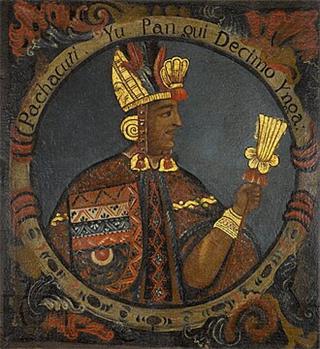
Pachacuti
PachacutiPublic domain

Machu Picchu lies in the Eastern Cordillera of southern Peru, on a narrow saddle between the mountains Machu Picchu and Huayna Picchu at about 2,430 metres, above a bow of the Urubamba River that surrounds it on three sides. Its early chronology is still debated. Earlier models, based on John H. Rowe's reconstruction of the reign of Pachacuti Inca Yupanqui, place the start of building around 1450, ten years after he took power; a 2021 study led by Richard L. Burger, reporting 26 radiocarbon measurements from human remains, concluded that the site was occupied from around 1420 to 1530, and other radiocarbon studies point the same way.

There is a consensus among archaeologists that Pachacutec ordered the royal estate after his conquest of the middle and lower Urubamba, as part of a wider programme of royal estates along the river, and construction appears to date from his reign and that of Túpac Inca Yupanqui. No contemporary written record confirms its purpose. The palace complex is thought to have been a seasonal royal retreat, and as an estate it would not have passed down the line of succession. The name its builders gave it is not known: a 2021 study suggests that it was probably "Huayna Picchu", after the smaller peak, or simply "Picchu", and that the name Machu Picchu, "old peak" in Quechua, was probably first attached to the ruins in Hiram Bingham's publications of 1911.

What It Is

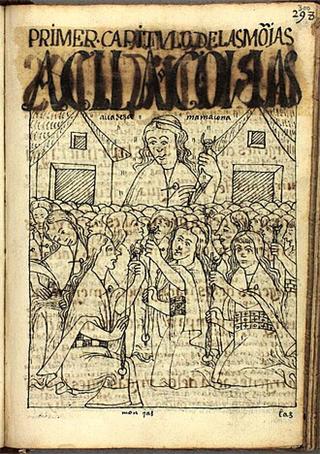
Acllahuasi
AcllahuasiGuaman Poma de Ayala, Public domain

The site has two main sectors: farming terraces to the southeast and an urban sector of houses, temples and stores, itself divided into an upper town (Hanan) and a lower town (Hurin). About 200 buildings stand on wide parallel terraces around an east–west central square, in long, narrow compounds called kanchas fitted to the terrain and linked by stone stairways. The upper town holds the Sacred Plaza, with the Main Temple and the Temple of the Three Windows, whose single wall of white granite has three large trapezoidal openings, and the platform of the Intihuatana, a ritual stone whose name, "place where the sun is tied", was probably given by Bingham; scholars generally reject the idea that it was a solar calendar. The lower town has the Main Square, workshops, a building interpreted as an Acllahuasi, and the Temple of the Condor with its ritual caves.

The Torreón, or Temple of the Sun, is a semicircular building among granite boulders with some of the finest ashlar on the site; its openings admit sunlight for ritual purposes, though 3D analyses show it was not a precise astronomical instrument. About 750 people lived on the estate, most of them yanaconas, permanent retainers of Andean, coastal, Ecuadorian and Amazonian ancestry. The terraces, about 4.9 hectares, grew mainly maize and potatoes, too little to feed them, so food was brought in. Some 104 caves and rock shelters held the remains of about 174 people.
How It Was Made

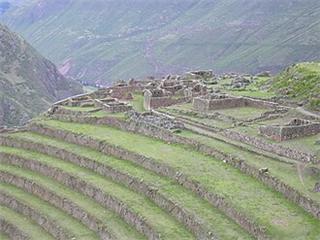
Andén
Andénwww.janto.com.ar, CC BY-SA 2.5

The central buildings are in classical Inca dry masonry: large blocks shaped by quarrying, cutting and dressing were fitted together without mortar. The site stands over two fault lines, which made mortar nearly useless against earthquakes but supplied fractured rock in plenty; the Inca quarried granite on the site, including a quarry identified in 2023 that was probably covered over to make the Plaza Principal. Their walls carry many stabilising features: trapezoidal doors and windows narrowing upward, rounded corners, inside corners inclining slightly into the rooms, L-shaped blocks tying outside corners, and rows offset slightly as they rise. How the largest stones were moved is uncertain; probably hundreds of men pushed them up gentle ramps with wooden rollers, levers and ropes of maguey fibre, and a few stones keep the knobs that could have levered them into place.

The terraces, or andenes, were built in layers, large stones at the bottom, then gravel, then mixed sand and gravel, under topsoil probably carried up from the valley floor, as Kenneth Wright's excavations of the 1990s showed. With more than 1,800 mm of rain a year they were made above all to drain water and hold the mountain against erosion and landslides; places where landslides shifted them during construction, and the Inca stabilised them, can still be seen. A study of 2017 to 2019 found that the Principal Plaza began as a smaller sunken plaza, later raised and expanded.

Reception

The estate was used for about 80 years. Its retainers lived there permanently, joined by religious specialists and temporary skilled workers, most likely for the ruler's well-being and enjoyment; in winter only a few hundred servants stayed. There is little direct evidence of human sacrifice, but camelid offerings were common, and the bones of llamas, alpacas, guinea pigs and six dogs were found among the remains. Machu Picchu is believed to have been abandoned in the mid-16th century, around the time of the Spanish conquest, likely through the collapse of Inca rule and disease; most of its people may have died of smallpox before the conquistadors reached the area. In the late 16th century Spaniards recorded native people speaking of returning to "Huayna Picchu".

The site was never unknown to the people around it. Maps refer to it from 1874, and the German engineer Augusto Berns may have exploited it in the late 19th century. In 1902 the Peruvian explorer Agustín Lizárraga reached the citadel. In 1911 Hiram Bingham, a Yale lecturer seeking the last Inca capital, was led there by the farmer Melchor Arteaga; at the top two Quechua farmers, Richarte and Alvarez, were working terraces they had cleared four years before, and Richarte's 11-year-old son, Pablito, showed him the ruins. Bingham first wrote in his journal that Lizárraga was the "discoverer of Machu Picchu", but in Lost City of the Incas (1952) claimed to have found it himself. Not the first to visit, he brought the site to international attention.

Survival & Rediscovery

Bingham returned in 1912 with the support of Yale University and the National Geographic Society, clearing the site by burning and cutting vegetation, mapping it and excavating with local labour organised in part by Ángel Lizárraga; work resumed in 1914 and 1915. In those years he took thousands of objects to Yale, among them ceramic vessels, silver statues, jewellery and human bones, supposedly for 18 months. He did so openly and legally under the 1852 Civil Code of Peru, but the local press accused his team of harming the site and depriving local archaeologists of knowledge of their own history, and Yale kept the collection, arguing that Peru lacked the means to care for it. The anthropologist Eliane Karp accused Yale of profiting from Peru's heritage. Yale acknowledged Peru's title in 2007, agreed in November 2010 to return the objects and delivered the last of them in November 2012.

Peru declared 325.92 square kilometres around the ruins a Historic Sanctuary in 1981, and UNESCO made it a World Heritage Site in 1983. Restoration and limited excavation followed between 1929 and 1971, and the PIAISHM programme of 2014 to 2017 clarified the building phases. Tourism has brought pressure: a cable car planned in the late 1990s met wide protest, UNESCO considered listing the site as in danger in 2017, and the number of daily visitors has been capped, at 2,500 in 2011 and 4,500 from 2024.

Legacy

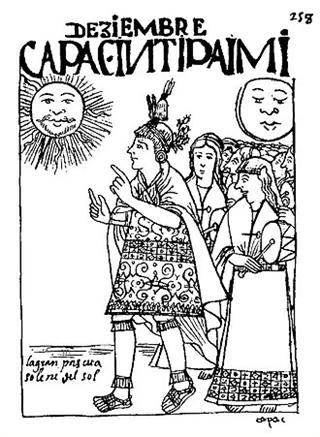
Inti
IntiFelipe Guaman Poma de Ayala, Public domain

Machu Picchu is one of the best-known symbols of the Inca civilisation and is often called the "Lost City of the Incas", though contemporary accounts note that local people maintained the roads that converge on it, which complicates any picture of a site completely isolated. UNESCO described it as "a masterpiece of art, urbanism, architecture and engineering" and "a unique testimony" of the Inca civilisation, and in 2007 it was named one of the New Seven Wonders of the World. It is Peru's most visited tourist destination, with over 1.5 million visitors a year by 2025, most coming by train to Aguas Calientes, the town below, or on foot along the Inca Trail to the Sun Gate, Inti Punku.

The site has also shaped the study of the Incas. Genome-wide analyses of its burials show a retainer community of mixed ancestry living, having children and being buried together, and the 15th-century ceremonial knives of bismuth bronze found there are the earliest known objects of that alloy. Obsidian traced to the Titicaca or Chivay sources shows it tied into the Inca road system and long-distance exchange. It has appeared on screen from Secret of the Incas (1954), the first major Hollywood film shot on location there, and Werner Herzog's Aguirre, the Wrath of God (1972) to The Motorcycle Diaries (2004), and it is twinned with Haworth in West Yorkshire, Petra in Jordan and other places.

Machu Picchu is a 15th-century Inca royal estate on a mountain ridge above the Urubamba River in southern Peru, built of finely fitted dry stone and used for about 80 years before it was abandoned around the time of the Spanish conquest. Known to local farmers and reached by Agustín Lizárraga in 1902, it was brought to international attention by Hiram Bingham in 1911.

Test yourself

5 questions on this page, from its key events and facts.

The questions open here once the page has loaded.