Americas
Cahokia
At a glance
- The largest Mississippian centre, built from about 1050 on the Mississippi floodplain opposite present-day St Louis.
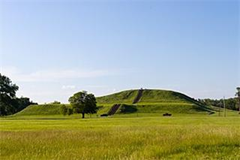
- Its Monks Mound, about 30 metres high, is the largest prehistoric earthwork in the Americas.
- From the late 12th century the city shrank behind a palisade, and by about 1350 it was largely abandoned.
Rise & Fall
- c. 1050Villages on the American Bottom are rebuilt to a grand plan around the Grand Plaza
- c. 1100Cahokia reaches its peak, with perhaps 10,000–20,000 people
- c. 1165A walled compound in the East St Louis precinct is burned
- c. 1175A palisade with bastions is built around the central precinct
- c. 1200Monks Mound receives its last major addition as the population falls
- c. 1350Cahokia is largely abandoned
- 1982Cahokia Mounds becomes a UNESCO World Heritage Site
Foundation
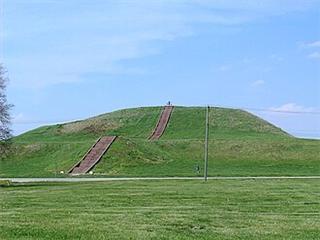
Cahokia rose on the American Bottom, the broad floodplain of the Mississippi opposite present-day St Louis, where farming villages had grown during the Terminal Late Woodland period. Before about 1050 the settlement held perhaps 1,000 people. In the decades after 1050 it was rebuilt to a grand plan, a transformation the archaeologist Timothy Pauketat has called Cahokia’s “Big Bang”. Builders levelled a Grand Plaza of about 20 hectares, laid out neighbourhoods of new wall-trench houses on a grid oriented to the cardinal directions, and enlarged Monks Mound, begun around 900–950, into a terraced platform about 30 metres high on a base of some 291 by 236 metres. Newcomers arrived in large numbers, as non-local pottery and chemical studies of teeth suggest, and estimates for the dense core between 1050 and 1100 range from about 10,000 to 15,000 people. Mound centres at East St Louis and St Louis formed with it what archaeologists call Greater Cahokia, and an upland shrine complex at the Emerald site, aligned to the moon, drew pilgrims. No written record survives, so the city’s own name, language and rulers are unknown; it was probably the first great capital of the Mississippian culture. The name Cahokia comes from an Illinois Confederation people who lived nearby when the French arrived in the late seventeenth century.
Socioeconomy
Cahokia’s economy rested on farming the fertile soils of the floodplain and the uplands to its east. Maize, worked with hoes of Mill Creek chert quarried in southern Illinois, became a staple alongside native seed crops such as goosefoot and sumpweed, squash, and the fish, waterfowl and deer of the river bottoms. Many immigrants settled in the upland farming villages of the Richland complex, which may have helped to feed the centre. Society was strongly ranked: elite households occupied the platform mounds and the precincts around them, while most people lived in rectangular pole-and-thatch houses grouped in neighbourhoods. Religious life centred on mound-top temples, great marker posts and public ceremonies. Craft workers made shell beads, the burnished jars with incised designs known as Ramey Incised, and red flint-clay figurines such as the Birger figurine, which shows a kneeling woman tilling the back of a serpent and is often read as a symbol of fertility. Exchange networks reaching from the Great Lakes to the Gulf of Mexico brought copper, mica, marine shells and shark teeth. Chunkey, a game in which players threw spears at a rolling stone disc, was played in the plazas, and later accounts of Southeastern peoples describe heavy betting on it.
Military
No battle at Cahokia is recorded; its military history comes from archaeology. The bow and arrow, adopted in the region centuries earlier, was the main weapon, and warfare carried prestige: elite graves in Mound 72 held more than 700 finely made arrowheads, some from distant parts of the Mississippian world. The same mound, excavated by Melvin Fowler from 1967, held some 270 bodies; besides dozens of apparently sacrificed young women, one pit contained 39 men and women who had died violently, some with arrowheads in their backs, and four men had been buried without heads or hands, perhaps enemies or captives. Images of a falcon-costumed figure, the so-called Birdman, often read as a warrior or hero, became central to Cahokian art. Around 1175, by most estimates, the Cahokians enclosed the central precinct, including Monks Mound and the Grand Plaza, with a palisade about 3 kilometres long. Each of its four versions reportedly took 15,000–20,000 oak and hickory logs set in a deep trench, and evenly spaced bastions allowed archers to shoot along the wall. Some scholars see it as a ritual boundary, but bastions usually mean defence. Pauketat has argued that Cahokia’s authority, backed by the threat of force, kept a regional peace for a time, a “Pax Cahokiana”; by the thirteenth century fortified villages and burned settlements spread across the Midwest.
Governance & Law
How Cahokia was governed is debated, because the evidence is entirely archaeological. Most scholars describe it as a paramount chiefdom, a ranked society led by hereditary chiefs whose authority was religious as well as political; others see something closer to an early state, or a looser coalition of kin groups and ritual societies. A building more than 30 metres long, the largest in the city, stood on the summit of Monks Mound, probably the residence or temple of its rulers. Power showed itself above all in the mobilisation of labour: Monks Mound holds some 622,000 cubic metres of earth, carried in baskets over many building stages. The beaded burial in Mound 72, long read as the grave of two high-status men, was shown by a re-examination published in 2016 to hold a man and a woman at its centre; its authors argued that Cahokian ritual stressed renewal, fertility and agriculture, and that the division it expressed was one of class rather than gender. Mounds and posts were aligned with the sky: from the centre of the reconstructed third Woodhenge, a circle of 48 posts about 125 metres across, the sun rises over Monks Mound at the equinoxes. Outlying mound centres were probably run by lesser elites bound to the centre by kinship, ceremony and gifts of food and prestige goods.
Global & Regional Impact
Cahokia was the largest and probably the earliest of the great Mississippian centres that spread across the Midwest and the South from the eleventh century to the sixteenth, and the features of its plan, platform mounds around plazas, maize farming, wall-trench houses and a shared religious imagery, reappear in the towns that followed. Its products and ideas travelled widely: flint-clay figurines and pipes carved in the St Louis area were buried in the Craig Mound at Spiro in present-day Oklahoma, and Mississippian towns as far north as Aztalan in present-day Wisconsin show close ties to the American Bottom. Archaeologists trace the earliest major style of the religious art later called the Southeastern Ceremonial Complex, the Braden style, with its falcon dancers, to Cahokia. Many scholars think its builders included ancestors of the Dhegiha Siouan peoples, the Osage, Omaha, Ponca, Kaw and Quapaw, and the Osage Nation now works with archaeologists and the site’s managers, though no single people can be named as Cahokia’s heirs. Farming, railways and the growth of St Louis destroyed much of Greater Cahokia: St Louis, once nicknamed the Mound City, kept only one of its roughly 40 mounds. About 80 of Cahokia’s some 120 mounds survive, and the Cahokia Mounds State Historic Site became a UNESCO World Heritage Site in 1982.
Decline & Fall
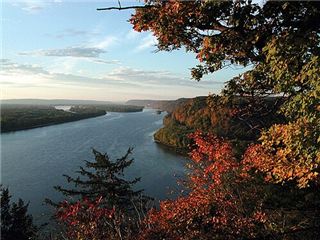
Cahokia’s decline was gradual. Around 1160–1170 a large walled compound in the East St Louis precinct was burned, perhaps in unrest, and the population of the region began to fall in the late twelfth century. Sediment cores from nearby Horseshoe Lake point to a Mississippi flood and summer droughts harmful to maize around 1150, and tree-ring records suggest repeated droughts between about 1100 and 1250. Monks Mound received its last major addition before about 1200, after which massive slumping on its eastern side was never repaired. In the Moorehead phase of the thirteenth century the upland villages were emptied, storage pits moved inside houses, large public buildings were no longer raised and the palisade was rebuilt around ever smaller areas; by the middle of the century the population may have fallen by half or more. Proposed causes include floods, drought, crop failure, warfare, political strife and the difficulty of holding together a city of immigrants, while a 2021 study found no sign of the erosion that heavy deforestation would have caused. By about 1350 the site was largely abandoned, part of a wider emptying of the central Mississippi and lower Ohio valleys that archaeologists call the Vacant Quarter. Oneota groups later lived there briefly, and in 1699 French missionaries founded a mission among the Cahokia and Tamaroa nearby.
Cahokia was the largest and probably the earliest great centre of the Mississippian culture, a planned city of perhaps 10,000–20,000 people around 1100 whose mounds, plazas, art and games spread across eastern North America; its rapid rise and slow abandonment within three centuries remain central questions of North American archaeology.
References
- Emerson, T.E. (1997) Cahokia and the Archaeology of Power. Tuscaloosa: University of Alabama Press.
- Milner, G.R. (1998) The Cahokia Chiefdom: The Archaeology of a Mississippian Society. Washington, DC: Smithsonian Institution Press.
- Pauketat, T.R. (2004) Ancient Cahokia and the Mississippians. Cambridge: Cambridge University Press.
- Pauketat, T.R. (2009) Cahokia: Ancient America’s Great City on the Mississippi. New York: Viking.
- Young, B.W. and Fowler, M.L. (2000) Cahokia: The Great Native American Metropolis. Urbana: University of Illinois Press.
Connections
Open the full connections map →