Egypt & North Africa
Almoravid Empire
At a glance
- Saharan Berber reformists who built an empire from the Senegal River to the Ebro, ruled from Marrakesh.
- Their victory at Sagrajas in 1086 halted Castile's advance and kept much of al-Andalus Muslim for generations.
- Overstretched on two fronts, they fell to the Almohads, who used the same charge of impiety the Almoravids once used.
Rise & Fall
- 1054–1055Almoravids capture Sijilmasa, northern terminus of the trans-Saharan gold trade
- c. 1070Marrakesh is founded as the capital of the northern branch
- 1086Yusuf ibn Tashfin shatters Alfonso VI's army at the Battle of Sagrajas
- 1091Almoravids absorb the taifa kingdom of Seville
- 1106Death of Yusuf ibn Tashfin, the empire's greatest ruler
- 1118Alfonso I of Aragon takes Zaragoza
- 1145Tashfin ibn Ali dies near Oran, opening Morocco to the Almohads
- 1147Almohads storm Marrakesh and kill the last Almoravid ruler, Ishaq ibn Ali
Foundation
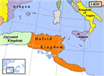
The Almoravid Empire originated in one of history's most improbable transformations: a community of Saharan Berber nomads, galvanised by a reformist Islamic preacher, who within some seventy years came to rule a territory stretching roughly three thousand kilometres from the Senegal River to the Ebro in northern Spain. The movement's genesis lay around 1035–1040 CE, when Yahya ibn Ibrahim, a chieftain of the Godala (Gudala) tribe returning from pilgrimage to Mecca, met the Fez-born Maliki jurist Abu Imran al-Fasi in Kairouan and was eventually provided with a teacher, Abdallah ibn Yasin, to instruct his people in orthodox Maliki practice. Ibn Yasin, rejected by the Godala, found a more receptive audience among the neighbouring Lamtuna and, according to tradition, established a ribat, a fortified religious community, that became the movement's spiritual and military nucleus. Its members called themselves al-Murabitun, "the people of the ribat", which Spanish rendered as Almorávides. The critical economic foundation was laid when the Almoravids captured Sijilmasa, the northern terminus of the trans-Saharan gold trade, in 1054–1055, and soon afterwards Awdaghust in the south. Control of this route, along which gold from the Bambuk and Bure fields of the upper Senegal and Niger flowed northward to Mediterranean markets, gave the movement a financial resource that would underpin its imperial ambitions for decades. Marrakesh, founded around 1070 (traditionally 1062), became the capital of the northern branch under Yusuf ibn Tashfin, who in 1086 crossed the Strait of Gibraltar at the invitation of the Andalusian taifa kings, the rulers of petty Muslim principalities who could not on their own resist the advance of Alfonso VI of Castile, conqueror of Toledo in 1085.
Socioeconomy

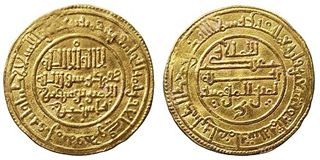
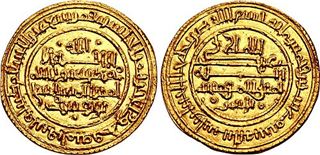
The Almoravid economy rested on three interconnected pillars: control of the trans-Saharan gold trade, the agricultural revenues of Morocco and western Algeria, and the sophisticated urban economy of al-Andalus. The trans-Saharan trade brought West African gold to the Mediterranean in volumes sufficient to make the Almoravid gold dinar one of the most trusted currencies of the medieval Mediterranean, prized for its purity and so widely used that Christian Iberia imitated it as the morabetino, the origin of the Castilian maravedí. This monetary strength gave the Almoravid treasury a structural advantage: it could finance campaigns, build mosques, fortifications and public works, and maintain a professional fighting force from revenues that flowed regardless of harvests. Morocco provided grain, livestock and pastoral products from the Atlantic plains, while Andalusian irrigated agriculture, the huertas of Valencia, Murcia and Granada, sustained by a hydraulic tradition that built on Roman foundations and techniques introduced from the Islamic East, produced surpluses that supported dense urban populations. The social fabric of the empire was marked by a fundamental tension between the austere Saharan Berber warrior class that formed the military and ruling elite and the sophisticated, cosmopolitan Andalusian urban civilisation it had conquered. Under Ali ibn Yusuf (r. 1106–1143), Andalusian culture flowed across the Strait into Marrakesh: Andalusian secretaries, artists and architects transformed the capital, introducing urban institutions, architectural refinement and intellectual culture far removed from the desert tradition from which the dynasty had sprung. This cultural absorption was at once a mark of success and the source of an internal contradiction that left the empire exposed to the same puritanical critique it had deployed against others.
Military

The Almoravid military derived its decisive early advantage from the Lamtuna and allied Sanhaja Berbers of the western Sahara, veiled warriors hardened by the desert who brought to battle an endurance, discipline and cohesion that the armies of Morocco and al-Andalus could not match. The Almoravids fought in disciplined infantry ranks armed with long spears and javelins, backed by cavalry, and they used massed war drums to coordinate manoeuvres and unnerve opponents, while the deployment of camels, whose smell unsettled horses, reportedly helped to disrupt enemy cavalry. The Battle of Sagrajas (al-Zallaqa in Arabic) on 23 October 1086 demonstrated the full effectiveness of this system: Yusuf ibn Tashfin's army shattered Alfonso VI's forces near Badajoz in one of the most decisive victories in Iberian history, halting the Christian advance at a critical moment. The subsequent absorption of the taifa kingdoms, Granada in 1090, Seville in 1091, Badajoz in 1094 and Zaragoza in 1110, was accomplished through a combination of military pressure and legal justification, with Yusuf obtaining fatwas from Maliki jurists condemning the taifa rulers for impiety and illegal taxation before deposing them, a formula that framed conquest as religious correction. The structural military weakness that proved fatal was the small absolute size of the Saharan elite: the empire was attempting to garrison both Morocco and al-Andalus with a pool of desert warriors that could not be quickly replaced. As this elite aged and was supplemented by Christian mercenaries under commanders such as the Catalan Reverter and by Andalusian levies, the army's founding character diluted and the dynasty lost the edge that had made it formidable. By the 1130s the Almoravids were fighting losing wars simultaneously against Christian armies in the north and the Almohad insurgency in the Atlas Mountains.
Governance & Law
Almoravid government was a hybrid of desert tribal authority and sophisticated urban administration inherited from the Andalusian taifa tradition. Yusuf ibn Tashfin took the title Amir al-Muslimin, Commander of the Muslims, deliberately stopping short of the caliphal title and acknowledging the nominal supremacy of the Abbasid caliph in Baghdad while exercising independent sovereign authority over his domains. The administrative machinery of the Andalusian cities was largely preserved after conquest, with existing secretaries and jurists retained under Almoravid governors, often members of the ruling family, a pragmatic accommodation that allowed the empire to function without the Lamtuna warriors needing administrative skills they did not possess. Maliki jurisprudence formed the empire's legal framework, and Maliki scholars enjoyed enormous prestige and political influence at court, supplying the religious legitimacy that justified both the original conquests and continuing tax demands; under Ali ibn Yusuf their influence extended to the public burning of the works of al-Ghazali. Marrakesh served as the capital, and under Ali ibn Yusuf it was transformed from a military encampment into a genuine city with mosques, baths, mills, an underground water supply and caravanserais built to Andalusian standards. The fundamental challenge was holding together an empire whose two halves, Saharan Morocco and urban al-Andalus, had little in common culturally, economically or socially. The Almoravid solution, separate administrative traditions under a unified military hierarchy, worked as long as that hierarchy remained capable and cohesive, but proved fragile once the two-front pressure of Christian advance and Almohad insurgency undermined Almoravid military credibility.
Global & Regional Impact

The Almoravid Empire's most consequential historical contribution was its intervention in Iberia, which preserved Muslim rule over much of southern Spain for a century and a half beyond what the fragmented taifa kingdoms could probably have achieved alone. Without the victory at Sagrajas in 1086, Alfonso VI's Castile might have overrun much of al-Andalus before the end of the eleventh century, altering the course of Iberian and European history. The empire's control of the trans-Saharan gold trade channelled West African wealth into the Mediterranean economy, and the Almoravid dinar served as a benchmark of monetary reliability in the western Mediterranean for decades, its name surviving in the Iberian maravedí. Culturally, the Almoravid synthesis of Saharan Berber, Moroccan and Andalusian traditions laid the architectural and artistic foundations that the Almohad and Marinid dynasties would develop further, producing the distinctive Hispano-Moresque aesthetic visible in monuments such as the Qubba Ba'adiyyin in Marrakesh, the Great Mosque of Tlemcen and the Qarawiyyin Mosque in Fez, which Ali ibn Yusuf enlarged. The absorption of the taifas also brought the intellectual resources of al-Andalus, its jurists, physicians, geographers and poets, under a single political umbrella, creating conditions for exchange across the Strait. In West Africa, the southern branch under Abu Bakr ibn Umar helped spread Maliki Islam through the Sahel, contributing to the Islamisation of the western Sudan and shaping the religious character of the later Mali and Songhai empires.
Decline & Fall

The Almoravid Empire's collapse was as swift as its rise: from the death of its greatest ruler, Yusuf ibn Tashfin, in 1106 to the fall of Marrakesh in 1147, just forty-one years elapsed. The structural cause was inherent in the empire's founding logic: a small Saharan Berber military elite attempting to govern a vast and culturally sophisticated Andalusian and Maghrebi society. The Almoravids had conquered al-Andalus by arguing that the taifa kings were insufficiently Islamic; their successors the Almohads conquered the Almoravids by deploying the same argument against them. The Almohad movement, launched by Ibn Tumart in the Atlas Mountains around 1121, denounced the Almoravids as anthropomorphist heretics who had succumbed to luxury and oppressed their subjects with unlawful taxation, much the same charges the Almoravids had levelled against the taifas. The Almoravids could not easily counter this critique because their own legitimacy rested on an identical claim to religious purity. Meanwhile the northern front deteriorated: Zaragoza, the chief city of the Ebro valley, fell to Alfonso I of Aragon in 1118; after the Battle of Ourique in 1139 Afonso Henriques assumed the title of King of Portugal; and Ali ibn Yusuf and his son Tashfin ibn Ali failed in campaign after campaign to destroy the Almohads. Tashfin's death near Oran in 1145 opened Morocco to the Almohads, and when Abd al-Mu'min's forces stormed Marrakesh in 1147, killing the last Almoravid ruler, the young Ishaq ibn Ali, and demolishing Almoravid monuments, including the palace on whose site the Koutoubia Mosque would rise, the erasure was as symbolic as it was military. The Almoravid Empire had been devoured by the formula it had used to build itself.
The Almoravid Empire's paradoxical legacy, a dynasty of desert puritans that saved Muslim al-Andalus from Christian conquest while succumbing to the very cultural sophistication it ostensibly disdained, makes it one of history's most vivid examples of how conquest transforms the conqueror.
References
- Bennison, A.K. (2016) The Almoravid and Almohad Empires. Edinburgh: Edinburgh University Press.
- Bosch-Vilá, J. (1990) Los Almorávides. Granada: Universidad de Granada.
- Constable, O.R. (1994) Trade and Traders in Muslim Spain: The Commercial Realignment of the Iberian Peninsula, 900–1500. Cambridge: Cambridge University Press.
- Fletcher, R. (1992) Moorish Spain. London: Weidenfeld and Nicolson.
- Lapidus, I.M. (2002) A History of Islamic Societies. 2nd edn. Cambridge: Cambridge University Press.
- Parias, L.H. (ed.) (1957) Histoire universelle des explorations. Paris: Nouvelle Librairie de France.
Connections
Open the full connections map →