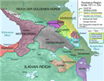
Islamic Caliphates & Middle East
Seljuk Empire
At a glance
- Oghuz Turks from the Central Asian steppe, the Seljuks built an empire from Khorasan to the Mediterranean and became protectors of Sunni Islam.
- Their victory at Manzikert opened Anatolia to Turkish settlement, paving the way for the Ottomans and helping provoke the Crusades.
- With no fixed succession, the empire splintered after 1092; Qara Khitai and Khwarazmian blows ended the Great Seljuk line by 1194.
Rise & Fall
- 1037Tughril and Chaghri take Merv and Nishapur, throwing off Ghaznavid authority
- 1040Tughril and Chaghri rout the Ghaznavid sultan Masud I at Dandanaqan
- 1055Tughril enters Baghdad and is recognised as sultan by the Abbasid caliph
- 1071Alp Arslan defeats and captures the Byzantine emperor Romanos IV at Manzikert
- 1092Vizier Nizam al-Mulk is assassinated and Malik Shah dies weeks later, sparking civil war
- 1141The Qara Khitai defeat Sultan Sanjar at the Battle of Qatwan
- 1157Sanjar's death ends the eastern Seljuk line
- 1194The Khwarazm Shah Tekish kills Toghrul III, extinguishing the Great Seljuks
Foundation
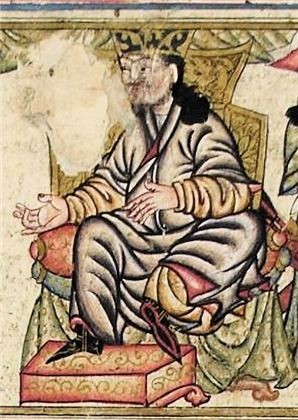
The Seljuk Empire emerged from the steppes of Central Asia in the early eleventh century, its origins rooted in the Oghuz Turkic tribal confederation that had long occupied the lands north of the Caspian and Aral Seas. The dynasty took its name from Seljuk Beg, a chieftain of the Qiniq clan of the Oghuz who, traditionally around 985 CE, converted to Sunni Islam and led his followers to the lower Syr Darya near Jand, on the frontiers of the Samanid and later Ghaznavid spheres. This conversion proved strategically transformative, giving the young dynasty religious legitimacy within the Islamic world and distinguishing it from pagan steppe rivals. Seljuk's grandsons Tughril and Chaghri led their tribesmen into Khorasan in the 1030s, taking Merv and Nishapur in 1037–1038 and throwing off Ghaznavid authority. The decisive moment came at the Battle of Dandanaqan in 1040, where Tughril and Chaghri routed the army of the Ghaznavid sultan Masud I, securing Khorasan and opening the Iranian plateau to Seljuk expansion. Tughril entered Baghdad in 1055, freeing the Abbasid caliph Al-Qa'im from the tutelage of the Shia Buyids and receiving formal recognition as sultan, a title meaning power or authority, from the caliph himself, a legitimising act that transformed a steppe warlord into the temporal protector of Sunni Islam.
Socioeconomy
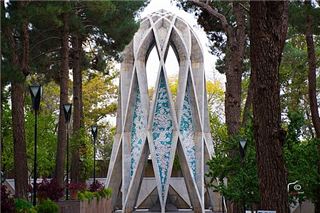
The Seljuk economy rested on a synthesis of nomadic pastoralism, sedentary Persian agrarian traditions and the long-distance trade networks of the Islamic world. The empire straddled the principal Silk Road arteries linking China and Central Asia to the Mediterranean and the Levant, and the sultans drew substantial revenue from caravan traffic through cities such as Nishapur, Rayy, Isfahan and later, in Anatolia, Konya. Agriculture in the Iranian heartland and Mesopotamia was administered through the iqta system, a form of conditional assignment in which military commanders and officials received the revenues of specific territories in lieu of salary, a mechanism that decentralised fiscal administration while sustaining central military capacity. The urban population of Iran was predominantly Persian-speaking, and the Seljuks adopted Persian as the language of administration and high culture, sponsoring a literary and intellectual renaissance. The social hierarchy placed the Turkic military elite at its apex, with Persian bureaucrats, ulama (religious scholars) and merchants forming an educated middle stratum. The madrasas endowed by the vizier Nizam al-Mulk, the Nizamiyya network and among the most systematic educational foundations of the medieval Islamic world, also served economic ends, training the administrative and juridical class that kept the empire's institutions functioning across its vast territories.
Military
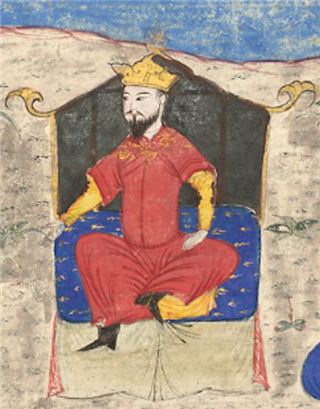
The Seljuk army was built around ghulams, professional slave soldiers, predominantly of Turkic origin, trained from youth in cavalry warfare and personally loyal to the sultan or senior commanders, supplemented by Turkmen tribal cavalry and, increasingly, infantry levied from conquered sedentary populations. The mounted archer remained the foundational tactical unit, combining the mobility of steppe warfare with the discipline of organised service. The empire's most consequential engagement was the Battle of Manzikert in August 1071, where Sultan Alp Arslan defeated the Byzantine emperor Romanos IV Diogenes and captured him alive, the first time a Byzantine emperor had been taken prisoner by a Muslim ruler; the defeat and the Byzantine civil wars that followed shattered imperial defences in Anatolia. Manzikert opened Asia Minor to Turkmen settlement and ultimately helped precipitate the Crusades, as Emperor Alexios I's appeal to Pope Urban II in 1095 was framed around the Turkish threat. Under Malik Shah I (r. 1072–1092) the empire campaigned across Syria, Anatolia, the Caucasus and Central Asia, receiving the submission of the Karakhanids of Samarkand and Kashgar and reaching an estimated maximum extent of some 3.9 million square kilometres, from the Mediterranean coast to the borders of the Chinese world. Nizam al-Mulk's Siyasat-nama set out the principles of military governance, stressing the value of a multi-ethnic professional standing army over reliance on unreliable tribal contingents.
Governance & Law
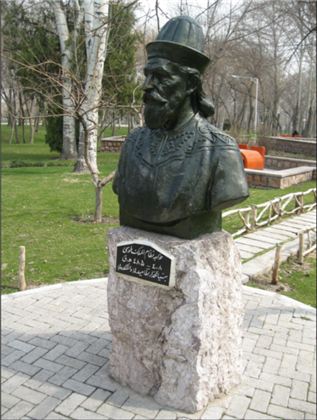
The Seljuk administrative system was a deliberate fusion of Turkic military authority and Persian bureaucratic sophistication, institutionalised most fully during the nearly thirty-year vizierate of Nizam al-Mulk (1064–1092), whose Siyasat-nama remains one of the foundational texts of Islamic political thought. Authority was formally divided between the sultan, who held military and temporal power, and the Abbasid caliph in Baghdad, who provided religious legitimation, a dual arrangement that gave Seljuk rule ideological coherence within the Sunni world. The iqta system governed provincial administration: territory was parcelled into revenue-yielding assignments held by military governors (muqtas or muqtis), theoretically non-hereditary appointees who in practice often became entrenched local powers. The Nizamiyya madrasas in Baghdad, Nishapur, Isfahan and elsewhere promoted Shafi'i jurisprudence and Ash'ari theology, helping to standardise Sunni learning and legal practice across the empire's diverse territories. Succession, however, was never systematically regulated; the Turkic tradition that sovereignty belonged to the ruling family as a whole, giving every adult male member a legitimate claim, generated endemic fragmentation after every major sultan's death. The assassination of Nizam al-Mulk in October 1092, attributed to an Ismaili Nizari agent, followed within weeks by the death of Malik Shah, triggered succession warfare from which the empire never structurally recovered.
Global & Regional Impact

The Seljuk Empire's most enduring geopolitical consequence was the Turkification and Islamisation of Anatolia, a transformation that ultimately produced the Ottoman Empire and reshaped the demographic character of the Middle East for a millennium. Manzikert's destruction of Byzantine power in Anatolia helped prompt the Crusades, making the Seljuks indirect architects of two centuries of Latin-Islamic conflict. Culturally, Seljuk patronage of Persian literature, architecture and philosophy sustained a remarkable intellectual flowering: the poet and mathematician Omar Khayyam worked under Malik Shah's patronage on the reform of the solar calendar, producing the Jalali calendar of 1079, more accurate than the contemporary Julian calendar, while the theologian al-Ghazali taught at the Baghdad Nizamiyya. The Nizamiyya network became a widely imitated model for Islamic higher education, influencing institutions from the Maghreb to Central Asia. Seljuk architectural innovations, including the four-iwan mosque plan seen at the Great Mosque of Isfahan, elaborate muqarnas vaulting and monumental decorated portals, defined the aesthetic vocabulary of Islamic architecture from Iran to Anatolia. Trade along the Silk Road routes flourished under Seljuk protection, and the empire's commercial connections extended to Fatimid Egypt, Byzantine Constantinople, the Crusader states and the trading cities of the Indian Ocean rim.
Decline & Fall
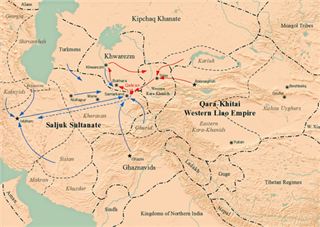
The Seljuk Empire's dissolution was primarily a structural consequence of its own political architecture. The Turkic principle of dynastic patrimony, under which sovereignty belonged collectively to the ruling family rather than to a single designated heir, meant that every succession became a potential civil war. After Malik Shah's death in 1092 the empire fractured into competing branches: the Sultanate of Rum in Anatolia, the Syrian Seljuks, the line ruling Iraq and western Iran, and the Khorasan branch under Ahmad Sanjar each pursued independent trajectories. The Nizari Ismailis, operating from mountain fortresses such as Alamut, seized by Hasan-i Sabbah in 1090, destabilised government through targeted political assassination, beginning with Nizam al-Mulk in 1092, and created a climate of insecurity at the highest levels of administration. The Crusader presence from 1098–1099 absorbed Seljuk military attention in the Levant, while new powers pressed from the east. The fatal blow came from the Qara Khitai, a Sinicised Khitan steppe power, who defeated Sanjar at the Battle of Qatwan in 1141, destroying Seljuk authority in Transoxiana and fatally undermining Sanjar's prestige; in 1153 he was captured by rebellious Oghuz tribesmen, and his death in 1157 ended the eastern line. The Iraqi line staggered on through a succession of weak sultans dominated by their atabegs until Toghrul III was killed in battle by the Khwarazm Shah Tekish in 1194, extinguishing the Great Seljuk line entirely.
The Seljuk Empire's historical significance lies above all in its dual role as the force that permanently reshaped the ethnic and religious geography of the Middle East and as the patron that preserved, institutionalised and transmitted the intellectual and architectural traditions of classical Islamic civilisation at a moment when that civilisation faced political fragmentation.
References
- Bosworth, C.E. (1968) 'The Political and Dynastic History of the Iranian World (AD 1000–1217)', in J.A. Boyle (ed.) The Cambridge History of Iran. Vol. 5. Cambridge: Cambridge University Press, pp. 1–202.
- Cahen, C. (1968) Pre-Ottoman Turkey: A General Survey of the Material and Spiritual Culture and History c. 1071–1330. Translated by J. Jones-Williams. London: Sidgwick and Jackson.
- Hillenbrand, C. (1988) 'Islamic Orthodoxy or Realpolitik? Al-Ghazali's Views on Government', Iran, 26, pp. 81–94.
- Köprülü, M.F. (1992) The Origins of the Ottoman Empire. Translated by G. Leiser. Albany: State University of New York Press.
- Peacock, A.C.S. (2015) The Great Seljuk Empire. Edinburgh: Edinburgh University Press.
- Tor, D.G. (2007) Violent Order: Religious Warfare, Chivalry, and the 'Ayyār Phenomenon in the Medieval Islamic World. Würzburg: Ergon.
Connections
Open the full connections map →