
Culture · Sub-Saharan Africa
Igbo-Ukwu culture
At a glance
- Igbo-Ukwu is a town in south-eastern Nigeria whose three excavated sites, a shrine, a burial chamber and a cache, held more than 700 objects of copper, bronze and iron.
- Its smiths cast bronzes of such fine detail that experts first doubted they were local; analysis showed that most of the metal came from mines about 100 kilometres away.
- Glass beads from as far as Mesopotamia, Iran and Egypt show that Igbo-Ukwu was tied into long-distance trade centuries before Europeans reached the coast.
Timeline
- c. 2000 BCEIron is smelted at Lejja in the Nsukka region, about 100 kilometres east of Igbo-Ukwu
- 9th century CEBronzes, beads and a rich burial are placed at Igbo-Ukwu, according to the first radiocarbon dates
- 1938Isaiah Anozie finds bronzes while digging beside his home
- 1946The district officer J. O. Field hands the objects he had bought to the Nigerian Department of Antiquities
- 1959–1964Thurstan Shaw excavates Igbo Isaiah, Igbo Richard and Igbo Jonah
- 1970Shaw publishes radiocarbon dates placing the sites in the 9th century
- 2022New radiocarbon dates from Igbo Isaiah fall between the 10th and 13th centuries
Origins
The Igbo-Ukwu culture is an archaeologists’ name for the people who left three rich deposits in what is now the town of Igbo-Ukwu, “Great Igbo”, in Anambra State in south-eastern Nigeria. The town stands about 366 metres above sea level on a sandstone ridge with little groundwater, between the Aghomili River to the east and the Obizi River to the west. Metalworking in the region was far older: furnaces and slag from iron smelting have been dated to 2000 BCE at Lejja and 750 BCE at Opi, both in the Nsukka region about 100 kilometres to the east.
The first finds were made in 1938 by Isaiah Anozie while digging in his compound. J. O. Field, the British district officer, bought many of them, published them, and in 1946 handed them to the Nigerian Department of Antiquities; Kenneth Murray collected more in 1954. From 1959 to 1964 the archaeologist Thurstan Shaw excavated three areas: Igbo Isaiah around the first find, Igbo Richard and Igbo Jonah.
Shaw’s radiocarbon dates, published in 1970, placed the sites in the 9th century, around 850 CE. Newer dates from Igbo Isaiah, published by Daraojimba and colleagues in 2022, fall between the 10th and 13th centuries, and a textile from the same site was dated to about 1027–1180. These results suggest that Igbo-Ukwu may have been used over several centuries, and that some objects may be younger than once thought, though all of them come well before European contact with the coast.
Society
The finds suggest an economy based on farming and trade. Excavations west of Igbo Richard in 2019 and 2021 yielded pottery, bronze, copper and iron objects, iron slag, chalk, bone and palm kernel, and the earlier digs found iron swords, spearheads and razors. Igbo Jonah, the largest excavated area at 19 by 11 metres, produced the least material: its pits had been deliberately backfilled, and it yielded ritual pottery, charcoal, animal bones and some bronzes.
Igbo Richard was a burial chamber holding the remains of several people, beaded wristlets and anklets, and a wooden stool associated with a single skeleton, possibly that of a priest-king; one body was adorned in what appears to be regalia. One of the bronzes is a small pendant in the shape of a chief’s head with ichi scarification marks on the face.
The town of Igbo-Ukwu is described as the capital of the Kingdom of Nri from the 8th or 9th century, and the sites are associated with the Nri-Igbo, though how the deposits relate to that kingdom is not set out in detail. The finds also overturned a colonial-era view that such craft could not come from an acephalous, or egalitarian, society such as that of the Igbo.
Beliefs & Worldview
The three sites are read as a shrine (Igbo Isaiah), a burial chamber (Igbo Richard) and a cache (Igbo Jonah), and many of the bronzes are ritual vessels. From them archaeologists infer that by the 9th century the people of Igbo-Ukwu had a complex religious system. The burial at Igbo Richard, with its stool and what appears to be regalia, is read by some as that of a priest-king, but this too is interpretation.
The textiles found at Igbo Isaiah have been thought to hold religious or spiritual meaning, but the ethnographic and archaeological evidence for the meaning of bark-fibre cloth in the forest zone is thin, so this remains speculation. Much about the beliefs behind the objects is still unknown.
Arts & Knowledge

The excavations recovered more than 700 high-quality objects of copper, bronze and iron, about 165,000 beads of glass, carnelian and stone, pottery, textiles and ivory. The bronzes were made by lost-wax casting, probably with latex rather than beeswax, which may explain their fine, filigree surface detail. The smiths did not use wire making, soldering or riveting, which suggests a tradition that developed on its own; small insects that seem to have landed on the surface were cast in one piece with the vessel. Complex objects were made in stages and joined by brazing or by casting linking sections, techniques not known elsewhere.
The alloy is unusual, with a high silver content unlike that of Europe, the Mediterranean or other African bronze centres. About 85–90% of the ore came from old mines at Abakaliki, about 100 kilometres away, with a small share from a second source not yet identified; lead isotopes point to possible sources in North Africa. The Grove Encyclopedia of Materials and Techniques in Art calls the bronzes “among the most inventive and technically accomplished bronzes ever made”, and Hugh Honour and John Fleming describe a water pot in a mesh of cast rope as “a virtuoso feat of cire perdue (lost wax) casting”.
The textiles were woven from Ficus bark fibre and raffia palm, with yarn 0.3–0.4 millimetres thick, an old weaving tradition of the Nigerian forest zone that cotton and wool have almost wholly replaced.
Contact & Exchange
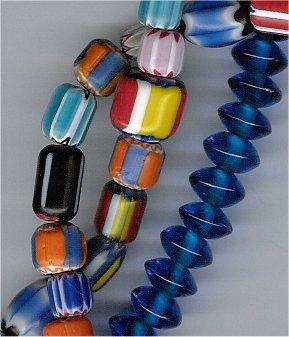
The beads show long-distance trade. An analysis of 138 of them found that the most common type was soda-lime glass made with plant ash, probably from glass produced in Mesopotamia and eastern Iran and carried along an eastern Niger corridor by the 9th or 10th century. Some glass and carnelian beads have been traced to the workshops of Fustat in Old Cairo. Other glass types have no known source yet, and Susan McIntosh argues that the possibility of trade across the Sahara needs more research.
Igbo-Ukwu is described as the centre of a trade system linking it with Gao on the bend of the Niger and, through Gao, with Egypt and North Africa. Its people traded with other African peoples as far as the Nile valley, while most of their metal came from the Abakaliki mines nearby.
Legacy

The sources do not say how the Igbo-Ukwu culture ended. Its bronzes stand centuries before the other known bronzes of the region, and their quality first led scholars to imagine that they were made after contact with Europeans. Isotope analysis and radiocarbon dating proved them local and far older, and with that they undid the colonial-era assumption that such work could only come from places in touch with Europe. Denis Williams called them “an exquisite explosion without antecedent or issue”, and Frank Willett compared their standard with that of Benvenuto Cellini five centuries later.
Five objects from Isaiah Anozie’s first finds are in the British Museum: a small staff, a ram’s head, a large manilla, a crescent-shaped vessel and the pendant of a chief’s head. After a memorial for Thurstan Shaw in 2014, the Igwe of Igbo-Ukwu, Martin E. Ezeh, allowed new fieldwork, coordinated by Pamela Jane Smith Shaw in 2019 and 2021, which aims to widen the record of the ancient settlement in time and space.
The Igbo-Ukwu culture is known from three sites in a town of south-eastern Nigeria: a shrine, a burial chamber and a cache, first dated to the 9th century CE and possibly used for several centuries. Its smiths cast intricate lost-wax bronzes from nearby ores, and its people traded for beads that came from as far as Egypt, Mesopotamia and Iran. The finds overturned colonial assumptions about early African art.
Test yourself
5 questions on this page, from its key events and facts.
The questions open here once the page has loaded.
References
- Ehret, C. (2002) The Civilizations of Africa: A History to 1800. James Currey.