
Culture · Americas
Lakota people
At a glance
- The Lakota, whose name means “allies”, are the westernmost of the Seven Council Fires of the Sioux; pushed west onto the Plains, they became horse-mounted bison hunters and made the Black Hills their home by the 1770s.
- The 1868 Fort Laramie Treaty closed the Black Hills to white settlement, but after gold was found there in 1874 war followed, and despite the Lakota and Cheyenne victory at the Battle of the Little Bighorn in 1876, resistance was broken by 1877.
- In 1890 Sitting Bull was killed and the 7th Cavalry massacred Lakota at Wounded Knee; the tribes still refuse the 1980 Supreme Court award for the Black Hills, because accepting it would end their claim to the land.
Timeline
- 1804The Lewis and Clark Expedition meets the Sicangu near the mouth of the Bad River, and a standoff ends when Black Buffalo grants the Americans passage
- 1851The Fort Laramie Treaty recognises Lakota title to nearly 100,000 square miles north of the North Platte in return for roads and military posts
- 1855General William S. Harney’s troops attack a Lakota and Cheyenne village at Blue Water Creek, killing at least 86 and taking 70 women and children captive
- 1866–1868Red Cloud leads the Lakota and their allies to victory in Red Cloud’s War, and the 1868 Fort Laramie Treaty establishes the Great Sioux Reservation
- 1874Custer’s expedition confirms gold in the Black Hills, and prospectors flood in against the terms of the 1868 treaty
- 1876Lakota and Cheyenne forces under Crazy Horse and Sitting Bull defeat Custer at the Battle of the Little Bighorn
- 1890Sitting Bull is killed at Standing Rock, and two weeks later the 7th Cavalry kills at least 270 Lakota in the Wounded Knee Massacre
- 1980In United States v. Sioux Nation of Indians the Supreme Court awards $122 million for the Black Hills, which the tribes refuse
Origins
The Lakota (Lakȟóta), also known as the Teton Sioux, are one of the three main divisions of the Sioux, with the Eastern Dakota (Santee) and the Western Dakota. They speak Lakȟótiyapi, the westernmost of three closely related Siouan languages. Their name means “allies”, and the seven Lakota tribes call themselves the Očhéthi Šakówiŋ, the Seven Council Fires, a name that can also stand for the whole Sioux Nation. Sioux comes from a French corruption of the Ojibwe Nadowessiwak.
Lakota tradition holds that the people emerged from Wind Cave in the Black Hills, so that their long migration east and back was a journey home. Scholars trace Siouan speakers to the central Mississippi Valley and a slow migration northwest, set off in part by the collapse of the Mississippian mound-building cultures from the 12th century. In the late 16th and early 17th centuries Dakota and Lakota speakers lived in the upper Mississippi region, in what is now Minnesota and Wisconsin, until Cree war parties armed with iron weapons pushed them west onto the Great Plains.
In the early 18th century the Lakota obtained horses from the Cheyenne along the Missouri River, calling them šuŋkawakaŋ, “dog of power”. After 1720 the Lakota split into two groups: the Saône reached the east bank of the Missouri by about 1750, and the Oglála and Sičháŋǧu followed ten years later, where the large Arikara, Mandan and Hidatsa villages had long barred the way. When smallpox devastated those villages from 1781, the Lakota crossed onto the High Plains and made the Black Hills their home.
Society
On the Plains the Lakota became a horse-mounted, bison-hunting people. With the Cheyenne and most of their neighbours they shared a seasonal round: dispersed band life in spring and autumn, sheltered winter camps, and a great summer gathering for ceremony and the communal hunt, when the tipi circles formed what the Lakota called the sacred hoop of the nation. The seven bands are the Sičháŋǧu (Brulé), Oglála, Itázipčho (Sans Arc), Húŋkpapȟa, Mnikȟówožu (Miniconjou), Sihásapa and Oóhenuŋpa (Two Kettles).
The American Horse ledger shows Lakota government at work before a council of 1825: the Oglála raised a council lodge, thiyóthipi, elder headmen presided, wakíčhuŋza, “deciders”, served as heralds, and akíčhita societies kept order, structures that almost certainly predate that year. The debate was fierce, and only the pressure of Bull Bear carried the Oglála to the council table.
The Lakota were one of the few Native nations whose numbers grew in the 19th century, from an estimated 8,500 in 1805 to 16,110 in 1881. Their dealings with neighbouring nations and with French, British and American traders ran through negotiation, gift exchange and ritual alliance, and their trade was aimed at horses and firearms. They took up what served them, grafting new economic networks onto their own sovereign structures.
Beliefs & Worldview
The Battiste Good winter count carries Lakota history back to 900 CE, when White Buffalo Calf Woman, Ptesáŋwiŋ, gave the people the sacred buffalo calf pipe. In this account, which remains central to Lakota religion, she appeared to two hunters, destroyed the one who approached her with impure intentions, and gave the pipe to the people through the chief Standing Hollow Horn. Its bowl of red stone stands for the Earth, its wooden stem for all growing things and its twelve eagle feathers for all winged creatures, binding the Lakota to every part of the universe through prayer to Wakȟáŋ Tȟáŋka, the Great Mystery. Leaving, she became in turn a red-and-brown calf, a white buffalo and a black buffalo, bowing to the four quarters, and promised to return.
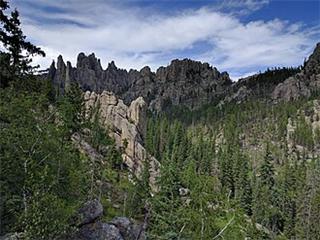
The Black Hills are sacred to the Lakota, and Wind Cave in their south is the place of the emergence story. The Lakota objected to mining in the Hills.
In 1890, after drought had destroyed the harvest and rations fell short, the Ghost Dance spread rapidly among the reservations, promising the resurrection of the old world and the disappearance of the white settlers. The new Pine Ridge agent, Daniel F. Royer, took this messianic revival for preparation for war, and his alarmed dispatches helped bring federal troops in that November.
Arts & Knowledge
The Lakota recorded their history in winter counts, waníyetu wówapi, pictorial calendars painted on hides and later on paper. The counts show what mattered to their keepers: most passed over the treaty of 1825 to record that year’s Missouri River flood, several for 1851 recorded a peace made with the Crow rather than the Fort Laramie Treaty, and they kept names for enemies, such as “The Butcher” and “Woman Killer” for General William S. Harney. Ledgers such as American Horse’s set down councils in detail.
The sacred pipe, with its bowl of red stone, wooden stem and eagle feathers, is not merely a ritual object but the symbolic centre of Lakota cosmology, its fire the focal point of the universe and its smoke a direct path to the Great Mystery. Camp life itself had a sacred pattern: the tipis of the summer gathering stood in circles that formed the sacred hoop of the nation. Oral heritage remains a living source, drawn on by the Lakota teacher, writer and actor Joseph M. Marshall III.
Lakȟótiyapi is written too. The linguist Ella Deloria devised an orthography in her fieldwork of the 1930s that anticipated much of the Standard Lakota Orthography, now the basis of the New Lakota Dictionary, with some 43,000 entries, and taught at Sitting Bull College, the Oglala Lakota County School District and Maȟpíya Lúta Owáyawa, formerly Red Cloud School.
Contact & Exchange

The Lakota rose to power on the Plains, pressing the Mandan, Crow, Pawnee and Arikara into the 1840s; the Cheyenne were pushed west by them, and made peace with them in 1840–1841. When the Lewis and Clark Expedition reached Sicangu land in 1804, the Lakota dealt with the United States as the dominant power of the region, granting passage on their own terms. The first treaty with the United States, in 1825, changed little. The Oregon Trail broke the peace: emigrants’ cattle ate the grass and spread disease among the buffalo, and in 1846 the Oglála and Sičháŋǧu wrote to the President as equal partners to demand compensation.
The army built Fort Laramie on Lakota and Arapaho land without permission, and the treaty of 1851 there recognised Lakota title to nearly 100,000 square miles. In 1855 General William S. Harney attacked a village at Blue Water Creek although its leader Little Thunder pleaded for peace, killing at least 86 and taking 70 women and children captive. Red Cloud’s War of 1866–1868 closed the Bozeman Trail, and the 1868 treaty set up the Great Sioux Reservation.
In 1874 Custer confirmed gold in the Black Hills; prospectors poured in and the government made no effort to remove them, and General Philip Sheridan urged the killing of the buffalo to starve the Lakota into submission. Lakota, Cheyenne and Arapaho forces defeated General George Crook at the Battle of the Rosebud in June 1876, and a week later Lakota and Cheyenne under Crazy Horse and Sitting Bull destroyed Custer’s column at the Battle of the Little Bighorn.
Legacy
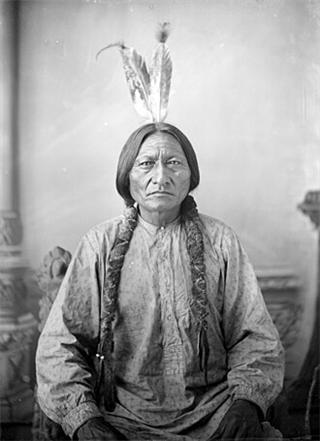
A winter campaign broke the remaining resistance. Crazy Horse surrendered in 1877 and was killed by a soldier later that year; Sitting Bull fled to Canada and surrendered in 1881. In 1877 some bands signed a treaty ceding the Black Hills, whose legitimacy remains disputed. In December 1890 Sitting Bull was killed at Standing Rock by Indian police sent to arrest him, and two weeks later the 7th Cavalry, with Hotchkiss guns, killed at least 270 Lakota of Spotted Elk’s band at Wounded Knee Creek, about 170 of them women and children. The massacre has endured as a defining symbol of US policy toward Native nations.
Today the Lakota live mainly on five reservations in South Dakota, governed by elected tribal councils; in 2010 they numbered over 170,000, about 2,000 of whom spoke Lakȟótiyapi. The tribes refused the $122 million that the Supreme Court awarded for the Black Hills in 1980, as accepting it would end their claim, and by 2011 the sum held for them exceeded $1 billion.
In Canada, nine Dakota and Lakota nations, Wood Mountain among them, received an apology and recognition as Aboriginal peoples in 2024. Lakota activists such as Madonna Thunder Hawk and Chase Iron Eyes fight the removal of Lakota children into South Dakota’s foster care system.
The Lakota, or Teton Sioux, moved from the upper Mississippi onto the northern Plains, became horse-mounted bison hunters and made the Black Hills the centre of their world. They defended it against the United States, winning at the Little Bighorn in 1876, but were confined to reservations, and the Wounded Knee Massacre of 1890 became a symbol of US policy. They still refuse payment for the Black Hills, holding to their claim to the land.
Test yourself
5 questions on this page, from its key events and facts.
The questions open here once the page has loaded.
References
- Christafferson, Dennis M., “Sioux, 1930–2000”, in R. J. DeMallie, ed., Handbook of North American Indians: Plains, Vol. 13, Part 2 (Smithsonian Institution, 2001)