
Culture · Central & East Asia
Ainu
At a glance
- The Ainu, whose name means “human being”, are the Indigenous people of Hokkaido, Sakhalin and the Kurils; their culture grew from the Satsumon culture with contributions from the Okhotsk culture.
- Living in small river villages called kotan, they fished for salmon, hunted deer and bears and traded between Honshu and the Asian mainland, in a world where everything held a kamuy.
- Japanese colonisation brought land seizure, forced labour, family separation, epidemics and bans on language and religion; a court first recognised the Ainu as an Indigenous people in 1997, and the Diet passed an act recognising them in 2019.
Timeline
- 13th centuryThe Ainu culture period begins, following the Satsumon culture
- 1264–1308The Ainu of northern Sakhalin resist the Mongol Yuan dynasty until they are subdued and pay tribute
- 1591A Jesuit Latin manuscript first records the name, as Aino, and calls Hokkaido “Aino moxori”
- 1799–1806The Tokugawa shogunate takes direct control of southern Hokkaido; forced labour, family separation and smallpox cut the Ainu population sharply
- 1869The Meiji government sets up the Hokkaidō Development Commission to settle Hokkaido
- 1899The Hokkaido Former Aborigines Protection Act takes Ainu land and aims to erase Ainu culture and identity
- 1997The Sapporo District Court’s Nibutani Dam ruling recognises the Ainu as an Indigenous people, and the Ainu Culture Law replaces the 1899 act
- 2019The National Diet passes an act recognising the Ainu as an Indigenous people of Japan
Origins

The Ainu are an Indigenous people of northern Japan and southeastern Russia, who call their homeland Ainu Mosir, “the land of the Ainu”. Their name, Aynu, means “human being” or “person”, as opposed to kamuy, divine beings; the Sakhalin Ainu also called themselves Enchiw. The name first appears, as Aino, in a Latin manuscript of 1591 kept in the Jesuit archives in Rome, which calls Hokkaido “Aino moxori”. Old Japanese texts call the region Ezochi and its people Emishi, a name now considered derogatory.
The Ainu are regarded as descendants of the Jōmon hunter-gatherers of Japan, and genetic research places them close to the deeply diverged Jōmon lineage of East Asia. Historians generally link the rise of Ainu culture to the Satsumon culture, which followed the Epi-Jōmon in Tōhoku and Hokkaido, with later contributions from the Okhotsk culture of the north. The Ainu culture period, also called the Nibutani period, began around the 13th century and runs to the present.
Ainu culture joins layers of different ages: elements going back to the Jōmon, Japanese elements gained through long contact, and a strong northern element from the Okhotsk population, whose last traces were absorbed into the Ainu. Their relation to the ancient Emishi of Tōhoku is still disputed, but at least some Emishi spoke Ainu languages, and Ainu place names show that Ainu once lived across northern Honshu. Ancestors of the Ainu referred to as Emishi came under Japanese subjugation from the 9th century and were pushed north.
Society

Ainu society was built around small villages called kotan, usually of fewer than ten households, set along rivers where salmon ran upstream or by the sea and named after the nearby river. Several kotan sometimes formed a local group, led by a headman who handled its outside and inside affairs. Wrongdoers were judged by members of the community; there was no imprisonment or death penalty, and a beating was usually the final punishment, though murder brought severe bodily punishment.
The Ainu lived mainly by hunting, fishing and gathering. They hunted Ezo deer, Ussuri brown bears and Asian black bears, foxes, hares and sea eagles, with arrows and spears tipped with surku, an aconite poison whose recipe was a family secret, and with spring traps called amappo. Salmon was called kamuy chep, “god’s fish”, and dried salmon was both a staple and a major trade good. Each village held its own hunting grounds and river fishing territory. They also grew millets and made starch from the bulbs of turep (Cardiocrinum cordatum).
Houses called chise had a wooden frame walled and roofed with reeds, grass or bark, a hearth near the centre and a sacred window on the east side. Men kept full beards; women were tattooed on the lips, hands and arms from about the age of 12 or 13, the tattoos completed at 15 or 16, when they could marry. In one custom a man ate half of a bowl of rice a woman gave him, and if she ate the rest, she accepted his proposal.
Beliefs & Worldview
The Ainu are traditionally animists: everything in nature holds a kamuy, a spirit or god. Among the most important are Kamuy-huci, goddess of the hearth and the most important female deity; Kim-un-kamuy, kamuy of bears and mountains; Repun Kamuy, god of the sea; and Kotan-kar-kamuy, regarded as the creator of the world. Things made with deep sincerity were also thought to become kamuy, and certain patterns in art could call on ancestors to protect against harm.
There were no professional priests: the village chief led the ceremonies, which consisted of libations of sake, prayers and offerings of inau, willow sticks with shavings attached. The Iyomante, the ceremony for sending back the spirits of bears, dates back to the 11th century: a bear cub was raised for years as a member of the family and then ritually killed, in the belief that its spirit, well treated in life, would care for the community. Before a hunt, Ainu prayed to Kamuy-huci and to the god of the mountains.
The soul was thought to travel through the hearth of Kamuy-huci to the afterlife, and the immortal spirit to be rewarded by rising to kamuy mosir, the land of the gods. The dead were dressed in ceremonial clothes, with treasured possessions broken to release their spirits, and graves were marked with carved poles called kuwa. At the Tohohata burial site, all but one of 75 graves face southeast, near the point of the midwinter sunrise. Today many Ainu combine Buddhism with traditional beliefs, and some northern Ainu became Russian Orthodox.
Arts & Knowledge
Without a writing system of their own, the Ainu were masters of spoken narrative. The Yukar epics and Uepeker tales were learned by heart and recited at gatherings that could last hours or days, and all Ainu speakers understood the classic language of the Yukar, though dialects from opposite ends of Hokkaido could not understand each other. Ainu is a language isolate, written today in katakana or the Latin alphabet. Ainu patterns (Ainu mon’yō) and the Yukar have been designated Hokkaido Heritage.
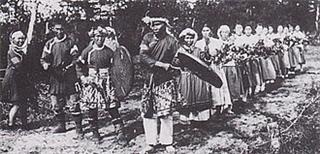
Clothing was a major art. The attus robe was woven from bark fibre; in winter people wore animal skins, and on Sakhalin boots of dog or salmon skin. Women wore embroidered headbands (matanpushi), earrings and necklaces of glass beads called tamasay, some from the Asian mainland. Men wore a ceremonial crown of shaved wood, the sapanpe, and carried an emush sword on a shoulder strap. Modern craftswomen still weave and embroider traditional garments.
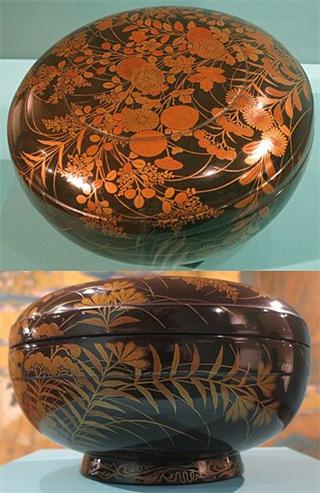
Lacquerware, almost all imported from Honshu, was treasured and used for offering drink to the kamuy. Music lives on in instruments such as the tonkori, played today by the musician Oki, and in dances at ceremonies, banquets and festivals. Hilltop forts called chashi, built on hills, promontories and river terraces, may have served for defence, ritual, trade or watching routes.
Contact & Exchange
The Ainu traded between Honshu and Northeast Asia. On Sakhalin they fought the Nivkh, and after the Mongols set up a post at Nurgan on the Amur in 1263, the Mongol-ruled Yuan dynasty attacked them in 1264; the northern Sakhalin Ainu resisted until 1308, then paid tribute. The Ming dynasty gave Sakhalin headmen hereditary titles: in 1431 one, Alige, brought marten pelts as tribute, and the Ming rewarded such headmen with silk uniforms; under Ming rule Chinese motifs and goods spread among the Ainu. Under the Qing dynasty Sakhalin, called Kuyedao, “island of the Ainu”, joined a fur-tribute system paid back in silk brocade and official robes.
From the south came the Matsumae clan, to whom the Tokugawa shogunate gave exclusive rights to trade with the Ainu. The clan leased its rights to merchants, Ainu groups competed for Japanese goods, and epidemics such as smallpox reduced their numbers. The Matsumae extorted Chinese silk from the Sakhalin Ainu, who fell into debt to obtain it, and sold it in Honshu; the shogunate ruled southern Hokkaido directly from 1799 to 1806 and took Sakhalin under its own control in 1807.
The Ainu were also go-betweens, serving as guides, translators and traders between Russians and Japanese, while Santan traders from the Amur kept dealing with them outside Japanese control. After the Treaty of Saint Petersburg of 1875 gave Sakhalin to Russia and the Kurils to Japan, 83 North Kuril Ainu chose Russian rule and moved to Kamchatka in 1877; under Soviet rule their villages were disbanded and the people moved by force.
Legacy

Japanese rule did grave harm. Under direct shogunate control in the early 19th century, Ainu women were separated from their husbands and raped or forcibly married to Japanese men, and Ainu men were sent to merchants for five- and ten-year terms of labour; with smallpox, these policies made the population fall steeply. Figures differ: one gives 80,000 Ainu in the 18th century, another a maximum of 26,800 in the Edo period, and by 1868 about 15,000 lived in Hokkaido, 2,000 on Sakhalin and 100 in the Kurils.
After the Meiji Restoration and the founding of the Hokkaidō Development Commission in 1869, Ainu land was given to Japanese settlers, a process called colonisation at the time. The Hokkaido Former Aborigines Protection Act of 1899 took Ainu land and was designed to erase Ainu culture and identity: the rights to hunt, gather and speak their language were denied, tattooing and religious practices were ordered stopped, and children were sent to schools where Ainu was forbidden. Most Ainu were forced into petty labour and lasting discrimination, and Hokkaido Ainu now probably has no native speakers.
Revival came through Ainu effort. The folklorist and former Diet member Shigeru Kayano opened an Ainu language school in 1987 and, with Tadashi Kaizawa and his son Koichi, fought the Nibutani Dam; the Sapporo District Court’s 1997 ruling recognised the Ainu as an Indigenous people, and the 1899 act was repealed. Japan passed recognition into law in 2019, and the National Ainu Museum opened at Upopoy in Shiraoi in 2020. Ainu in Russia still seek official recognition, and in 2023 Hokkaido Ainu sued to regain the right to fish salmon in rivers.
In the Research Series
The Ainu are the Indigenous people of Hokkaido, Sakhalin and the Kuril Islands, descended from the Jōmon peoples, whose own culture took shape around the 13th century. They lived in river villages by salmon fishing, hunting and trade, in a world where everything held a kamuy. Japanese and Russian colonisation took their land and suppressed their language and religion, before a court recognised them as an Indigenous people in 1997 and the Diet did so by law in 2019.
Test yourself
5 questions on this page, from its key events and facts.
The questions open here once the page has loaded.
References
- Majewicz, A. F. (ed. and trans.) The Collected Works of Bronisław Piłsudski. Vol. 1: The Aborigines of Sakhalin; Vols 2–3: Materials for the Study of the Ainu Language and Folklore.