Culture · Central & East Asia
Yayoi culture
At a glance
- The Yayoi period brought wet-rice farming to the Japanese archipelago, and with it permanent villages, stored grain, landholding and a more stratified society.
- Farming migrants from the Korean Peninsula and other parts of the continent mixed with the Jōmon population, laying the foundations of the modern Japanese people and, most linguists think, spreading the Japonic languages.
- Chinese histories describe the land of Wa as many scattered communities, among them the Na state, which received a golden seal in 57 CE, and Yamataikoku under Queen Himiko.
Timeline
- c. 1000–800 BCEThe earliest start for the Yayoi suggested by disputed radiocarbon dates from residue on pottery
- c. 300 BCEThe conventional start of the Yayoi period, as wet-rice farming spreads from northern Kyushu
- 1st century CEIron farming tools and weapons come into use, and large regional powers emerge across western Japan
- 57 CEThe Na state of Wo receives a golden seal from Emperor Guangwu of the Later Han dynasty
- late 2nd century CEThe political entity known as Wa-koku has formed
- 3rd century CEThe Wei zhi records Queen Himiko of Yamataikoku, who took the throne of Wa as a spiritual leader after a civil war
- mid-3rd century CEThe first keyhole-shaped burial mounds mark the transition to the Kofun period
- 19th centuryArchaeologists name the culture after the Yayoi district of Tokyo, where its pottery was first found
Origins
The Yayoi period is generally defined as the era between the beginning of food production in Japan and the appearance of the first keyhole-shaped burial mounds. It is usually dated from about 300 BCE to 300 CE, but its start is disputed. Radiocarbon dates from organic residue on pottery sherds may push the beginning back by up to 500 years, to around 1000–800 BCE, a result that remains highly controversial; other accounts place the start in the 10th century or the 9th–8th centuries BCE. The name was given by archaeologists in the 19th century after the Yayoi district of Tokyo, where pottery of this kind was first found.
The earliest sites, Itazuke and Nabata, lie in northern Kyushu, the part of Japan closest to Korea, though even this is still debated. Over several centuries features from Korea and China arrived there and spread south and east, mixing with the native Jōmon culture. The archaeologist Mark J. Hudson lists the evidence that ties the Yayoi to the southern Korean Peninsula: bounded paddy fields, new types of polished stone tools, wooden farming implements, iron tools, weaving, ceramic storage jars, the bonding of clay coils on the outside of pots, ditched settlements, domesticated pigs and jawbone rituals. Between 1996 and 1999 a team led by Satoshi Yamaguchi of Japan’s National Museum of Nature and Science also found many similarities between Yayoi remains from Yamaguchi and Fukuoka prefectures and remains from Jiangsu province on the Chinese coast.
In archaeology the term “Yayoi people” means the farming migrants from the Korean Peninsula and regions to the south who arrived in this period, not a single ethnic group. Some scholars argue that the growth of roughly four million people between the Jōmon and Yayoi periods cannot be explained by migration alone and owes most to the shift to a farming diet; still, archaeological evidence supports an influx of farmers from the continent who absorbed or overwhelmed the native hunter-gatherers.
Society

Rice changed the way people lived. Irrigated paddy fields, introduced first in Kyushu along with millets, led people to stay in one place for long periods in permanent farming villages. Stone harvesting knives like those of the Korean Peninsula appear at the very start of the period, and by the 1st century CE iron farming tools were in use. People wove hemp and lived in raised-floor dwellings with thatched roofs, while many still used the same pit or circular houses as the Jōmon.
As the population grew, society became more stratified and complex. Owning land and storing grain allowed people to accumulate wealth, and distinct social classes developed. Chinese sources describe tattoos and other bodily markings that showed differences in status, and in parts of Kyushu chiefs appear to have sponsored and politically manipulated the trade in bronze and other prestige objects. In the latter half of the late Yayoi, around the 1st century CE, large regional powers emerged across western Japan, including the Tōkai and Hokuriku regions, and by the end of the 2nd century the political entity called Wa-koku had formed.
Chinese writers of the 3rd century described the Wa as eating raw fish, vegetables and rice served on bamboo and wooden trays, observing mourning, collecting taxes, keeping provincial granaries and markets, and maintaining relations of lord and vassal. They also called the society one of violent struggles, and archaeology points the same way: many excavated settlements were moated or built on hilltops, headless skeletons have been found at Yoshinogari, and stone arrowheads are often found among the grave goods of the Inland Sea coast.
Beliefs & Worldview

Yayoi craft specialists cast bronze ceremonial bells called dōtaku, as well as mirrors and weapons, and the bronze mirror, the bronze sword and the royal seal stone are counted as the three major symbols of Yayoi culture. The earliest written records about people in Japan are Chinese, so the meaning these objects held for their makers has to be read from the finds and from what outsiders wrote. Hudson counts “jawbone rituals” among the practices that link the Yayoi to the southern Korean Peninsula.
Chinese sources of the 3rd century say that the Wa clapped their hands in worship, a gesture still made at Shinto shrines today, built earthen grave mounds and observed mourning. Yayoi burial mounds, like their pottery and their ways of preserving food, were found to be very similar to those of southern Korea. Rice cultivation itself came to be deified, and it is thought likely that rice farming and its deification allowed a slow and gradual rise in population.
Religion and power were closely joined. According to the Wei zhi, part of the Records of the Three Kingdoms, Queen Himiko took the throne of Wa as a spiritual leader after a major civil war, while her younger brother handled the affairs of state, including relations with the court of the Kingdom of Wei. When the Wei embassy asked about their origins, the people of Wa claimed descent from Taibo of Wu, a figure of the Wu Kingdom around the Yangtze Delta.
Arts & Knowledge
Yayoi pottery is simpler and more practical than the richly decorated wares of the Jōmon. It was made with the same coiling technique, and some pieces clearly show the influence of Jōmon ceramics, but new features arrived from the continent, among them ceramic storage jars and the bonding of clay coils on the outside of the vessel. Yayoi pottery and burial mounds closely resemble those of southern Korea.
Metalworking was the great novelty. Techniques for bronze and iron were introduced, and Yayoi craft specialists made bronze ceremonial bells (dōtaku), mirrors and weapons. Chinese influence is clear in the bronze and copper weapons, the mirrors called dōkyō and the dōtaku. By the 1st century CE iron agricultural tools and weapons were in use. Farming brought its own equipment: new types of polished stone tools, wooden implements and stone harvesting knives like those of the Korean Peninsula.
The Yayoi wove textiles, including hemp, and built with wood and stone, from raised-floor dwellings with thatched roofs to villages surrounded by moats. Many older skills carried on. Chipped stone tools for hunting, bone tools for fishing, shell bracelets and lacquer decoration on vessels and accessories all continue Jōmon practice, a reminder that the period mixed new influences from the continent with existing traditions.
Contact & Exchange
The Yayoi world grew from long contact across the sea between Kyushu and Korea. Fishing communities on the coast of northern Kyushu and the southern coast of Korea had already exchanged goods such as fishhooks and obsidian in the Jōmon period. Irrigated wet-rice farming itself came from the Yangtze estuary in southern China, reaching Japan through the Ryukyu Islands or the Korean Peninsula. Skeletons show the meeting of peoples: the Jōmon were shorter, with wider faces and strongly raised brow ridges, while Yayoi people averaged 2.5–5 cm taller, with higher, narrower faces. By the Kofun period almost all skeletons found in Japan, except those of the Ainu, are of the Yayoi type, some with a small Jōmon admixture.
Most linguists and archaeologists agree that the Japonic language family was introduced to the archipelago and spread through it in this period. According to several linguists, Japonic languages were also once spoken across much of the southern Korean Peninsula before Koreanic languages replaced them. Whitman and other researchers propose that Japonic reached Korea around 1500 BCE and was carried to Japan by wet-rice farmers between 700 and 300 BCE, and Kazuo Miyamoto traces a shared origin of proto-Japonic and proto-Koreanic to the eastern Liaoxi district of southern Manchuria.
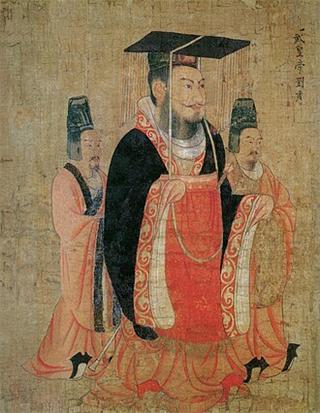
The Yayoi also entered the written history of China. The Book of the Later Han, compiled by Fan Ye in the 5th century, records that in 57 CE the Na state of Wo received a golden seal from Emperor Guangwu. In the 3rd century the Wei zhi describes Queen Himiko and Wa’s relations with the Kingdom of Wei. Chinese historians saw Wa as a land of hundreds of scattered tribal communities, not the unified land with a 700-year tradition that the 8th-century Nihon Shoki would later describe.
Legacy

The Yayoi period gave way to the Kofun period around the middle of the 3rd century CE, marked by the appearance of keyhole-shaped burial mounds, although the exact starting point of the Kofun period is still debated. Where Queen Himiko’s Yamataikoku lay has long been researched. Two sites have been proposed, Yoshinogari in Saga Prefecture and Makimuku in Nara Prefecture, and recent archaeological research at Makimuku suggests that Yamataikoku was there. Some scholars think the Hashihaka kofun at Makimuku was Himiko’s tomb, and how Yamataikoku relates to the Yamato polity of the following Kofun period is also debated.
The migrants of the Yayoi period gradually merged with the native Jōmon population, forming the foundation of the modern Japanese people. The mix varied from place to place: Kyushu, Okinawa and the Tōhoku region kept stronger Jōmon traits, while Kansai and Shikoku show more pronounced Yayoi features.
The Yayoi period marked Japan’s change from a hunter-gatherer economy to one based on wet-rice agriculture, with metal tools, permanent villages, stored wealth and ranked societies. The custom of clapping hands in worship, noted by Chinese visitors in the 3rd century, is still part of visits to Shinto shrines today.
The Yayoi culture brought wet-rice farming, bronze and iron to the Japanese archipelago, spreading from northern Kyushu from about 300 BCE, though disputed radiocarbon dates suggest an earlier start. Migrants from the Korean Peninsula and beyond mixed with the Jōmon population, and farming villages grew into stratified societies and regional powers. Chinese histories record the land of Wa and Queen Himiko before the Kofun period began in the mid-3rd century CE.
References
- Beckwith, Christopher I. (2004) Koguryo, the Language of Japan’s Continental Relatives. Brill.
- Habu, Junko (2004) Ancient Jomon of Japan. Cambridge: Cambridge University Press.
- Miyamoto, Kazuo (2016) “Archaeological Explanation for the Diffusion Theory of the Japonic and Koreanic Language”. Japanese Journal of Archaeology 4 (1): 53–75.
- Serafim, Leon A. (2008) “The uses of Ryukyuan in understanding Japanese language history”, in Frellesvig, Bjarke and Whitman, John (eds) Proto-Japanese: Issues and Prospects. John Benjamins, 79–99.
- Unger, J. Marshall (2009) The Role of Contact in the Origins of the Japanese and Korean Languages. Honolulu: University of Hawaii Press.
- Vovin, Alexander (2017) “Origins of the Japanese Language”. Oxford Research Encyclopedia of Linguistics. Oxford University Press.