Culture · South & Southeast Asia
Sangam-age Tamilakam
At a glance
- Sangam-age Tamilakam was the ancient Tamil-speaking country of southern India, divided among the Chera, Chola and Pandya kings and lesser chieftains, the Velir.
- Its 2,381 surviving poems by 473 poets, at least 27 of them women, sing of love and war and are the earliest known literature of South India.
- Farming, weaving, pearl fishing and shipbuilding supported a sea trade in pearls, pepper and textiles that brought Roman coins to Kerala and Tamil Nadu.
Timeline
- 6th century BCEA settlement at Keezhadi, near Madurai, is occupied, according to radiocarbon dating
- 3rd century BCEInscriptions of the time of the Maurya Empire give the earliest datable references to the Tamil kingdoms
- c. 237 BCETwo adventurers from southern India take control of the Anuradhapura kingdom in Sri Lanka
- 145 BCEElara, a Chola general or prince, takes the throne of Anuradhapura and rules for forty-four years
- c. 100 BCE–250 CEThe span Kamil Zvelebil finds most acceptable for the Sangam poems
- 1st century CEThe Periplus of the Erythraean Sea describes Muziris, a Chera port of the trade with Rome
- 1883U. V. Swaminatha Aiyar finds major Sangam manuscripts at the Thiruvavaduthurai Adhinam
- 2013–2014A survey along the Vaigai river led by Amarnath Ramakrishna identifies Keezhadi among 293 sites with archaeological remains
Origins
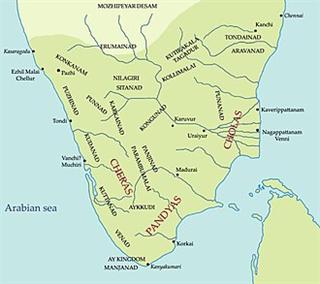
Tamilakam, “the home of Tamil”, seems to be the oldest name for the Tamil country, found in the Purananuru and the Patiṟṟuppattu. It covered the southernmost part of the Indian subcontinent: present-day Tamil Nadu, Kerala, Puducherry, Lakshadweep and southern parts of Andhra Pradesh and Karnataka. A preface added later to the grammar Tolkāppiyam places it between the Venkata hill in the north and Kumari in the south; the seas are assumed to have been its other borders. Sri Lanka was distinguished from it as Ilam.
The Sangam age, or Sangam period, is the history of this region and parts of Sri Lanka from about 300 BCE to 300 CE. It takes its name from the Sangam literature, the early classical Tamil poetry, which Tamil tradition links to three legendary literary academies, or sangams, at Madurai and Kapāṭapuram lasting thousands of years. That chronology is regarded as mythical: David Shulman finds “not the slightest shred of evidence” that such academies existed, while Kamil Zvelebil sees a kernel of truth and concludes that an academy did exist at Madurai at the beginning of the Christian era. Zvelebil finds 100 BCE to 250 CE the most acceptable range for the poems; others place them somewhat later and more narrowly, but all before 300 CE.
Archaeology reaches further back. Excavations at Keezhadi, on the border of Madurai and Sivagangai districts, revealed a Sangam-era settlement radiocarbon-dated to the 6th century BCE, and some accounts begin the age around 600 BCE. Claims that Keezhadi proves writing at that date have been challenged, since it is unclear whether the inscribed sherds came from the same layer as the dated samples.
Society
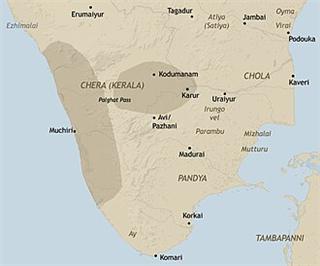
Between 300 BCE and 300 CE Tamilakam was ruled by three dynasties, the Pandya, Chola and Chera, and a few independent chieftains, the Velir. The Cholas’ heartland was the fertile Kaveri valley; the Pandyas held the Vaigai valley, ruling first from the port of Korkai and later from Madurai; the Cheras ruled what is now western Tamil Nadu and Kerala. The country was divided into great regions (perunadu) and into 13 smaller nadus, each with its own dialect of Tamil. The Silappadikaram names four great cities: Madurai, Uraiyur, Kanchi and Puhar.
Agriculture was the main occupation and was counted the foremost. Paddy was the staple and served as a medium of exchange for inland trade; pepper, sugarcane and millets were also grown, and the farmers (Ulavar) were placed at the top of the social order. Irrigation, ploughing, manuring and storage improved over the period. Industry was mostly domestic: weaving, pearl fishing, smithing and shipbuilding were the chief crafts, with cotton and silk cloth from Madurai and Uraiyur in great demand and Korkai the centre of the pearl trade.
The poets came from many walks of life. According to the historian Nilakanta Sastri, some were royal, some merchants, some farmers, and at least 27 of the 473 poets were women. The poems praise the just king as Sengol-valavan and describe the handing over of a royal sceptre, the Sengol, as a charge to rule fairly; priests warned that royal injustice would bring divine punishment.
Beliefs & Worldview

Several faiths lived side by side. Hinduism, in the forms of Vaishnavism, Kaumaram, Shaktism, Shaivism and Dravidian folk religion, together with Jainism and Buddhism, was present in the Tamil country from at least the 2nd century BCE. The Pattinappalai, one of the Ten Idylls, describes the worship of Vishnu and Murugan alongside Buddhist and Jain monasteries in the Chola capital.
The gods of the poems are tied to landscapes. In the Tolkappiyam, Mayon, “the dark one”, identified with Vishnu, is the deity of the pastoral mullai land, and Ceyon, “the red one”, is Murugan, praised in the poems as “the favoured god of the Tamils”, ever young and seated on a blue peacock. Ventan, identified with Indra, Korravai, identified with Durga, and Varunan, the sea god, also appear. The 33 surviving poems of the Paripatal praise Vishnu, Durga and Murugan, and the Kalittokai mentions Krishna, Shiva, Murugan, the Pandava brothers of the Mahabharata and the goddess Ganga. Zvelebil describes Vishnu as the ageless supreme god of the Tamils and Skanda, Murugan, as their young and personal god; the Tolkappiyam does not mention Shaivism.
Some Paripatal poems are set at bathing festivals and mention temples and shrines. One poem speaks of the “merciful men of Benares”, and loan words from Sanskrit, such as aciriyan (priest, teacher) from acarya, suggest ongoing linguistic and literary exchange with other parts of the subcontinent.
Arts & Knowledge
The Sangam corpus is largely bardic poetry: 2,381 poems by 473 poets, 102 of them anonymous, from 3 to 782 lines long. Sixteen poets wrote about half of it, and Kapilar alone almost a tenth. It includes the oldest surviving Tamil grammar, the Tolkappiyam, and the anthologies of the Ettuttokai (“Eight Anthologies”) and the Pattuppāṭṭu (“Ten Idylls”), grouped in the 10th century CE among the Eighteen Greater Texts.
About three-quarters of the poems are akam, “inner” poems of love, and a quarter puram, “outer” poems of war and public life. Both are set in landscapes (tinai): kurinci, the mountains; mullai, pastoral forest; marutam, farmland by rivers; neytal, the coast; and palai, arid land. Akam poems never name people or places and leave the context to listeners who know the tradition; puram poems name them directly. The early poems follow two metres, akaval and vanci, built from units called acai, which Zvelebil praises for their “wonderful conciseness, terseness, pithiness”.
Music mattered: the colophons of the Paripatal name music and tunes, evidence, according to Zvelebil, of a sophisticated and prosperous civilisation in the 2nd or 3rd century CE. Finds from Keezhadi include ivory and terracotta dice, terracotta figurines of men and women, an iron dagger and punch-marked coins, and some of its pottery sherds contain carbon nanomaterials, among them carbon nanotubes.
Contact & Exchange

Tamilakam traded far overseas. The Periplus of the Erythraean Sea (1st century CE) and Ptolemy’s Geography (2nd century CE) name its coasts and ports: Limyrike for the south-western coast, the Chera port of Muziris, a major centre of Indo-Roman trade, and Kaberis Emporion, identified with Kaveripattinam. Megasthenes and Pliny the Elder wrote of the Pandya kingdom, Pliny of its trade with Rome. Pearls, pepper, textiles, ivory and precious stones were exported, and Roman coins and amphorae found in Kerala and Tamil Nadu confirm the trade; Korkai’s pearls were sought in northern India and in Rome. The Pattinappalai describes a harbour city full of ships and merchandise.
The northern empires knew the Tamil lands as independent. Ashoka’s inscriptions refer to independent states beyond his southern frontier, and Kharavela’s Hathigumpha inscription records the destruction of a “confederacy of Tamil powers”; the region mostly remained unconquered by the Maurya and Gupta empires while having exchanges with them. The three dynasties often competed for supremacy, and the poems record their conflicts and rival claims to superiority.
Tamil language and culture spread beyond Tamilakam, to the Maldives, Sri Lanka and some coasts of Southeast Asia. Coins of the 2nd century BCE to the 2nd century CE from Tissamaharama in southern Sri Lanka carry Tamil names, suggesting Tamil merchants there. Around 237 BCE two adventurers from southern India took control of Anuradhapura, and in 145 BCE the Chola Elara took its throne, ruling for forty-four years until the Sinhalese Dutugamunu defeated him.
Legacy
The Sangam age gave way to the post-Sangam period, whose literature dates from about 250 to 600 CE. The three dynasties long outlived it: the Cholas ruled in central Tamil Nadu until the 13th century, the Cheras until the 12th, and the Pandyas parts of South India until the late 17th century, while Tondai Nadu, once under the Cholas, emerged as the independent Pallava realm by the 6th century CE.
The poems themselves were lost for most of the second millennium, preserved in Hindu monasteries. In the 19th century Arumuka Navalar of Jaffna printed the first Sangam text in 1851, C. W. Damodaram Pillai hunted out manuscripts and published works such as the Kalittokai (1887), and U. V. Swaminatha Aiyar, after finding palm-leaf manuscripts at the Thiruvavaduthurai Adhinam in 1883, published the Ten Idylls in 1889; together they printed more than 100 works. A. K. Ramanujan, quoted by Zvelebil, judged that there is “not much else in any Indian literature equal to these quiet and dramatic Tamil poems”.
The literature is evidence of a literary tradition in South India in parallel to Sanskrit and of the classical status of Tamil. Its poems are quoted in modern Tamil cinema and have been set to symphonic music, and Tamil politicians use the name Tamilakam for Tamil Nadu. The Keezhadi Heritage Museum near Sivaganga, opened in 2023, shows finds from excavations whose claimed evidence of early writing has been challenged.
Sangam-age Tamilakam was the ancient Tamil country of southern India, c. 300 BCE–300 CE, covering today’s Tamil Nadu and Kerala and parts of neighbouring states. It was ruled by the Chera, Chola and Pandya dynasties and lesser chieftains, lived by farming, weaving and pearl fishing, and traded overseas as far as Rome. Its 2,381 poems of love and war are the earliest known literature of South India.
References
- Navalar, A. (ed.) (1851) Tirumurukāṟṟuppaṭai.
- Damodaram Pillai, C. W. (ed.) (1887) Kalittokai.
- Swaminatha Aiyar, U. V. (ed.) (1889) Pattuppāṭṭu.