
Culture · Europe
La Tène culture
At a glance
- The La Tène culture followed the Hallstatt culture without a definite break about 450 BCE and spread from its core north of the Alps across much of Europe, as far as Galatia in Asia Minor.
- Its people were those whom Greek and Roman writers called Celts and Gauls, though how far its objects, a language and a people coincide is debated.
- From the 2nd century BCE its people built oppida, walled towns of up to hundreds of hectares, and many of them became Roman cities, among them Lutetia (Paris) and Avaricum (Bourges).
Timeline
- early 5th century BCEElite graves are built at Glauberg in Hesse, a region once thought peripheral to the La Tène world
- c. 450 BCEThe La Tène culture succeeds the final phase of the Hallstatt culture north of the Alps
- c. 387 BCECelts under Brennus defeat the Romans and sack Rome
- 4th century BCEIn several major migrations the culture spreads across France, Germany and Central Europe and on to Hispania, Italy, the Balkans and Asia Minor
- 279 BCECeltic groups who have crossed the Balkans attack and sack Delphi
- 2nd century BCEOppida appear more or less at once from the Atlantic to central Europe
- 58–50 BCEJulius Caesar’s Gallic Wars complete the Roman conquest of Gaul
- 1857A drought lowers Lake Neuchâtel and reveals the type site of La Tène
Origins

The La Tène culture is named after its type site on the north shore of Lake Neuchâtel in Switzerland, where thousands of objects had been deposited in the lake. It grew out of the final phase of the Hallstatt culture, HaD (c. 650–450 BCE), without any definite break; the change is detected mainly through elite objects in the new style, which first appear on the western edge of the old Hallstatt region. There is no agreement on exactly where it began, but there is broad consensus that its centre lay on the north-western edge of the Hallstatt world, north of the Alps, between the valleys of the Marne and Moselle and the nearby Rhineland. Elite graves of the early 5th century BCE excavated at Glauberg in Hesse in 1994 showed that a region once thought peripheral belonged to this core.
Barry Cunliffe describes two “zones of power and innovation” in the 5th century BCE: a Marne–Moselle zone in the west, linked to the Po Valley through the central Alpine passes, and a Bohemian zone in the east, linked to the Adriatic. Mediterranean influence from the Greeks, the Etruscans and the Golasecca culture was considerable, but the new art style did not depend on it.
Its bearers were the people Greek and Roman writers called Keltoi and Galli. Whether the whole culture belonged to one Celtic people is hard to judge, since language, material culture and political affiliation need not run together, and the popular equation of La Tène with “the Celts” is controversial.
Society
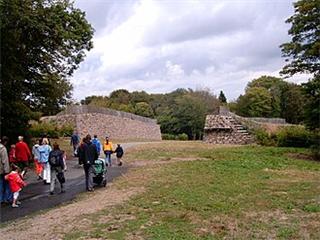
At first La Tène people lived in open settlements dominated by chieftains’ hillforts, while most lived in small villages or farmsteads. From the 2nd century BCE walled towns, the oppida, appeared from the Atlantic to central Europe; more than 180 are known from France to Hungary. Covering up to hundreds of hectares behind massive ramparts, they were centres of craft, trade, politics and religion, and the largest were the capitals of Celtic states. Many had planned layouts: at Manching in Germany every building followed the same standard measurements, and a metal measuring rod of that standard was found there.
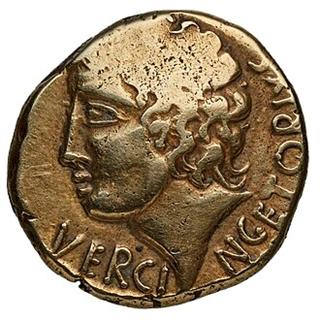
Society was ranked, with nobles, a priestly class of Druids, merchants, artisans and farmers, and status came partly from birth and partly from achievement. Peoples were divided into tribes, usually ruled by kings, and allied tribes could choose a war leader, as an assembly of Gauls at Bibracte chose Vercingetorix against Rome. Julius Caesar describes states, civitates, with three classes, knights, Druids and commoners, and by about 50 BCE some tribes had replaced kingship with elected magistrates, the Vergobrets. Women could reach the highest ranks, including rule as queens, particularly in Britain, and some of the richest graves of central Europe are women’s. Slavery and the slave trade existed.
Iron production grew enormously: by the 2nd century BCE some 200 types of iron tool were in common use.
Beliefs & Worldview
The Druids were religious leaders and also judges, keepers of lore, healers and political advisers. Classical writers describe them as philosophers and teachers of natural philosophy, astronomy and mathematics. Julius Caesar says that one chief Druid held the highest authority, and that at a set time of year the Druids met in the territory of the Carnutes in central Gaul to judge disputes. Their training was said to last up to twenty years and was learned by heart, for they did not think it right to write their teaching down. Its central doctrine, in Caesar’s account, was that souls do not die but pass after death from one to another. Classical sources also name Bards, singers and poets, and Vates, diviners.
Burials held weapons, chariots and both elite and household goods, suggesting a strong sense of an afterlife continuing this life. La Tène peoples dug ritual shafts into which votive offerings and even human sacrifices were cast, and made offerings in lakes and rivers. Severed heads, particularly of defeated enemies, seem to have held great power and were often carved. The type site, with 166 swords, most without signs of wear, and many human and animal bones, is read by some scholars as a place of sacrifice after a battle; others think its bridge was destroyed by high water.
At Bibracte a monumental stone basin with a precise geometric design and an astronomical alignment has been suggested as a “Druidic monument”.
Arts & Knowledge
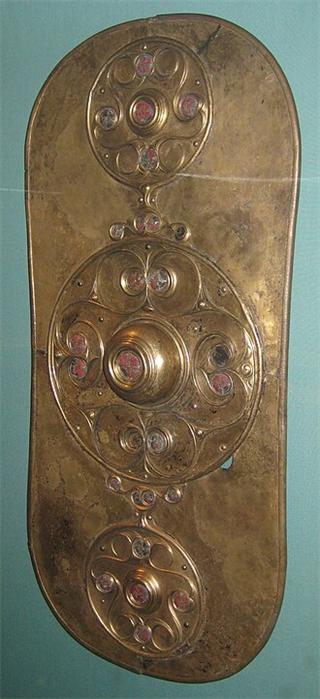
La Tène metalwork in bronze, iron and gold grew technically out of the Hallstatt tradition but developed a style of its own: intricate spirals and interlace, inscribed and inlaid, on fine bronze vessels, helmets, shields, horse trappings and elite jewellery, above all the neck rings called torcs and the clasps called fibulae. Elegant, stylised animal and plant forms were joined to the Hallstatt habit of geometric patterning. The Early Style was mostly static and geometric; the Developed Style moved to forms full of movement such as triskeles, among them the serpentine scroll of the Waldalgesheim Style. Many designs were laid out with compasses, and myths appear in highly stylised form. Celebrated pieces include the Basse Yutz Flagons, the gold-covered Agris Helmet, the Battersea Shield and the Great Torc from Snettisham.
Celtic craftsmen are credited with shrunk-on iron tyres, wagons with front-axle steering, roller bearings in wheel hubs and wooden barrels bound with hoops, and the Roman writer Varro credited them with chain mail. Coins, first minted in the late 4th century BCE, carried stylised portraits, abstract symbols and mythological images.
Music is shown by sculptures of lyre players, thought to be Bards, by remains of string instruments and by the great metal horns called carnyxes. Diodorus Siculus wrote that the Bards sang to lyre-like instruments songs of praise or of obloquy.
Contact & Exchange
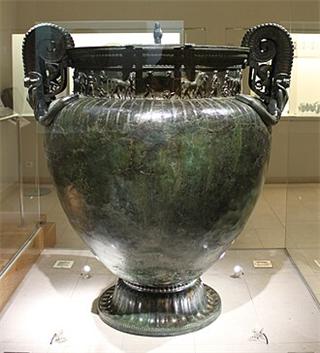
Trade ran intensively across Europe. The Greek colony of Massalia (Marseille) drew trade up the Rhône and Saône, and early La Tène elite burials such as the Vix Grave in Burgundy hold imported luxuries; by 500 BCE, as the Etruscans came to border the Celts in northern Italy, trade across the Alps overtook the Rhône route. In the last two centuries BCE the trade in manufactured goods grew sharply: oppida mass-produced pottery, iron weapons, bronze vessels and glass jewellery for export, carried by packhorse, wagon and river boat, and local rulers charged tolls. Salt, tin, copper, amber, wool, leather, furs and gold went south, and wine, luxuries and coral came north. Caesar says the Veneti of Armorica dominated the trade with Britain in their oak-built ships.
In the 4th century BCE several major migrations carried the culture to Hispania, Italy, the Balkans and Asia Minor. About 387 BCE Celts under Brennus defeated the Romans and sacked Rome; in 279 BCE groups crossing the Balkans sacked Delphi, and Galatia was established in Anatolia. In Britain the style spread apparently without significant movements of people. Celts served as mercenaries in Greek armies, and the spatha, a long sword of Celtic design, reached the Romans through Celtic mercenaries and auxiliaries.
Roman expansion into the La Tène area began after about 275 BCE with the conquest of Cisalpine Gaul and was completed by Julius Caesar’s Gallic Wars of 58–50 BCE.
Legacy

After the Roman conquest Gaulish culture quickly merged with Roman culture into the Gallo-Roman culture of Roman Gaul, though many La Tène elements survived in Gallo-Roman and Romano-British culture. A significant number of oppida became Roman cities, among them Vesontio (Besançon), Durocortorum (Reims), Lutetia (Paris) and Avaricum (Bourges). Near Bibracte, the later Aeduan capital Augustodunum held the Menian schools, where, according to Tacitus, the sons of great Gallic families received a liberal education. Celtic helmets served as the model for Roman imperial helmets, the spatha replaced the gladius as the Roman heavy infantry sword by the 2nd century CE, and hooped barrels gradually replaced amphorae in the Roman empire.
Ancient DNA from Gaulish cemeteries such as Urville-Nacqueville in Normandy and Gurgy near Paris shows strong continuity with the Bronze Age people of France, and the Iron Age samples resemble the people of present-day France, Britain and Spain.
The type site came to light in 1857, when drought lowered Lake Neuchâtel by about 2 metres and Hansli Kopp collected some forty iron swords there; Ferdinand Keller, Eduard Desor and Emile Vouga studied it, and over 2,500 objects have been found. An exhibition for the 150th anniversary opened in 2007 at the Musée Schwab in Biel/Bienne. The archaeologist Miranda Aldhouse-Green calls the La Tène period “the floruit of Celtic civilisation”.
The La Tène culture was the late Iron Age culture of much of Europe from about 450 BCE to the Roman conquest in the 1st century BCE, centred on Gaul and carried by the peoples Greek and Roman writers called Celts and Gauls. It is known for its curving art in metal, its oppida, its Druids and its coinage. After the conquest Gaul became Gallo-Roman, but many oppida lived on as cities.
References
- Cunliffe, Barry. The Ancient Celts. Oxford: Oxford University Press, 1997.
- Collis, John. The Celts: Origins, Myths, Invention. London: Tempus, 2003.
- Megaw, Ruth and Vincent (2001). Celtic Art.
- Garrow, Duncan (ed.), Rethinking Celtic Art, 2008, Oxbow Books.
- Green, Miranda, Celtic Art, Reading the Messages, 1996, The Everyman Art Library.
- Fischer, Claire-Elise; et al. (2022). “Origin and mobility of Iron Age Gaulish groups in present-day France revealed through archaeogenomics”. iScience 25 (4) 104094.