
Culture · Central & East Asia
Tocharians
At a glance
- The Tocharians are known by a borrowed name: scholars called their languages after the Tókharoi of Bactria, an identification now generally considered erroneous, and what they called themselves is unknown.
- Their two languages, Tocharian A and Tocharian B, were Indo-European, and by glotto-chronological data closest to Western branches such as proto-Germanic and proto-Italic.
- Their oasis cities, Kucha the largest, were Buddhist centres on the Silk Road; they never recovered from the Tang conquest of the 640s, and their people blended with the Uyghurs, whose language replaced theirs.
Timeline
- c. 2000 BCESettled Bronze Age farming communities appear in the oases of the northern Tarim and the Turpan Depression
- 177 BCEThe Xiongnu drive the Yuezhi from western Gansu and then overcome the Tarim statelets
- 60 BCEAfter campaigns begun in 108 BCE, the Han dynasty establishes the Protectorate of the Western Regions under Zheng Ji
- 401Kumārajīva of Kucha, captured in 384, is brought to Chang’an, where he heads a translation bureau until his death in 413
- c. 480–550The Hephthalites rule the region, and the swordsmen of the Kizil Caves appear to have been painted in these years
- 630The monk Xuanzang visits Kucha and records about a hundred convents with more than five thousand monks
- 648The Tang send an army under Ashina She’er, who takes Kucha and later has 11,000 of its people executed in reprisal for the killing of the protector-general
- 9th centuryThe Tocharian languages die out as the oasis peoples blend with the Uyghurs, who found the Kingdom of Qocho in 866
Origins
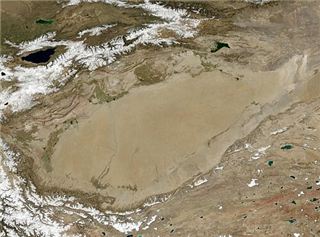
The Tocharians are known first through their languages. Around the beginning of the 20th century archaeologists recovered manuscripts from oases of the Tarim Basin written in two closely related but previously unknown Indo-European languages. Friedrich W. K. Müller called them “Tocharian”, linking an Old Uyghur phrase, “the language of the Togari”, with the Tókharoi whom Strabo counted among the peoples who overran the Greco-Bactrian kingdom. That link became a minority view once it emerged that the people of Bactria spoke Bactrian, an Iranian language, but the name stuck. What the speakers called themselves is unknown; they may have used Ārśi and Kuśi, or Agniya and Kuchiya, after their main centres.
How Indo-European speakers reached the Tarim is uncertain. A leading candidate is the Afanasievo culture of the Altai (3300–2500 BCE), an eastern offshoot of the Yamnaya culture: J. P. Mallory and Victor H. Mair argued that Proto-Tocharian speakers from it settled the northern and eastern edges of the basin. Alexey Kovalev has proposed the Chemurchek culture (2750–1900 BCE) instead. Burials of around 200 BCE at Shirenzigou, on the edge of Dzungaria, carry 20–80% Yamnaya-like ancestry.
The Tarim mummies, the oldest from 2000 BCE, were once linked to the Tocharians, but a 2021 genomic study found them an isolated local population unrelated to Afanasievo, while people in Dzungaria to the north did carry Afanasievo ancestry.
Society
The Taklamakan Desert at the heart of the Tarim Basin is barren, but meltwater from the surrounding mountains feeds streams that people turned into oases with mild microclimates and intensive farming. From around 2000 BCE these oases supported settled farming communities. Their irrigation technology had first developed in the Bactria-Margiana Archaeological Complex west of the Pamirs, though how it reached the Tarim is unclear, and their staple crops, wheat and barley, also came from the west.
By the 2nd century BCE the settlements had become city-states; the Book of Han lists 36 statelets in the basin. The largest were Kucha, with 81,000 inhabitants, and Agni, with 32,000. Kucha was ruled by royal families, sometimes on their own and sometimes as vassals, with some 30 named posts below the king, all but the highest in pairs of left and right; its kings took the title Ñäktemts soy, the equal of the Kushan “Son of God”. The Book of Jin describes a city with threefold walls, a thousand temples and stupas, and a palace “glittering like an abode of the gods”.
The people grew red millet, wheat, rice, legumes, hemp, grapes and pomegranates, and reared horses, cattle, sheep and camels. They mined metals and minerals in the mountains and made leather goods, fine felts and rugs.
Beliefs & Worldview

Most Tocharian texts are Buddhist monastic writings, which suggests that the Tocharians largely embraced Buddhism. It came with the Kushan expansion into the Tarim in the 2nd century CE, together with Kushan art and Sanskrit as a liturgical language. From the 3rd century Kucha was a centre of Buddhist study. Its most famous monk, Kumārajīva (344–412/5), was captured when Lü Guang of the Later Liang attacked Kucha in 384, learned Chinese in captivity and from 401 headed a translation bureau at Chang’an.
When Xuanzang visited Kucha in 630 he was received by its king, Suvarnadeva, and found about a hundred convents with more than five thousand monks of the Sarvāstivāda school of the “Little Vehicle”, whose scriptures and rules of discipline were like those of India. Many of the differences in vocabulary between Tocharian A and B concern Buddhist ideas, which may mean that the two belonged to different Buddhist traditions.
The beliefs before Buddhism are largely unknown. Tocharian B has a noun, swāñco, derived from the name of the Proto-Indo-European sun goddess, and Tocharian A has koṃ, a loanword connected to the Turkic sun goddess Gun Ana; they may also have worshipped a moon deity and an earth deity. Several Chinese goddesses resemble the reconstructed Indo-European sun and dawn goddesses, which has been taken as a sign of Tocharian influence along the trade routes.
Arts & Knowledge

The Kizil Caves, 65 km west of Kucha, hold over 236 Buddhist temples whose murals date from the 3rd to the 8th century. They mostly depict Jataka tales, avadanas and legends of the Buddha, in the tradition of the Sarvāstivāda school. The influence of the art of Gandhara in some of the earliest, of around 500 CE, is put down to the political union of Bactria and Kucha under the Hephthalites. Under their rule, c. 480–550, dignitaries in the region’s paintings wear caftans with a triangular collar on the right and crowns with three crescents, and the swordsmen of Kizil carry their swords on the two-point suspension the Hephthalites introduced.
The caves also hold portraits of royal families, king, queen and young prince, with monks and men in caftans. Many murals were removed by Albert von Le Coq and other European archaeologists in the early 20th century and are now in European museums; others remain in place.
The Tocharians wrote in a close variant of the Indian Middle-Brahmi script. Most of their texts are religious, but those from the time of Western Turkic rule deal with administrative, religious and everyday matters, and one love poem in Tocharian B, manuscript B-496, was found at Kizil.
Contact & Exchange
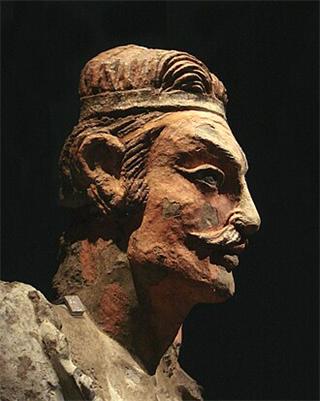
The oasis cities stood on the branch of the Silk Road along the northern edge of the Taklamakan, overshadowed by nomads to the north and Chinese empires to the east; they paid tribute when they had to and acted on their own when they could. In 177 BCE the Xiongnu drove the Yuezhi from western Gansu and overcame the Tarim statelets. The Han dynasty, campaigning from 108 BCE, set up the Protectorate of the Western Regions in 60 BCE, using plots against local rulers, attacks such as that on Kucha in 65 BCE, and the massacre of the whole population of Luntai when it resisted. Kucha later allied with the Xiongnu and the Yuezhi against the general Ban Chao, and formally submitted in 124 CE.
Along these routes came the Roman Maes Titianus and Buddhist missionaries such as the Parthian An Shigao. The Rouran conquered the northern oasis states in the late 5th century, the Hephthalites held the Tarim until about 560, and then the First Turkic Khaganate took Turfan and Kucha; Kucha’s royal family served the Western Turks with tribute and troops.
The Tang dynasty took Turfan in 630 and Agni in 644. In 648 the general Ashina She’er took Kucha, and when its forces killed the protector-general Guo Xiaoke he had 11,000 inhabitants executed. The Tocharian cities never recovered. The Tibetan Empire and the Tang fought over the basin until the Uyghur Khaganate took the northern Tarim in 803.
Legacy
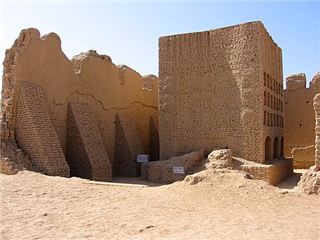
The ruling Bai family of Kucha is last mentioned in Chinese sources in 787; the Chinese had named its kings with the prefix Bai, “White”, probably for the Kucheans’ fair complexion. After the Yenisei Kyrgyz sacked the Uyghur capital in Mongolia in 840, the Uyghurs founded the Kingdom of Qocho, with its capital at Gaochang near Turfan, in 866. Over centuries of contact and intermarriage the pastoralist rulers and their farming subjects blended: many Uyghurs took up the Buddhism of the Tocharians or Nestorian Christianity and the farming life of the oases, and the townspeople switched to Old Uyghur. The Tocharian languages are believed to have died out during the 9th century, and modern Uyghurs are described as the result of this admixture of Tocharians and Orkhon Uyghurs.
The languages were recovered only in the early 20th century, and the name given them then remains the usual term. Tocharian A, from Agni and Turpan, may by then have been chiefly a literary and liturgical language, while Tocharian B, from Kucha, was still in daily use; their differences suggest they split from a common ancestor in the 1st millennium BCE. Thomas Burrow proposed a third variety, Tocharian C, behind some 100 loanwords and 1,000 names in 3rd-century Prakrit documents from Krorän, Andir and Niya, a view widely accepted though the evidence is meagre. Scholars are compiling dictionaries of the languages.
The Tocharians were the speakers of two Indo-European languages known from Buddhist manuscripts of the Tarim Basin, a name borrowed in error from the Tókharoi of Bactria. Their irrigated oasis cities, Kucha the largest, stood on the Silk Road and served a succession of empires. After the Tang conquest of the 640s they declined, and their people blended with the Uyghurs, whose language replaced theirs by about the 9th century.
Test yourself
5 questions on this page, from its key events and facts.
The questions open here once the page has loaded.
References
- Barber, Elizabeth Wayland. 1999. The Mummies of Ürümchi. London. Pan Books.
- Ning, Chao, Chuan-Chao Wang, Shizhu Gao, Y. Yang and Yinqiu Cui. "Ancient Genomes Reveal Yamnaya-Related Ancestry and a Potential Source of Indo-European Speakers in Iron Age Tianshan". In: Current Biology 29 (2019): 2526–2532.e4.
- Walter, Mariko Namba 1998 "Tocharian Buddhism in Kucha: Buddhism of Indo-European Centum Speakers in Chinese Turkestan before the 10th Century C.E." Sino-Platonic Papers 85.
- Xu, Wenkan 1995 "The Discovery of the Xinjiang Mummies and Studies of the Origin of the Tocharians" The Journal of Indo-European Studies, Vol. 23, Number 3 & 4, Fall/Winter 1995, pp. 357–369.
- Xu, Wenkan 1996 "The Tokharians and Buddhism" In: Studies in Central and East Asian Religions 9, pp. 1–17.
- Mair, Victor H.; Zhang, Shuheng; Adams, Douglas Q.; Blažek, Václav; Comsa, Alexandra; Haarmann, Harald; Joseph, Brian D.; Malzahn, Melanie; Poruciuc, Adrian; Ringe, Don; Wells, Peter S. (2024). Tocharica et archeologica: A Festschrift in Honor of J. P. Mallory. Washington DC: The Institute for the Study of Man, Inc.