Sub-Saharan Africa
Kaabu Empire
At a glance
- A Mandinka state in today's Guinea-Bissau and Senegambia that began as a western province of the Mali Empire.
- Ruled by the nyancho warrior aristocracy, it grew rich by selling war captives into the Atlantic slave trade for guns and goods.
- Fula forces from Futa Jallon destroyed its capital Kansala in 1867, and the region later fell to European colonial rule.
Rise & Fall
- 13th centuryTiramakhan Traore, by tradition, founds Kaabu as a western province of Mali
- 15th-16th centuriesKaabu becomes autonomous as Mali's central authority weakens
- 1588The Portuguese found Cacheu, a key coastal port for Kaabu's slave trade
- 1867Futa Jallon forces besiege and destroy Kansala, ending the empire
Foundation
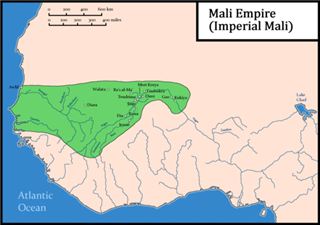
The Kaabu Empire emerged in the thirteenth century as a western province of the Mali Empire, in the region corresponding to present-day Guinea-Bissau, southern Senegal and The Gambia. Its origins are bound up with Mandinka expansion under Sundiata Keita, and oral tradition credits its founding to his general Tiramakhan Traore, whose conquests established frontier provinces governed by loyal military elites. Kaabu initially functioned as a dependency, but as Mali's central authority weakened in the fifteenth and sixteenth centuries it evolved into an autonomous state ruled by a warrior aristocracy known as the nyancho (or nyantio). The capital at Kansala became the political and ritual centre of regional authority. The ecological diversity of the region, combining savannah, riverine and forest zones, supported both agriculture and military mobilisation. Kaabu's rise was enabled by its strategic position along routes connecting the interior to the Atlantic coast and by its capacity to exploit both agricultural surplus and captive labour for expansion.
Socioeconomy
Kaabu's society was deeply hierarchical, dominated by a warrior aristocracy that controlled land, labour and trade. It was divided into freeborn elites, commoners, artisan groups and a substantial enslaved population, many captured in military campaigns. Agriculture formed the economic base, with rice and millet, and later groundnuts, cultivated across diverse ecological zones, while livestock rearing supplemented subsistence. The defining feature of the economy, however, was its integration into the Atlantic slave trade, which intensified from the sixteenth century. Captives were exchanged for European goods, including firearms, textiles, iron bars and metal tools, creating a cycle in which warfare fuelled economic growth. Trade ran through coastal intermediaries and Luso-African communities at ports such as Cacheu, founded by the Portuguese in 1588, and later through British and French traders on the Gambia. Revenue came through tribute and direct extraction by local elites, reinforcing social stratification. This model generated wealth but entrenched dependence on external demand and perpetuated internal instability.
Military
Military organisation was central to Kaabu's identity and expansion. It was a highly militarised society in which the nyancho warrior elite held dominant political and social power, and armies combined free warriors with enslaved soldiers, mobilised for raids and territorial consolidation. Firearms acquired through Atlantic trade altered military practice and gave Kaabu forces an advantage over many neighbouring societies. Cavalry played a role in open terrain, while infantry dominated in forest and swamp, reflecting adaptation to varied environments. Campaigns were aimed chiefly at taking captives and asserting dominance over surrounding communities rather than establishing centralised administrative control, so that continuous warfare became a self-sustaining system of expansion and extraction. This militarised structure also generated persistent conflict with neighbouring groups, particularly the Fula, whose resistance would later challenge Kaabu's dominance. The absence of a unified command structure beyond the elite lineages limited strategic co-ordination in prolonged conflicts.
Governance & Law
Governance within the Kaabu Empire was decentralised, structured around a network of provincial rulers drawn from the nyancho aristocracy, who governed their territories while acknowledging the supremacy of the mansaba, the paramount ruler at Kansala. By tradition the office rotated among the royal lineages of the leading provinces, notably Sama, Pachana and Jimara, with succession settled through negotiation rather than fixed hereditary rules. This system fostered both flexibility and factionalism, as competing lineages vied for influence. Law was primarily customary, rooted in Mandinka tradition and administered locally by chiefs and elders. Islamic influences were present but did not transform the legal order, as Kaabu's ruling class remained largely attached to its traditional religion. The absence of a centralised bureaucracy limited uniform governance, with taxation and judicial authority largely in the hands of regional elites. This structure allowed rapid mobilisation and local autonomy but weakened the empire's coherence during periods of internal conflict and external pressure.
Global & Regional Impact
The Kaabu Empire played a significant role in the transformation of West African political and economic systems during the early modern period, particularly through its participation in the Atlantic slave trade. Its position enabled it to act as an intermediary between inland societies and European traders on the coast, facilitating the large-scale export of enslaved people. This integration into global trade networks contributed to the reorientation of regional economies from trans-Saharan to Atlantic systems. Culturally, Kaabu served as a centre of Mandinka influence, spreading language, social structures and political practices across Senegambia. Its military dominance shaped the regional balance of power, influencing the development of neighbouring states and patterns of conflict and alliance. Its long confrontation with the Fula, particularly the Islamic state of Futa Jallon, had lasting implications for the religious and political landscape of West Africa. Kaabu's legacy survives above all in Mandinka oral tradition, where griots still recount its history and the fall of Kansala.
Decline & Fall
The decline of the Kaabu Empire was a gradual process driven by internal fragmentation and sustained external challenges, culminating in its dramatic fall in the nineteenth century. Dependence on the slave trade left it vulnerable to the suppression of the Atlantic trade and to growing resistance from subject and neighbouring populations, many of them Fula herders who resented nyancho exactions. Internal divisions among the aristocracy weakened political cohesion, while the Islamic imamate of Futa Jallon and local Fula leaders such as Alfa Molo Balde posed a formidable ideological and military challenge. The decisive event came in 1867 at the Battle of Kansala, when Futa Jallon forces besieged the capital. In a final act of defiance, the mansaba Janke Waali had the gunpowder stores ignited, destroying the city, its defenders and many of the attackers, and effectively ending the empire. The catastrophe marked the culmination of long-term structural weaknesses, including overreliance on militarised extraction. The region then fragmented into smaller polities, most notably the Fula kingdom of Fuladu established by Alfa Molo, before falling under Portuguese, British and French colonial rule.
The Kaabu Empire shows both the power and the cost of a state built on war and the Atlantic slave trade: its warrior aristocracy dominated Senegambia for centuries, yet the same militarised extraction left it divided and exposed when the Fula states rose against it, ending with the destruction of Kansala in 1867.
Test yourself
4 questions on this page, from its key events and facts.
The questions open here once the page has loaded.
References
- Barry, B. (1998) Senegambia and the Atlantic Slave Trade. Translated by A.K. Armah. Cambridge: Cambridge University Press.
- Brooks, G.E. (1993) Landlords and Strangers: Ecology, Society, and Trade in Western Africa, 1000–1630. Boulder: Westview Press.
- Curtin, P.D. (1975) Economic Change in Precolonial Africa: Senegambia in the Era of the Slave Trade. Madison: University of Wisconsin Press.
- Hawthorne, W. (2003) Planting Rice and Harvesting Slaves: Transformations along the Guinea-Bissau Coast, 1400–1900. Portsmouth: Heinemann.
- Niane, D.T. (ed.) (1984) General History of Africa. Vol. 4: Africa from the Twelfth to the Sixteenth Century. Paris: UNESCO.
- Rodney, W. (1970) A History of the Upper Guinea Coast, 1545–1800. Oxford: Clarendon Press.
Connections
Open the full connections map →