Sub-Saharan Africa
Mali Empire
At a glance
- The Mali Empire was a Mandinka state founded by Sundiata Keita that dominated West Africa from the 13th century.
- Its gold from Bambuk and Bure fed trans-Saharan trade and made Timbuktu and Djenné centres of commerce and Islamic learning.
- Succession disputes, Tuareg and Songhai attacks and shifting trade routes shrank it to its Manding heartland by the 1600s.
Rise & Fall
- c. 1235Sundiata Keita defeats Sumanguru Kanté of Sosso at the Battle of Kirina
- 1240Mali traditionally captures Koumbi Saleh, the former capital of Ghana
- c. 1312Mansa Musa begins his reign, Mali's era of greatest renown
- 1324Mansa Musa makes his pilgrimage to Mecca, dazzling Cairo with gold
- 1352–1353Ibn Battuta visits and describes the court of Mansa Sulayman
- c. 1433The Tuareg seize Timbuktu and Walata
- 1468Songhai ruler Sonni Ali captures Timbuktu
- c. 1610Death of Mahmud IV, the last powerful mansa; the kingdom splits among his heirs
Foundation

The Mali Empire was founded in the early 13th century, emerging from the decline of the Ghana Empire and the fragmentation of smaller Mandinka chiefdoms. Its establishment is attributed to Sundiata Keita, a prince of the Keita clan who, around 1235, forged a coalition of Mema, Wagadou and Mandinka forces to confront Sumanguru Kanté of the Sosso kingdom at the decisive Battle of Kirina. Victory enabled Sundiata to unite the Manding chiefdoms under his authority, inaugurating the Mali Empire, whose name is traditionally interpreted as 'where the king lives'. Tradition credits Sundiata with the Kouroukan Fouga, an assembly and charter regulating succession, clan obligations and social order, which laid the institutional foundations for a state that would dominate West Africa. The subjugation of the old Ghanaian heartland, including the capture of Koumbi Saleh, its former capital, traditionally dated to 1240, gave Mali access to critical trade routes and goldfields, setting the stage for both territorial expansion and the accumulation of wealth. After Sundiata's death around 1255, his successors, notably Mansa Uli, expanded the empire towards the Senegal River and opened ties with the wider Islamic world, exemplified by Uli's pilgrimage to Mecca.
Socioeconomy

Mali's economy was anchored in control of the gold-producing regions of Bambuk and Bure, complemented by the salt mines of Taghaza in the Sahara and the trans-Saharan trade networks that linked them. Society combined a hereditary aristocracy led by the Keita dynasty with subordinate local chiefs, Muslim scholars and hereditary occupational groups such as smiths and griots (jeli), while most of the population engaged in farming, herding, fishing and craft production. Cities such as Timbuktu, Djenné and Gao became commercial and intellectual hubs, fostering trade, Islamic scholarship and the arts. Revenue came from tribute paid by subject territories and from duties on trade, particularly the gold and salt caravans crossing the Sahara, while subjects also owed labour obligations to the state. By the reign of Mansa Musa (c. 1312–1337), Mali had become internationally renowned for its wealth, sophistication and cosmopolitanism. Its population included Mandinka, Soninke, Fulani, Songhai and Tuareg communities, fostering cultural exchange and binding peripheral regions into a coherent imperial economy.
Military
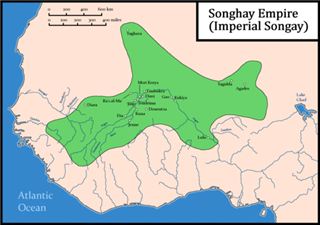
Mali's military strength underpinned its territorial dominance, combining a core of royal troops, levies from subject communities and an elite cavalry drawn from the nobility. Early campaigns under Sundiata emphasised coalition warfare, as seen at Kirina and in the subjugation of the former Ghanaian lands. During the late 13th-century revival under the usurper Mansa Sakura, Mali's armies extended its reach towards the Niger bend and west towards the Atlantic, securing control of key trade arteries. The army was organised into northern and southern commands under senior generals, and the Arab writer al-Umari reported a force of around 100,000 men, including some 10,000 cavalry, though such figures are uncertain. Military power also served as a political instrument, enforcing tribute and integrating new territories, while control of trade routes reinforced the empire's fiscal base. Campaigns against the Tuareg and Songhai and defence against Mossi raids, which reached Timbuktu in the 14th century, illustrate both the reach and the limits of Malian power across its vast and heterogeneous domains.
Governance & Law

The Mali Empire was governed through a strong monarchy that delegated authority to provincial governors (farbas) and local chiefs, balancing imperial oversight with local autonomy. Many conquered rulers retained their thrones as tributaries, supervised by royal representatives. Law was hybrid, combining Mandinka customary law, traditionally traced to the Kouroukan Fouga, with Islamic jurisprudence administered by qadis, particularly as the empire deepened its ties with North Africa and Egypt. The administration included tax collectors, military officers, royal slaves serving at court and envoys responsible for maintaining cohesion across diverse regions. Succession crises, notably after Sundiata and in the late 13th century, exposed vulnerabilities in dynastic rule, though the state proved able to recover. Mansa Musa's reign, followed by that of Mansa Sulayman (c. 1341–1360), whose court was described by the traveller Ibn Battuta in 1352–1353, exemplified effective administration, combining religious legitimacy, diplomacy and careful oversight of trade. Power rested on royal prestige, tribute and the distribution of resources, ensuring loyalty across vast and culturally diverse territories.
Global & Regional Impact
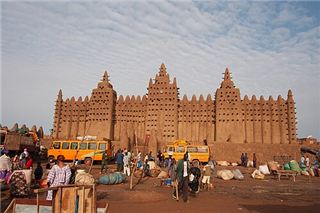
Mali's influence extended across West Africa and into the wider Islamic world. Through control of the gold and salt trade, the empire sustained trans-Saharan commerce linking the Sahel with North Africa and the Mediterranean. Timbuktu and Djenné became centres of learning and manuscript production, attracting scholars, merchants and pilgrims, and Mansa Musa is credited with commissioning the Djinguereber mosque in Timbuktu, traditionally attributed to the Andalusi poet-architect Abu Ishaq al-Sahili. Mansa Musa's pilgrimage of 1324 projected Mali's prestige abroad: his lavish spending of gold in Cairo was remembered for years afterwards, and Mali soon appeared on European maps such as the Catalan Atlas of 1375. Regionally, Mali shaped political dynamics through alliances, tributary arrangements and military interventions affecting the Mossi, Songhai and Tuareg. Its wealth and model of government influenced later West African states, above all Songhai, and its legacy endures in Sudano-Sahelian architecture, the epic of Sundiata preserved by griots, and Islamic scholarship.
Decline & Fall
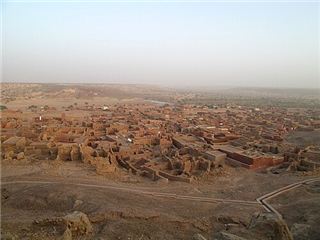
Mali's decline was gradual, extending from the late 14th century into the early 17th century and driven by both internal and external pressures. Succession disputes weakened central authority, while provincial governors increasingly treated their territories as autonomous domains. External pressures included Mossi raids, the Tuareg seizure of Timbuktu and Walata around 1433, and the capture of Timbuktu by the Songhai ruler Sonni Ali in 1468. The shift of trade towards Songhai-controlled routes, combined with the arrival of Portuguese traders on the Atlantic coast, undermined the empire's economic foundations. By the 16th century Mali was reduced to its Manding heartland around Kangaba and some western provinces, with diminished territory and prestige. After a failed attack on Djenné in 1599, the last powerful mansa, Mahmud IV, died around 1610, and the kingdom split among his heirs, marking the effective end of the Mali Empire as a coherent political entity.
Despite centuries of fragmentation, the Mali Empire's historical significance endures as a model of wealth, governance and cultural synthesis in medieval West Africa.
Test yourself
5 questions on this page, from its key events and facts.
The questions open here once the page has loaded.
References
- Conrad, D.C. (2010) Empires of Medieval West Africa: Ghana, Mali, and Songhay. Revised edn. New York: Chelsea House.
- Hunwick, J.O. (1999) Timbuktu and the Songhay Empire: Al-Sa'di's Ta'rīkh al-Sūdān down to 1613. Leiden: Brill.
- Ibn Battuta (1929) Ibn Battuta: Travels in Asia and Africa, 1325–1354. Translated by H.A.R. Gibb. London: Routledge.
- Levtzion, N. (1973) Ancient Ghana and Mali. London: Methuen.
- Nehemia Levtzion and Hopkins, J.F.P. (eds.) (2000) Corpus of Early Arabic Sources for West African History. 2nd edn. Princeton: Markus Wiener.
- Niane, D.T. (1965) Sundiata: An Epic of Old Mali. Translated by G.D. Pickett. London: Longman.
Connections
Open the full connections map →