Work / monument · monument
Karabel relief
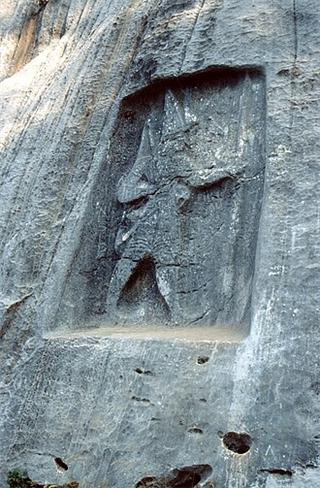
The Karabel relief is a Late Bronze Age rock carving at the Karabel pass near Izmir in western Turkey, showing a warrior with bow and spear accompanied by a Luwian hieroglyphic inscription. Herodotus took it for an image of the Egyptian king Sesostris. A reading of the inscription published in 1998 identified the figure as Tarkasnawa, king of Mira, a vassal of the Hittites, which helped fix the location of the Arzawa lands in western Anatolia.
Mentioned in 1 state history
See also



Cite this entry
- APA
- The Epoch Institute. (2026). Karabel relief. In The Epoch Institute Encyclopedia. https://the-epoch-institute.org/encyclopedia/karabel-relief
- MLA
- “Karabel relief.” The Epoch Institute Encyclopedia, The Epoch Institute, 2026, https://the-epoch-institute.org/encyclopedia/karabel-relief. Accessed .
- Chicago
- The Epoch Institute. “Karabel relief.” The Epoch Institute Encyclopedia. 2026. https://the-epoch-institute.org/encyclopedia/karabel-relief.
- Harvard
- The Epoch Institute (2026) ‘Karabel relief’, The Epoch Institute Encyclopedia. Available at: https://the-epoch-institute.org/encyclopedia/karabel-relief (Accessed: ).
Last reviewed October 2026Random entry ↻