Person
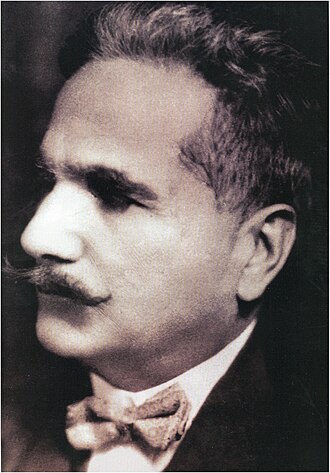
Muhammad Iqbal
Sir Muhammad Iqbal was an Islamic philosopher and poet of British India, among the most influential Muslim thinkers of the 20th century. Born in Sialkot, Punjab, he studied at Trinity College, Cambridge, qualified as a barrister at Lincoln's Inn and earned a PhD in philosophy in Munich in 1908, and he wrote in Urdu and Persian such works as Asrar-e-Khudi and Bang-e-Dara. In his Allahabad Address of 1930 to the All-India Muslim League he set out a political framework for the Muslim-majority regions of northwestern India. Pakistan, established in 1947, nine years after his death, honours him as its national poet.
Mentioned in 3 profiles
Songs in history
See also







Cite this entry
- APA
- The Epoch Institute. (2026). Muhammad Iqbal. In The Epoch Institute Encyclopedia. https://the-epoch-institute.org/encyclopedia/muhammad-iqbal
- MLA
- “Muhammad Iqbal.” The Epoch Institute Encyclopedia, The Epoch Institute, 2026, https://the-epoch-institute.org/encyclopedia/muhammad-iqbal. Accessed .
- Chicago
- The Epoch Institute. “Muhammad Iqbal.” The Epoch Institute Encyclopedia. 2026. https://the-epoch-institute.org/encyclopedia/muhammad-iqbal.
- Harvard
- The Epoch Institute (2026) ‘Muhammad Iqbal’, The Epoch Institute Encyclopedia. Available at: https://the-epoch-institute.org/encyclopedia/muhammad-iqbal (Accessed: ).
Last reviewed October 2026Random entry ↻