South & Southeast Asia
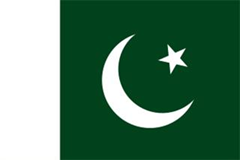
Islamic Republic of Pakistan
At a glance
- Pakistan was created on 14 August 1947 by the partition of British India, in riots that killed between 200,000 and 2,000,000 people and the largest migration in history; it adopted a republican constitution in 1956 and became an Islamic republic of two provinces, East and West Pakistan.
- East Pakistan seceded as Bangladesh in 1971 after a nine-month war in which independent researchers estimate 300,000 to 500,000 civilians died; the loss drove Pakistan to build the nuclear weapons it tested in 1998, the seventh state to do so.
- Military coups in 1958, 1977 and 1999 put generals in power for three long stretches, and the first transfer from one elected government to another came only in May 2013.
Rise & Fall
- 1956Pakistan adopts a republican constitution and becomes an Islamic republic with two geographically separate provinces, East Pakistan and West Pakistan.
- 1958President Iskander Mirza imposes martial law and is succeeded by General Ayub Khan, who suspends the constitution; a presidential constitution follows in 1962.
- 1971After the military refuses to transfer power to the Awami League and launches Operation Searchlight, war with India ends in defeat and East Pakistan becomes Bangladesh.
- 1977A military coup against Zulfikar Ali Bhutto's Pakistan Peoples Party ends democracy; General Zia-ul-Haq becomes president in 1978 and Islamises law and the economy.
- 1998Nawaz Sharif authorises nuclear tests in answer to India's, making Pakistan the seventh nuclear-armed state.
- 1999The Kargil War brings Pakistan and India to the brink, and General Pervez Musharraf takes power in a bloodless coup.
- 2008After Benazir Bhutto's assassination in 2007 the Pakistan Peoples Party wins the election; Musharraf resigns on 18 August and Asif Ali Zardari succeeds him.
- 2013The Pakistan Muslim League (N) wins the general election and Nawaz Sharif becomes prime minister for the third time, in the first successful democratic transition.
Foundation
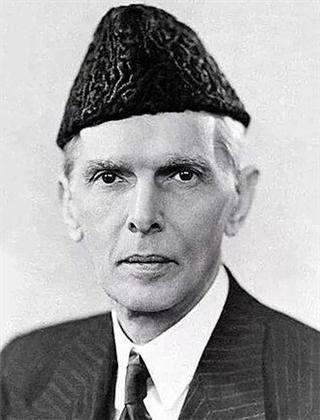
The Indus plain held Mehrgarh, the cities of the Indus Valley Civilisation and Gandhara, and official chronology dates the foundation of Pakistan to Muhammad ibn Qasim's conquest of Sindh in 711. Britain took Karachi in 1839 and Sindh in 1843 and by 1893 ruled the whole region. Sir Syed Ahmed Khan's two-nation theory led to the All-India Muslim League in 1906, and under Muhammad Ali Jinnah the Lahore Resolution of 1940 demanded a separate state. The League won 90 percent of the Muslim seats in 1946, and on 3 June 1947 Lord Mountbatten announced partition. Pakistan was established on 14 August 1947 from the Muslim-majority provinces of the north-west and East Bengal. In the Punjab riots between 200,000 and 2,000,000 people were killed; some 6.5 million Muslims moved to West Pakistan and 4.7 million Hindus and Sikhs to India, the largest migration in human history, and a dispute over Jammu and Kashmir brought war with India in 1947–1948.
Jinnah became the first governor-general and died of tuberculosis on 11 September 1948; Liaquat Ali Khan was the first prime minister. From 1947 to 1956 Pakistan was a monarchy within the Commonwealth under two monarchs. The Objectives Resolution of March 1949 affirmed that sovereignty over the universe belongs to God alone, and it became the preamble of the constitutions of 1956, 1962 and 1973. The constitution of 1956 made Pakistan an Islamic republic of two provinces, East and West Pakistan, separated by the breadth of India.
Socioeconomy

Pakistan is the fifth most populous country, with more than 241.5 million people in 2023 and the second-largest Muslim population in the world; 96.35 percent are Muslim, 2.17 percent Hindu and 1.37 percent Christian. By the 2023 census Punjabis are 36.98 percent, Pashtuns 18.15 and Sindhis 14.31 of a people speaking 75 to 85 languages, with Urdu and English official. A diaspora of seven to ten million sent home $38.3 billion in 2024–25. Literacy was 62.3 percent in 2018, with wide regional and gender gaps, and the state spends 2.3 percent of GDP on education, among the lowest in the region; about one in six girls is married in childhood.
The economy ranks 26th in the world by purchasing power and 42nd by nominal GDP, $450 billion in 2026, or $1,840 a head. Agriculture employs 43.5 percent of the labour force: Pakistan is the seventh wheat producer, fourth in cotton and milk and fifth in sugar. Textiles contribute 9.5 percent of GDP and employ some 15 million; services make 58.42 percent of GDP, and ICT exports reached a record $2.6 billion in 2023–24 with three million freelancers. Beneath lie the fifth-largest coal reserves in the world and the Reko Diq copper and gold deposit. Yet 44.7 percent of the population live below $4.20 a day, growth of 2.5 percent in 2024 was the second lowest in South Asia, women's economic participation ranks near the bottom of the world and the trade deficit was $21.3 billion in 2023.
Military
Pakistan has the world's seventh-largest standing armed forces, about 660,000 active troops and 291,000 paramilitary personnel in 2024, in an Army, Navy and Air Force that have wielded significant influence over politics since 1947. The National Command Authority controls the nuclear arsenal under a doctrine of full-spectrum deterrence. The nuclear programme began in 1972 after the loss of East Pakistan, Abdul Qadeer Khan founded the Kahuta Research Laboratories in 1976 to enrich uranium, and India's tests in May 1998 were answered with Pakistan's own, making it the seventh nuclear-armed state. The United States, Turkey and China supply its equipment.
Four conventional wars have been fought with India: the Kashmir war of 1947–1948, which left Pakistan a third of the region; 1965; 1971, when India's support for the Bengali Mukti Bahini ended in Indian victory and the independence of Bangladesh; and the Kargil War of 1999. The Inter-Services Intelligence, founded within a year of independence, channelled American resources to the Afghan mujahideen against the Soviet Union and later helped establish the Taliban. Since 2001 the army has fought the Tehrik-e-Taliban Pakistan in Khyber Pakhtunkhwa; by its own reckoning the war on terrorism has cost up to $118 billion, over 81,000 casualties and 1.8 million displaced civilians. In September 2025 a Strategic Mutual Defence Agreement extended Pakistan's nuclear umbrella to Saudi Arabia.
Governance & Law
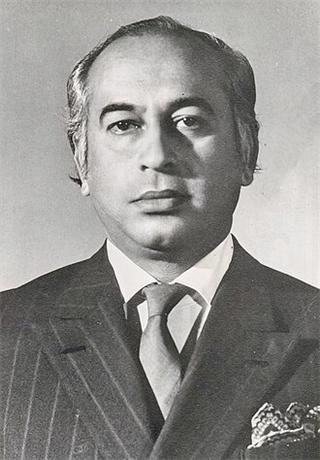
Pakistan is a federal parliamentary republic with Islam as the state religion. Its constitutions of 1956 and 1962 were each swept away by generals, and the 1973 constitution written under Zulfikar Ali Bhutto, which declared an Islamic Republic whose laws must conform to the Quran and Sunnah, was suspended by Zia-ul-Haq's martial law in 1977 and restored with amendments in 1985. Military rulers governed de facto as presidents in 1958–1971, 1977–1988 and 1999–2008; Zia instituted Shariat courts, and the Ahmadis have been barred from calling themselves Muslims since 1974.
Today the president is a ceremonial head of state chosen by an electoral college. The National Assembly has 336 members, 70 seats reserved for women and religious minorities, and the 96-member Senate gives the four provinces, Punjab, Khyber Pakhtunkhwa, Sindh and Balochistan, equal weight. Benazir Bhutto became the first woman prime minister in 1988, and power alternated between her Pakistan Peoples Party and Nawaz Sharif's Pakistan Muslim League (N) until Musharraf's coup; the first democratic transition came in May 2013, Imran Khan's PTI won in 2018, and Shehbaz Sharif took office after a no-confidence vote in 2022 and again in 2024. All sex outside marriage is a crime, male homosexuality carries up to ten years, hundreds of women die each year in honour killings, and Reporters Without Borders ranked the press 158th of 180 in 2025.
Global & Regional Impact
Pakistan is a middle power and a declared nuclear-weapon state, a member of the Organisation of Islamic Cooperation and the Shanghai Cooperation Organisation and a major non-NATO ally of the United States since 2004. Its founders sought to lead the Muslim world, and though their 'Islamistan' found no takers, the OIC they wanted was formed in the 1970s; Pakistan backed independence movements from Indonesia to Algeria and championed the Palestinian cause. China calls it an 'Iron Brother': China is its largest trading partner and the builder of Gwadar port and the China–Pakistan Economic Corridor. Relations with Washington have been 'on-and-off', from Cold War alliance to sanctions over the nuclear programme and mistrust during the twenty-year war in Afghanistan.
Kashmir divides the subcontinent: India holds about 45.1 percent, Pakistan 38.2 and China 20, along a Line of Control drawn in 1949, and three of the four Indo-Pakistani wars were fought over it. Pakistan sheltered millions of Afghans after the Soviet invasion, sustained the mujahideen and the Taliban, and ordered undocumented Afghans expelled in October 2023. In culture the national poet Muhammad Iqbal shaped Urdu letters, Abdus Salam won the Nobel Prize in Physics and Malala Yousafzai became the youngest Nobel laureate; Pakistan launched the first satellite of any Muslim nation in 1990 and has won every major ICC cricket tournament.
Into the Present
Pakistan's politics since 2008 have been civilian but unsteady. Musharraf resigned under threat of impeachment on 18 August 2008; the Pakistan Peoples Party governed until the Pakistan Muslim League (N) won in 2013 and Nawaz Sharif returned. Imran Khan's Pakistan Tehreek-e-Insaf won in 2018 and lost a no-confidence vote in April 2022; in the election of 2024 PTI-backed independents formed the largest bloc, yet Shehbaz Sharif was elected prime minister by a coalition of the PML (N) and PPP. The military's influence persists, and Freedom House rated internet freedom 'Not Free' in 2024.
The economy is the pressing weakness. Growth of 2.5 percent in 2024 was the second lowest in South Asia, 44.7 percent of Pakistanis live below the international poverty line, 16.5 percent in extreme poverty, and the trade deficit stood at $21.3 billion in 2023; the country scored 27 of 100 on the Corruption Perceptions Index in 2024 and ranks near the bottom for women's economic participation. Terrorism continues in Khyber Pakhtunkhwa, where the army has fought the Tehrik-e-Taliban since 2001. Against this stand remittances of $38.3 billion, ICT exports and freelancers earning nearly $1 billion in foreign exchange, nuclear and hydroelectric power, the untapped coal and the Reko Diq mine, and new weight abroad: the Strategic Mutual Defence Agreement with Saudi Arabia of September 2025 makes an attack on either an attack on both.
The Islamic Republic of Pakistan, proclaimed in 1956 in the state carved from British India in 1947, lost East Pakistan as Bangladesh in 1971, answered India with nuclear weapons in 1998 and has swung between generals and elected governments, a middle power of 241 million people tied to China and Saudi Arabia and still facing poverty, terrorism and the dispute over Kashmir.
Test yourself
5 questions on this page, from its key events and facts.
The questions open here once the page has loaded.
References
- Ian Talbot, Pakistan: A New History (Hurst, 2012)
- Ayesha Jalal, The Struggle for Pakistan: A Muslim Homeland and Global Politics (Harvard University Press, 2014)
Connections
Open the full connections map →