At a glance
- Burma won independence from Britain in 1948 as a federal union of the Bamar majority and many ethnic minorities.
- The army has ruled for most of the period since 1962, first through Ne Win's isolationist socialism and then through juntas.
- Brief reforms after 2011 ended with the coup of 2021, which turned decades of borderland insurgency into nationwide war.
Rise & Fall
- 1947Aung San and minority leaders agree to form a union at the Panglong Conference
- 1948The Union of Burma becomes independent on 4 January
- 1962General Ne Win seizes power and launches the Burmese Way to Socialism
- 1988A nationwide uprising is crushed and a new military junta takes power
- 1990The NLD of Aung San Suu Kyi wins an election the junta refuses to honour
- 2008Cyclone Nargis kills about 138,000 people in the Irrawaddy delta
- 2017Army operations drive over 700,000 Rohingya into Bangladesh
- 2021The military seizes power on 1 February, sparking nationwide armed resistance
Foundation

Myanmar became independent as the Union of Burma on 4 January 1948, ending more than six decades of British rule that had begun with the annexation of Arakan and Tenasserim in 1826 and of Lower Burma in 1852 and the fall of the Konbaung kingdom at Mandalay in 1885. British Burma was governed as a province of India until 1937, with the central plains under direct administration and the hill areas of the Shan, Kachin, Chin and Karenni peoples ruled separately through their own chiefs. Burmese nationalism grew from student and Buddhist movements in the 1920s and 1930s, and young Thakins such as Aung San trained with the Japanese, entered Burma with them in 1942, then turned against them in March 1945. After the war Aung San led the Anti-Fascist People's Freedom League (AFPFL) and negotiated independence with the British government of Clement Attlee in January 1947. At the Panglong Conference in February 1947 he secured the agreement of Shan, Kachin and Chin leaders to join a federal union. On 19 July 1947 Aung San and six members of his executive council were assassinated on the orders of a political rival, U Saw, and U Nu led the country to independence outside the Commonwealth and became its first prime minister.
Socioeconomy

Myanmar has some 55 million people. The Bamar, or Burmans, of the central Irrawaddy valley form about two-thirds of the population; the Shan, Karen, Rakhine, Mon, Chin, Kachin and many smaller groups live mostly in the hills and borderlands that ring the plains. The state recognises 135 "national races" but under the citizenship law of 1982 excludes most Rohingya Muslims of Rakhine State. Theravada Buddhism, followed by nearly nine-tenths of the population, shapes daily life through monasteries, ordination and merit-making, and the monkhood, or sangha, carries great moral authority; Christianity is strong among the Kachin, Chin and many Karen. Before the Second World War, Burma was the world's largest exporter of rice, but the Burmese Way to Socialism after 1962 nationalised trade and industry, and by 1987 the country was classed by the United Nations as one of the least developed in the world. Two demonetisations, in 1985 and 1987, wiped out savings overnight. After 1988 the junta opened the economy to cronies and foreign investors, especially from China and Thailand, who exploited natural gas, jade, teak and hydropower. Opium and methamphetamine from the Shan hills have long financed armed groups. Growth accelerated during the reforms of the 2010s but has collapsed since the coup of 2021.
Military
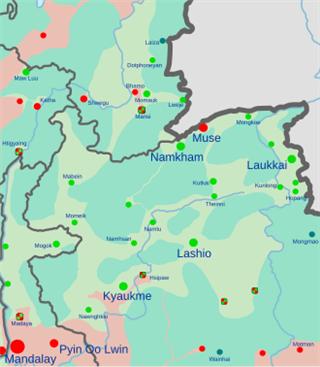
The armed forces, known as the Tatmadaw, trace their origin to the Burma Independence Army formed by Aung San with Japanese help in 1941, and their history since 1948 has been one of almost uninterrupted internal war. Within months of independence the Communist Party of Burma went underground, and in January 1949 the Karen National Union rose in revolt; Karen forces fought on the outskirts of Rangoon at Insein, and for a time the government controlled little beyond the capital. In the early 1950s Chinese Nationalist (Kuomintang) troops who had fled into Shan State added another war. Under Ne Win the army grew into the strongest institution in the state, with its own businesses and a counter-insurgency strategy, the "four cuts", meant to separate rebels from food, funds, intelligence and recruits, at heavy cost to civilians. Ceasefires agreed from 1989 onwards with the Kachin, Wa and other groups lasted for years, but fighting resumed in Kachin and northern Shan States after 2011. In 2017 army "clearance operations" in Rakhine State drove over 700,000 Rohingya into Bangladesh. Since the coup of 2021 the military has faced People's Defence Forces and ethnic armies at once, and the Three Brotherhood Alliance's Operation 1027, launched in October 2023, took large areas of northern Shan State.
Governance & Law

The constitution of 1947 created a parliamentary union with semi-autonomous ethnic states, and U Nu governed through the AFPFL until it split in 1958, when General Ne Win led a caretaker government for eighteen months. After U Nu won the 1960 election, Ne Win seized power on 2 March 1962, abolished parliament and the federal arrangements, and ruled through a Revolutionary Council and from 1964 a single party, the Burma Socialist Programme Party. The 1974 constitution created the Socialist Republic of the Union of Burma. When mass protests brought down this system in 1988, the army formed the State Law and Order Restoration Council (SLORC), renamed in 1997 the State Peace and Development Council, which ignored the election of 1990 won by Aung San Suu Kyi's National League for Democracy (NLD) and held her under house arrest for much of the next twenty years. Senior General Than Shwe moved the capital to the newly built Naypyidaw in 2005–2006. The 2008 constitution, passed in a disputed referendum days after Cyclone Nargis, reserved a quarter of parliamentary seats and key ministries for the military. Under it, Thein Sein's government from 2011 freed political prisoners and eased censorship, and the NLD governed from 2016, with Suu Kyi as State Counsellor, until the coup of 1 February 2021.
Global & Regional Impact

Independent Burma briefly enjoyed considerable international standing. U Nu was a leading figure at the Bandung Conference of 1955 and among the founders of the Non-Aligned Movement, and the Burmese diplomat U Thant served as Secretary-General of the United Nations from 1961 to 1971, the first Asian to hold the post. Under Ne Win, however, Burma withdrew into isolation, and its experience became a standard example of how military rule and autarkic socialism can impoverish a well-endowed country. The suppression of the 1988 uprising and the long detention of Aung San Suu Kyi, who received the Nobel Peace Prize in 1991, made Burma a focus of Western sanctions and human rights campaigns, while China, India and the Association of Southeast Asian Nations (ASEAN), which Myanmar joined in 1997, pursued engagement. The persecution of the Rohingya led The Gambia to bring a genocide case against Myanmar at the International Court of Justice in 2019 and created one of the world's largest refugee camps, at Cox's Bazar in Bangladesh. Burmese Buddhist scholarship and meditation teachers, notably Mahasi Sayadaw and the lay teacher S.N. Goenka, who trained in Burma, spread vipassana meditation worldwide. Myanmar's borderland wars and drug economy continue to affect Thailand, China, India and Bangladesh.
Into the Present
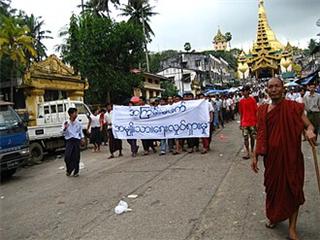
Myanmar's history since independence has not been one of steady decline but of repeated breakdowns. The Burmese Way to Socialism ended in economic collapse in 1987–1988, and the uprising that began on 8 August 1988 was crushed by the army with the loss of perhaps 3,000 lives. In 1989 the junta renamed the country Myanmar and Rangoon Yangon. The Saffron Revolution led by Buddhist monks in 2007 was suppressed, and in May 2008 Cyclone Nargis killed about 138,000 people in the Irrawaddy delta while the regime initially blocked foreign aid. The reforms after 2011 raised hopes of a lasting transition: the NLD won landslide victories in 2015 and 2020. When the military, alleging fraud, refused to accept the 2020 result and arrested Aung San Suu Kyi and President Win Myint on 1 February 2021, peaceful mass protests were met with lethal force, and the opposition formed a National Unity Government and armed resistance across the Bamar heartland. By 2024 the junta of Senior General Min Aung Hlaing had lost control of large parts of the borderlands to ethnic armies and resistance forces, the economy had contracted sharply and millions had been displaced. A military-run election in 2025–2026, widely judged neither free nor fair, made Min Aung Hlaing president in April 2026, but Myanmar remains a fragmented state at war with much of its own population.
Myanmar matters as one of Asia's longest-running cases of civil war and military rule: born as a federal union in 1948, it was impoverished by Ne Win's isolationist socialism, drew worldwide attention through Aung San Suu Kyi's democracy movement and the expulsion of the Rohingya, and returned to war after the coup of 2021.
References
- Thant Myint-U (2006) The River of Lost Footsteps: Histories of Burma. New York: Farrar, Straus and Giroux.
- Smith, M. (1991) Burma: Insurgency and the Politics of Ethnicity. London: Zed Books.
- Taylor, R.H. (2009) The State in Myanmar. London: Hurst & Company.
- Callahan, M.P. (2003) Making Enemies: War and State Building in Burma. Ithaca: Cornell University Press.
- Charney, M.W. (2009) A History of Modern Burma. Cambridge: Cambridge University Press.
Connections
Open the full connections map →