Social ladder · 1428–1521 (from the Triple Alliance to the Spanish conquest)
Social Hierarchy of the Aztec Empire
From Huey Tlatoani to Enslaved

Aztec society, centred on the island city of Tenochtitlan, divided people first by birth into two classes: the nobles (pipiltin), perhaps one person in twenty, and the commoners (macehualtin). Law and custom marked the line. Nobles received tribute and the labour of commoners, held estates, wore fine garments forbidden to others and were schooled for war, office and the priesthood, while commoners worked the land of their calpolli and paid tribute in goods and labour. Each class had its own grades. Above all stood the huey tlatoani, ruler of Tenochtitlan and head of the Triple Alliance with Texcoco and Tlacopan. Long-distance merchants enjoyed privileges close to those of the lesser nobility, landless tenants worked the nobles’ estates, and at the bottom were the enslaved, whose status was not passed to their children. In a state built on war, taking captives was a commoner’s surest road upward.
Period 1428–1521 (from the Triple Alliance to the Spanish conquest)People c. 5–10 million (est.)Ranks 7Profile Aztec Empire
The ladder
By rank, the ladder is drawn as a pyramid. To scale, each bar is as wide as that rank’s share of the people. Shares marked est. are estimates where no count survives; their boxes and bars are dashed.

Ruler · One ruler
Huey tlatoani (The emperor)
The huey tlatoani, or “great speaker”, ruled the Aztecs from the island city of Tenochtitlan.
At the top stood the huey tlatoani, the “great speaker”. From Itzcoatl (r. 1427–1440) onwards the ruler of Tenochtitlan also led the Triple Alliance with Texcoco and Tlacopan, and by the 1500s he dominated it. He did not simply inherit the throne: the lords of the royal lineage chose him from among the four generals of the war council. He commanded the army, decided war and diplomacy, received the tribute of the provinces and was the final judge, while a close kinsman, the cihuacoatl, governed the city itself. He led the cult of Huitzilopochtli, and rulers were held to govern by divine right. Each reign opened with a campaign to show the new ruler’s strength and take captives for his coronation. A ruler who failed in war lost the nobles’ trust: Tizoc (r. 1481–1486) was probably murdered by his own court. Moctezuma II’s palace, some 200 metres square, held law courts, a war council and a zoo.
Moving in or out. Each ruler was chosen by the lords from the close kin of earlier rulers, a brother, son, nephew or grandson who had proved himself in war. He could also be removed: in 1520 the council of Tenochtitlan deposed Moctezuma II, then a captive of the Spaniards, and chose his brother Cuitláhuac.
How many? One man, the ruler of Tenochtitlan, with his household.
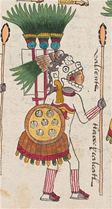
Nobility and officials · 5%
Pipiltin (Nobles)
teteuctin (lords)
Aztec nobles were born into their rank, went to temple schools and became generals, officials and priests.
The nobles (pipiltin) were born to their rank and claimed descent from the Toltecs and, through them, from the god Quetzalcoatl. The greatest were the lords (teteuctin), who headed noble houses (teccalli) with lands and dependent labourers of their own and held the highest offices of state and army; the rulers of the subject city-states were nobles too. Nobles paid no tribute but received it, could own land, called on the labour of commoners and alone had the right to fine garments and luxury goods. Their sons were schooled at the calmecac, the temple school, in history, the calendar, law, oratory and war, and served as ambassadors, ministers, generals and priests. Many lords had several wives, and marriages between noble houses bound the city-states together. Privilege carried a heavier duty: for the same offence the law punished a noble more harshly than a commoner.
Moving in or out. Rank came by birth, and a lesser noble who married a daughter of a grander lineage passed her higher standing to their children. A commoner could enter the nobility only by outstanding deeds, and then only for his own lifetime; a noble who disgraced himself could be cast down among the commoners.
How many? Nobles made up about 5 per cent of the population, a common modern estimate.

Religious and learned · c. 0.5–1% (est.)
Teopixqui (Priests)
tlamacazqui
Aztec priests looked after the temples, taught in the schools and led the festivals for the gods.
Priests (teopixqui, “keepers of the god”) served the gods in the great temples and in the temple of every calpolli. At their head were the two high priests of the Templo Mayor in Tenochtitlan, one serving Huitzilopochtli and the other Tlaloc, both bearing the title Quetzalcoatl; the friars Bernardino de Sahagún and Diego Durán describe them as respected at every level of society. Below them came many grades of priests, priestesses and novices, some of them part-time. Priests taught at the calmecac, where young nobles learned the calendar, history and sacred songs; they carried the images of the gods into battle, and they performed the sacrifices of the great festivals. Their lives were austere, with long vigils, fasting and the drawing of their own blood in penance. Noble boys trained for the priesthood at the calmecac, while commoners could enter it from the telpochcalli, the school of their calpolli.
Moving in or out. Parents chose a boy’s school at his birth, and future priests trained in the temple schools. It brought a commoner respect, but historians doubt it was a quick road to high rank.
How many? Estimate: every great temple and every calpolli temple had its priests, some serving part-time; the Templo Mayor alone is said to have had thousands.
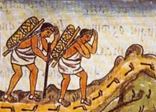
Soldiers, merchants and craftsmen · c. 1–3% (est.)
Pochteca (Long-distance merchants and luxury craftsmen)
amanteca (featherworkers), tolteca (fine artisans)
Aztec merchants made long journeys to faraway lands to trade for colourful feathers and other treasures.
The pochteca were professional long-distance merchants, organised in hereditary guilds in thirteen towns of the Valley of Mexico, each with its own ward, temple, leaders and laws, and with their own god, Yacatecuhtli. They sold the surplus tribute of the nobles, traded on behalf of the ruler and brought back luxuries from beyond the frontiers, such as tropical feathers; their goods travelled by canoe or on the backs of slaves. They also spied on foreign cities for the ruler and judged disputes in the great market of Tlatelolco, and the killing of a merchant abroad was a cause for war. In law they were commoners, yet they held privileges like those of the lesser nobility, and many grew as rich as nobles, though they had to hide their wealth to avoid the envy of the nobility. Beside them stood the makers of luxury goods, such as the featherworkers (amanteca) of the Amantla ward in Tenochtitlan, who paid no tribute and owed no public labour.
Moving in or out. Membership passed from father to son, and a newcomer needed the consent of the guild and the approval of its lord.
How many? Estimate: the merchant guilds of thirteen towns of the Valley of Mexico and the craft wards of the cities, a small part of the commoners.

Free commoners · About 76% (the rest, est.)
Macehualtin (Commoners)
Most Aztecs were farmers who grew maize, beans and squash and gave part of what they made to their rulers.
Most people were commoners (macehualtin), organised in calpolli: wards or villages of related families, each with its own leader, temple and school. The calpolli held the land and allotted plots to its households, which kept them as long as they did not leave them fallow for more than two years. Commoners grew maize, beans, squash and chillies on rain-fed fields and hillside terraces and, around the lakes, on the fertile chinampa gardens; many also worked as potters, weavers or makers of obsidian tools. Through the calpolli they paid tribute several times a year, above all in cotton cloth, and gave their labour to the lords and to public works. Every boy trained for war at the calpolli’s telpochcalli from the age of fifteen, and men fought under their calpolli’s banner. Sumptuary laws kept fine clothing and jewellery for nobles and proven warriors, and taking captives in war was a commoner’s chief road to honour.
Moving in or out. A youth who took a captive became a full warrior, and one who took four could join the eagle or jaguar warriors and be made a quauhpilli, a noble for life but not by descent; Moctezuma II made this harder. Debt, crime or famine could push a family into slavery.
How many? Everyone not counted above: the great majority of the people, most of them farmers. Several of the other ranks are estimates, so this share is one too.

Serfs and dependants · c. 10–20% (est.)
Mayeque (Landless tenants)
tlalmaitl
Some Aztec farmers had no land of their own and worked the fields of a noble instead.
Not every commoner belonged to a calpolli with land of its own. The mayeque were landless commoners who worked directly for a lord, farming the lands of his noble house and owing him part of their harvest and their labour in return for their plots. They were free people, not slaves, with homes and families of their own. But they depended on a single lord rather than on a calpolli, and on colonial accounts their status passed to their children along with the land. In some regions, such as Tlaxcala and the Puebla valley, the lords’ houses (teccalli) rather than the calpolli allotted land to commoners, so that commoners there held their land from a lord. Historians debate how numerous the mayeque were and how sharply they differed from other commoners.
Moving in or out. On colonial accounts the status passed from parents to children with the land. Like any commoner, a tenant’s son could win honour and rank by taking captives in war.
How many? Estimate: how many commoners worked the estates of nobles rather than calpolli land is debated; estimates for particular regions run from about a tenth to nearly a third.
Picture: Planting maize with a digging stick, Florentine Codex, Book IV, 1570s · Bernardino de Sahagún · Public domain · Wikimedia Commons


Enslaved · c. 1–2% (est.)
Tlacotin (Enslaved people)
Enslaved people had to work for an owner without pay, but their children were born free.
Enslaved people (tlacotin) were owned by others, but Aztec slavery was not inherited: the children of slaves were born free. People became slaves through debt, gambling or hunger, selling themselves or their children; a self-sale was made before witnesses, and the seller received a price, often twenty cotton cloaks, enough to live on for a year before the service began. Theft and other crimes were also punished with slavery. Most slaves served in the households of lords; others carried merchants’ loads or worked the land. Slaves could marry, keep property of their own and even own slaves, and an owner could not sell a slave without consent unless the authorities declared the slave incorrigible. Such slaves wore a wooden collar, and one sold three times could be bought for sacrifice: merchants bought slaves in the markets of Azcapotzalco and Itzocan to offer at their festivals. A collared slave who escaped into the royal palace or a temple was freed.
Moving in or out. Freedom came by working off the debt, by the owner’s gift or will, since owners often freed loyal slaves at their death, or by escape to the palace or a temple. Whatever happened, a slave’s children were born free.
How many? Estimate: slaves served chiefly in the households of lords and merchants; many had sold themselves or been sold for debt, and their children were born free.
Picture: A collared slave, from the Codex Mendoza, c. 1541 · Unknown author · Public domain · Wikimedia Commons

Born into history
Where would you have stood? Chance places you on the ladder, as birth placed most people: weighted by how many each rank held.
Moving up and down
Aztec teaching held that everyone had a proper place: nobles were made to rule and commoners to work. The ladder still had rungs a man could climb, and war was the main one. A youth became a full warrior only by taking a captive, each further captive brought new insignia, and a commoner who took four could join the eagle or jaguar warriors. Moctezuma I (r. 1440–1469) created the title quauhpilli, a nobility for life won by outstanding service; Moctezuma II (r. 1502–1520) made such promotion harder and barred commoners and the illegitimate sons of nobles from his palace and from high office. Trade lifted the pochteca to wealth and privilege. The fall was shorter: debt, gambling, crime or famine made free people slaves, as in the famines of the 1450s and of 1505, but slavery ended with the slave, whose children were born free. After 1521 Spanish rule kept the line between nobles and commoners, and Moctezuma II’s descendants became nobles of Spain.
Women on the ladder
Aztec kinship counted both parents equally, and daughters as well as sons inherited, so women could own land and goods in their own right, though a woman shared the rank of her family and her husband. Their work was set apart from men’s: they spun and wove cloth of cotton and maguey fibre, and cotton cloth paid tribute and served as money; they ground maize, kept the house and sold surplus in the markets. Women also worked as healers, midwives, traders and priestesses, and girls learned song and dance at the house of song (cuicalco). Childbirth was likened to battle, and a woman who died giving birth was honoured like a warrior killed in war. Noblewomen were married to seal alliances, often as one of a lord’s several wives; most commoners had one spouse, and either partner could seek a separation for cruelty or infertility. The poet Macuilxochitzin is among the women whose verses survive.
Compare with another society
Test yourself
3 questions on the ladder of the Aztec Empire.
The questions open here once the page has loaded.
Sources and further reading
- Berdan, F. F. (2014) Aztec Archaeology and Ethnohistory. Cambridge: Cambridge University Press.
- Clendinnen, I. (1991) Aztecs: An Interpretation. Cambridge: Cambridge University Press.
- Hassig, R. (1988) Aztec Warfare: Imperial Expansion and Political Control. Norman: University of Oklahoma Press.
- Sahagún, B. de (1950–1982) Florentine Codex: General History of the Things of New Spain. Translated by A. J. O. Anderson and C. E. Dibble. 13 vols. Santa Fe: School of American Research and University of Utah.
- Smith, M. E. (2012) The Aztecs. 3rd edn. Malden, MA: Wiley-Blackwell.
- Soustelle, J. (1961) Daily Life of the Aztecs on the Eve of the Spanish Conquest. Translated by P. O'Brian. London: Weidenfeld and Nicolson.
The shares are of the whole population, children included. Where a scholar has counted or estimated a rank, its share follows that work, named on the rank; where no count survives, the share is an estimate, marked est. and drawn dashed, made from what the rank was and did, from related figures and from the same rank in comparable societies, and its note says what it rests on. Population: Estimate: the Basin of Mexico alone held some 1–1.5 million people (Sanders; Whitmore), and the Triple Alliance's subject provinces several million more; figures for central Mexico as a whole run to 18–30 million (Borah and Cook), most recent work far lower.
Cite this page
- APA
- The Epoch Institute. (2026). Social Hierarchy of the Aztec Empire. In Social Ladders. https://the-epoch-institute.org/societies/aztec-empire
- MLA
- “Social Hierarchy of the Aztec Empire.” Social Ladders, The Epoch Institute, 2026, https://the-epoch-institute.org/societies/aztec-empire. Accessed .
- Chicago
- The Epoch Institute. “Social Hierarchy of the Aztec Empire.” Social Ladders. 2026. https://the-epoch-institute.org/societies/aztec-empire.
- Harvard
- The Epoch Institute (2026) ‘Social Hierarchy of the Aztec Empire’, Social Ladders. Available at: https://the-epoch-institute.org/societies/aztec-empire (Accessed: ).