Social ladder · c. 850–1204 (the middle Byzantine period, from the Macedonian emperors to the Fourth Crusade)
Social Hierarchy of the Byzantine Empire
From Emperor to Enslaved

The Byzantines called themselves Romans (Rhomaioi), and their emperor, the basileus, was held to be God’s chosen ruler and the living law. Rank flowed above all from him: the court awarded titles and offices in a strict order of precedence, set out in lists such as the Kletorologion of Philotheos (899), with separate ranks for eunuchs. Beside this hierarchy stood the Church’s, from the patriarch down to the village priest and the monks. Most people were peasants, many of them free owners in village communities that answered for the land tax together, others tenants of great landlords, and some households owed military service for their land. In the 10th century emperors legislated to protect small farmers from “the powerful” (dynatoi), but in the 11th and 12th centuries a few aristocratic families, closely tied to the ruling Komnenoi, came to dominate the state and its land.
Period c. 850–1204 (the middle Byzantine period, from the Macedonian emperors to the Fourth Crusade)People 12–18 millionRanks 10Profile Byzantine Empire
The ladder
By rank, the ladder is drawn as a pyramid. To scale, each bar is as wide as that rank’s share of the people. Shares marked est. are estimates where no count survives; their boxes and bars are dashed.

Ruler · One ruler
Basileus (The emperor)
autokrator
The emperor ruled from a great palace in Constantinople, and people believed God had chosen him.
The emperor (basileus) was held to be chosen by God and to be the living law (nomos empsychos), and his court, whose ceremonies Constantine VII had set down in the Book of Ceremonies, was meant to mirror the order of heaven. He commanded the armies, made the law and appointed every official. Yet no law fixed the succession. In principle the Senate, the army and the people acclaimed each emperor; in practice emperors crowned their sons as co-emperors in childhood, and a son born to a reigning emperor in the palace’s purple chamber was called porphyrogennetos, “born in the purple”. Usurpation was common: generals seized the throne, and fallen emperors were blinded, forced into monasteries or murdered. In the 10th century emperors legislated to protect peasants and soldiers’ lands from the great landowners, and from 1081 the Komnenian emperors ruled through their own extended family.
Moving in or out. Any man the army, Senate and people accepted could rule, and outsiders did: Basil I, born to peasant parents, rose from groom to co-emperor and seized sole power in 867, and Romanos I Lekapenos, a peasant’s son and admiral, was crowned in 920.
How many? One man, with the imperial family; co-emperors, usually his young sons, were often crowned beside him.

Nobility and officials · c. 0.05–0.2% (est.)
Dynatoi (The powerful)
archontes
Rich families held the top jobs in the army and government, but they needed the emperor’s favour.
At the top of society stood “the powerful” (dynatoi), a legal term for the senior ranks of civil, military and church office, who usually also owned great estates. Every official from the rank of protospatharios upwards counted as a member of the Senate, by now a ceremonial body. Historians distinguish a civil nobility of Constantinople from a military nobility of the provinces, above all Asia Minor, where families such as the Phokades and the Maleinoi almost monopolised high command in the 10th century; unlike western lords, they kept no private armies. Their estates were worked by tenants and slaves, and their fortunes rose and fell with the emperor’s favour. Office was not hereditary, but by the mid-11th century a limited number of families had made it so in practice, and under the Komnenoi the highest titles went to the emperor’s kin: only about 80 civil and 64 military noble families of the 11th and 12th centuries are known.
Moving in or out. Imperial favour, office and marriage made a family great, and the emperor could raise men of any birth. Rebellion could ruin it: after the revolts of Bardas Skleros and Bardas Phokas, Basil II sidelined the old military families.
How many? Estimate: historians have identified some 80 civil and 64 military noble families in the 11th and 12th centuries; with their households and retainers, a few thousand to some tens of thousands of people among 12–18 million.

Religious and learned · Fewer than 1 in 1,000 (est.)
Episkopoi (The patriarch and bishops)
patriarches, metropolitai
Bishops led the Church in each region, and the patriarch of Constantinople was the most senior bishop in the empire.
The Church of the empire was led by the patriarch of Constantinople, who crowned emperors, though emperors could also depose a patriarch, as Leo VI deposed Nicholas I Mystikos for opposing his fourth marriage. Below him, metropolitans and bishops governed the dioceses of the empire with their lands and charities. Unlike parish priests, who could be married men, bishops had to be celibate. In law the bishops, like the heads of great monasteries, counted among “the powerful”, and the Church and the monasteries were among the greatest landowners of the empire, often with privileges in tax. The patriarch was a political figure as well as a pastor: disputes with Rome over authority, doctrine and ritual came to a head in 1054 in the schism between the eastern and western churches.
Moving in or out. Bishops came from the monks and the educated clergy, so learning could carry a man of modest birth to high church office, but a patriarch who crossed the emperor could be deposed.
How many? Estimate: the patriarch, some 50 metropolitans and several hundred bishops, with their households.
Nobility and officials · c. 0.1–0.3% (est.)
Logothetai (Officials)
asekretis, notarioi
Officials kept the records, collected taxes and ran the empire’s offices for the emperor.
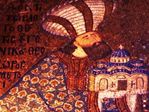
The empire was governed by a large, literate bureaucracy: in Constantinople there were hundreds, if not thousands, of officials at any time. They served in the great bureaus under the logothetes, who handled the land tax, the army’s pay, the post and diplomacy, and in the themes, where tax officials assessed and collected the land tax village by village. Officials usually held a court title, granted by the emperor, as well as their office, and the titles were ranked in a strict order of precedence, in which a magistros stood far above an imperial messenger (mandator); officials wore elaborate dress, often with huge hats, that showed their rank. Eunuchs had a separate set of titles and could rise very high precisely because they could never become emperor: in the 9th and 10th centuries the parakoimomenos, the eunuch chamberlain who slept in the emperor’s bedchamber, often acted as chief minister. Learning was the usual way in: Michael Psellos began as a secretary and became adviser to several emperors.
Moving in or out. Education in law and letters and a patron at court opened the way into the bureaus, and promotion came by the emperor’s grant; a change of emperor could end a career.
How many? Estimate: hundreds, if not thousands, of officials in Constantinople at any time, with those of the provinces and their families.
Picture: Theodore Metochites, Grand Logothete, offers his church to Christ: mosaic in the Chora Church, Constantinople, c. 1321 · José Luiz Bernardes Ribeiro · CC BY-SA 3.0 · Wikimedia Commons

Soldiers, merchants and craftsmen · 3–6%
Stratiotai (Soldiers)
Many soldiers were farmers whose land came with a duty to serve in the army when called.
Many peasant households in the themes, the military provinces, held land registered for military service (stratiotika ktemata). The holder of such a duty (strateia) served in person or paid for a soldier, sometimes jointly with others, and was exempt from most taxes besides the land tax; in law the stratiotai were distinguished from ordinary farmers. On campaign they received pay and supplies. Emperors of the 10th century protected these holdings: Constantine VII forbade selling military land below a value of four pounds of gold for a cavalryman and two for a sailor, and Nikephoros II Phokas raised the minimum to twelve pounds for his new heavy cavalry. Beside the provincial soldiers stood the professional regiments (tagmata) of Constantinople and, from about 988, the Varangian Guard. Historians debate how far 10th-century stratiotai still fought in person; by the 11th century the duty had become a tax that paid for mercenaries, and under the Komnenoi officers were rewarded with grants of tax revenue (pronoia).
Moving in or out. The duty was hereditary and passed with the land. The army offered careers to provincials, and a successful general could seize the throne, as Nikephoros II Phokas did in 963.
How many? About 140,000 soldiers in the late 10th century, a modern estimate; with their families roughly 3–6 per cent of 12–18 million people.

Religious and learned · c. 1–3% (est.)
Monachoi (Monks, nuns and parish clergy)
monachai, hiereis
Monks and nuns lived in monasteries to pray and work, and many monasteries owned large farms.
Monasteries ranged from small houses to great foundations in Constantinople and on Mount Athos, where the monk Athanasios founded the Great Lavra in 963 with the support of Nikephoros Phokas, turning a land of hermits into a community of organised monasteries. Monks and nuns lived under a rule, in prayer and work, and many monasteries grew rich from gifts of land and tax privileges; the heads of great houses counted among “the powerful”. The monastery was also a refuge and a prison: deposed emperors and fallen officials ended their days as monks, as Romanos I Lekapenos did after his sons overthrew him in 944. Parish priests lived very differently. Unlike western priests, they could be married men, ordained after their wedding, and they lived among their parishioners. Women founded and ran many nunneries, which also served as schools for girls, poorhouses and hospitals.
Moving in or out. People of every rank, from deposed emperors to villagers, entered monasteries, and since bishops had to be celibate, learned monks were the natural candidates for high church office.
How many? Estimate: monasteries were numerous, from the great houses of Constantinople and Mount Athos to small rural foundations, and every village had its priest.

Soldiers, merchants and craftsmen · c. 2–4% (est.)
Emporoi kai technitai (Merchants and craftsmen of the guilds)
emporoi, technitai, systemata
In Constantinople, bakers, silk makers and other traders belonged to guilds that set their prices.
Constantinople, with perhaps 400,000 to 500,000 people around 1200, was by far the largest city of the empire, and its trades were organised in guilds. The Book of the Eparch, compiled by the later 10th century for the city’s governor, the eparch, sets out the rules of its guilds, among them the notaries, the bullion dealers and bankers, several guilds of silk merchants, dressers and dyers, and the linen and perfume merchants, grocers, saddlers, butchers, fishmongers, bakers and innkeepers. The rules fixed entry fees and elections, prices and profit margins, and the parts of the city where each trade could work. The guilds were exclusive and privileged: not everyone in a trade belonged, and silk dressers outside the guild paid more for raw silk. Below the masters worked hired labourers (misthioi) and slaves. In the 11th and 12th centuries Venetian, Genoese and Pisan merchants took over much of the empire’s long-distance trade, at the expense of native merchants.
Moving in or out. Entry to a guild needed its members’ election and a fee, which kept many out; outside the guilds, poor townspeople worked for wages.
How many? Estimate: Constantinople alone may have held 400,000–500,000 people around 1200, but most townspeople did not belong to a guild.
Picture: The Byzantine shops at Sardis, a street of shops and workshops used until the early 7th century · Carole Raddato · CC BY-SA 2.0 · Wikimedia Commons

Free commoners · About 66% (the rest, est.)
Georgoi (Free peasants)
penetes
Many farmers owned small fields in villages and paid taxes to the emperor.
Most Byzantines were peasants, and in the 10th century free smallholders, who owned their land and lived in village communities, were the main pillar of society and of the state’s revenue. A village’s families were jointly liable for its land tax, and Basil II made the great landowners answer for their poorer neighbours’ taxes as well (the allelengyon). Bad harvests and debt pushed peasants to sell out to the powerful: after the famine of 927 Romanos I Lekapenos passed laws to stop the dynatoi from buying up peasant land, and Basil II’s law of 996 ordered land taken illegally to be returned and required the powerful to prove their titles. The laws slowed the process but did not stop it. In the 12th century great estates spread at the expense of the village communities, and many villages passed into the estates of monasteries and the powerful.
Moving in or out. A free peasant could prosper and buy land or send a son into the army or the Church, but debt or a bad harvest could force him to sell and become a tenant (paroikos) on a great estate.
How many? Everyone not counted in the other tiers: mostly the free peasants of the villages, the backbone of society in the 10th century. Several of the other ranks are estimates, so this share is one too.
Picture: Labourers at work in a vineyard, from a Byzantine Gospel book of the 11th century (BnF, gr. 74) · Unknown author · Public domain · Wikimedia Commons

Serfs and dependants · c. 15–30% (est.)
Paroikoi (Dependent peasants)
Many farmers worked land that belonged to rich landowners or monasteries and paid them rent.
Paroikoi were peasants who farmed land they did not own, as tenants on the estates of great landowners, monasteries, churches and the emperor himself. They held their plots by hereditary right and could not be removed as long as they paid their rent, but they paid that rent and other dues to a landlord. Their numbers grew as the powerful absorbed village land in the 10th and 11th centuries. Under the Komnenoi, emperors granted the revenues of whole districts to officers and monasteries as pronoia, and the peasants who paid them were also called paroikoi in the grants’ records; the grant-holder took their dues, though the land still belonged in law to the emperor. Historians disagree about how far paroikoi resembled western serfs: some compare them closely, while others stress that they owed no personal service to the grant-holder. Their condition varied with the landlord and the region, and they were widespread by the 13th century.
Moving in or out. Tenancy passed from parents to children, so most families of paroikoi stayed tenants for generations; free smallholders sank into it through debt or by selling their land to the powerful.
How many? Estimate: tenants on the estates of the powerful, the church and the monasteries, a share that grew from the 10th century until such tenants were widespread by the 13th.
Picture: Harvesting grapes, mosaic from the Church of Elias, Mary and Soreg at Jerash, late 6th century · Ken & Nyetta · CC BY 2.0 · Wikimedia Commons


Enslaved · c. 1–3% (est.)
Douloi (Enslaved people)
Enslaved people were owned by others and made to work without pay, mostly as servants in rich homes.
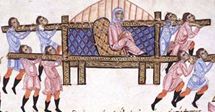
Slavery remained legal throughout Byzantine history and reached its height in the 10th century, when wars in the Balkans and the reconquest of Crete in 961 brought many captives, and Rus’ traders brought more from the north. Most slaves served in rich households: the widow Danielis of Patras gave Basil I 3,000 slaves, and the eunuch Basil Lekapenos was said to own 3,000 slaves and retainers. Some managed workshops for their masters, with authority over hired free workers, and many were drafted into the army. Castration was forbidden within the empire, but the law was poorly enforced, and eunuchs fetched the highest prices. Christian teaching shaped the law: owners lost the right to kill or abuse their slaves, and the Church condemned slavery as contrary to nature. Yet slaves could not legally marry until Alexios I Komnenos allowed it in 1095, and their children were born slaves. By about 1200 slavery had become a minor urban phenomenon.
Moving in or out. Freedom came by manumission, and under Justinian’s law a freed slave became a citizen; Manuel I Komnenos freed all the slaves of Constantinople in the 12th century.
How many? Estimate: slavery reached its height in the 10th century, mostly in rich urban households, and was a minor urban phenomenon by about 1200.
Picture: The widow Danielis travels to Constantinople, carried by her slaves: Madrid Skylitzes, 12th century · Unknown illuminator · Public domain · Wikimedia Commons

Born into history
Where would you have stood? Chance places you on the ladder, as birth placed most people: weighted by how many each rank held.
Moving up and down
Rank in Byzantium came from the emperor’s grant of office and title, so the ladder was open at the top to men of any birth. Basil I, born to peasant parents, rose from groom to emperor in 867, and Romanos I Lekapenos, a peasant’s son, was crowned in 920. Education opened the bureaus: Michael Psellos began as a provincial judge’s secretary and became adviser to several emperors. Even captives could rise: John Axouch, a Turkish boy captured at Nicaea in 1097 and given to Alexios I as a present, grew up with the future John II and became commander-in-chief of the army. The army and the Church offered careers to provincials, and eunuchs, barred from the throne, could reach the highest offices. Falls were as sudden: titles were lost with the emperor’s favour, and deposed emperors and ministers were sent to monasteries. From the 11th century, as a few families closed ranks around high office and great estates swallowed the villages, it became harder for outsiders and smallholders to rise.
Women on the ladder
Women took the rank of their fathers and husbands, and most married by about fourteen. Unlike women in much of western Europe, Byzantine women, married or not, kept the Roman right to inherit, own and manage property and to make contracts, and a wife could reclaim her dowry. Yet a woman’s testimony in court counted for less than a man’s, Leo VI barred women from witnessing business contracts, and upper-class women in the capital were expected to keep to the women’s quarters. Imperial women could hold real power: four emperors owed their throne to their link with the empress Zoe, and her sister Theodora ruled alone in 1055–1056, while Anna Komnene wrote the history of her father Alexios I’s reign. Rich widows managed great fortunes, like Danielis of Patras, the patron of the young Basil I. Many women founded and ran nunneries, and poorer women worked as domestic servants or in the food and textile trades.
Compare with another society
Test yourself
5 questions on the ladder of the Byzantine Empire.
The questions open here once the page has loaded.
Sources and further reading
- Kazhdan, A. P. (ed.) (1991) The Oxford Dictionary of Byzantium. New York and Oxford: Oxford University Press.
- Laiou, A. E. (ed.) (2002) The Economic History of Byzantium: From the Seventh through the Fifteenth Century. Washington, D.C.: Dumbarton Oaks.
- Lemerle, P. (1979) The Agrarian History of Byzantium from the Origins to the Twelfth Century: The Sources and Problems. Galway: Galway University Press.
- McGeer, E. (2000) The Land Legislation of the Macedonian Emperors. Toronto: Pontifical Institute of Mediaeval Studies.
- Rotman, Y. (2009) Byzantine Slavery and the Mediterranean World. Trans. J. M. Todd. Cambridge, MA: Harvard University Press.
- Treadgold, W. (1997) A History of the Byzantine State and Society. Stanford: Stanford University Press.
The shares are of the whole population, children included. Where a scholar has counted or estimated a rank, its share follows that work, named on the rank; where no count survives, the share is an estimate, marked est. and drawn dashed, made from what the rank was and did, from related figures and from the same rank in comparable societies, and its note says what it rests on. Population: modern estimates: about 12 million around 800, and perhaps as many as 18 million by 1025.
Cite this page
- APA
- The Epoch Institute. (2026). Social Hierarchy of the Byzantine Empire. In Social Ladders. https://the-epoch-institute.org/societies/byzantine-empire
- MLA
- “Social Hierarchy of the Byzantine Empire.” Social Ladders, The Epoch Institute, 2026, https://the-epoch-institute.org/societies/byzantine-empire. Accessed .
- Chicago
- The Epoch Institute. “Social Hierarchy of the Byzantine Empire.” Social Ladders. 2026. https://the-epoch-institute.org/societies/byzantine-empire.
- Harvard
- The Epoch Institute (2026) ‘Social Hierarchy of the Byzantine Empire’, Social Ladders. Available at: https://the-epoch-institute.org/societies/byzantine-empire (Accessed: ).