Social ladder · 794–1185 (the Heian period, in the age of the Fujiwara regents)
Social Hierarchy of Heian Japan
From Emperor to Base People
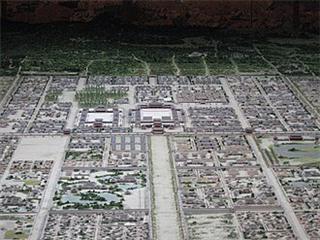
Heian Japan ranked its people by the ritsuryō, law codes modelled on those of Tang China, and more and more by birth into a few great families. The codes gave every public post a court rank, over thirty in all, and drew a sharp line between the aristocrats of the fifth rank and above and the menials of the sixth rank and below. They also divided the people into the “good” (ryōmin) and the “base” (senmin), close to slaves, a line that had almost lost its meaning by the 10th century. Around the year 1000 the emperor reigned in Heian-kyō, the capital, but the Fujiwara regents, fathers and grandfathers of emperors, ruled. About 5,000 aristocrats enjoyed the court’s culture in a land of perhaps five million. Most people farmed rice on fields that were passing into the tax-free estates (shōen) of nobles and temples, while in the provinces a new class of warriors was forming.
Period 794–1185 (the Heian period, in the age of the Fujiwara regents)People c. 4–6 million (est.)Ranks 8Profile Shinto
The ladder
By rank, the ladder is drawn as a pyramid. To scale, each bar is as wide as that rank’s share of the people. Shares marked est. are estimates where no count survives; their boxes and bars are dashed.
Ruler · One ruler
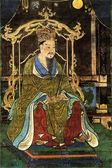
Tennō (The emperor)
mikado
The emperor lived in the palace at Heian-kyō, today’s Kyoto, and led the court, but his Fujiwara relatives held the real power.
The emperor stood at the head of the ritsuryō state and ruled from Heian-kyō, the capital Emperor Kanmu founded in 794 on the model of the Tang capital Chang’an. Kanmu and his successors down to Emperor Saga governed in person, and Emperor Daigo ruled directly from 897 to 930. By 1000 the imperial house had power only on the surface. Most emperors had Fujiwara mothers and, by the custom of the time, were raised in their mother’s household and owed loyalty to their Fujiwara grandfather. Fujiwara no Michinaga could enthrone and dethrone emperors at will. Even so, the Fujiwara never tried to replace the dynasty, and the succession stayed within the imperial family.
Moving in or out. The throne passed by heredity within the imperial family, but in the age of the regents the head of the Fujiwara decided who would reign. Branches of the imperial line grew into clans of their own: the Taira and Minamoto both descended from the imperial family.
How many? One man, with the imperial family.

Ruler · One ruler
Sesshō and kampaku (The Fujiwara regents)
sesshō (regent for a child emperor), kampaku (regent for an adult emperor)
The Fujiwara regents married their daughters to emperors and then ruled Japan in the name of their young grandsons.
The real power lay with the Fujiwara, descendants of Nakatomi no Kamatari, and their way to it was marriage: Fujiwara daughters became the consorts of emperors, and the clan’s heads were the fathers-in-law, uncles and grandfathers of the next. In 858 Fujiwara no Yoshifusa became the first man outside the imperial family to act as regent for a child emperor, his grandson; his adopted son Mototsune was made kampaku, regent for an adult emperor, a newly invented post. The Northern branch made the regency hereditary. Fujiwara no Michinaga (966–1027), grandfather of three emperors and father of six empresses or imperial consorts, never took the title of kampaku: he had no need of it. Government passed through the family’s private administration: the historian George Sansom called the Fujiwara “hereditary dictators”.
Moving in or out. The regency stayed within the Northern Fujiwara, and its hold rested on Fujiwara daughters married into the imperial family. An emperor born of another mother could slip their hold: Emperor Uda regained much of the government, and Emperor Go-Sanjō, from 1068, curbed the Fujiwara and began the rule of retired emperors.
How many? One man at a time: the head of the Northern (Hokke) branch of the Fujiwara, with his household.
Nobility and officials · 0.1%
Kizoku (Court nobles)
kuge, kugyō (holders of the highest offices)
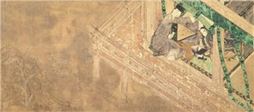
Court nobles lived in the capital, wore robes chosen by their office and the season, and wrote poems for every occasion.
The codes gave every public post a court rank, from the first rank down to the eighth and an initial rank below it, divided into senior and junior and, below the third rank, into upper and lower. Holders of the fifth rank and above were the aristocrats (kizoku), and their rice income rose steeply: a fifth-rank noble might draw 225 koku a year and a third-rank one as much as 6,957. Hereditary high ranks let a few families, the Fujiwara, Minamoto, Taira and Tachibana, monopolise the great posts. The nobles preferred life at court to governing the provinces. Poetry was a staple of their lives, any occasion called for a verse, and a poor hand was taken as a sign of poor breeding.
Moving in or out. Rank came largely with birth: the children of high officials were granted a minimal rank of their own, and promotion was slow and bureaucratic. A noble out of favour could lose everything: when the warrior Taira no Kiyomori ruled after 1159, he removed and exiled 45 court officials.
How many? About 5,000 aristocrats “in a land of perhaps five million”, the Heian period article’s figure.
Picture: Court nobles in the Yadorigi chapter of the illustrated Tale of Genji scroll, 12th century · Unknown author · Public domain · Wikimedia Commons
Religious and learned · c. 0.3–1% (est.)
Buddhist monks and Shinto priests
-
Buddhist monks lived in great mountain monasteries near the capital and were among the few people who could read and write.
Two new schools of Buddhism rose with the Heian court. Tendai, brought from China by the monk Saichō, rested on the Lotus Sutra and taught that enlightenment was open to “every creature”; its monastery on Mount Hiei, above the capital, grew close to the court and taught great reverence for the emperor. Shingon, brought by the monk Kūkai, who founded the monastery of Mount Kōya in 819, worked through symbols, rituals, incantations and mandalas. Both sought the support of the aristocracy, the “aristocratic Buddhism” of the age. The great temples of Heian-kyō and Nara held tax-free estates, and the temples and shrines formed guard units of their own. Literacy was common only among the court and the Buddhist clergy.
Moving in or out. Saichō sought the right to ordain Tendai monks independently. Emperors too could take the robe: in 1087 Emperor Shirakawa abdicated and became a Buddhist monk, the first of the cloistered emperors.
How many? Estimate: the monks of the great monasteries of Heian-kyō, Nara, Mount Hiei and Mount Kōya and the priests of the shrines; the articles give no count.
Soldiers, merchants and craftsmen · c. 0.2–0.5% (est.)
Jige (Court clerks and menials)
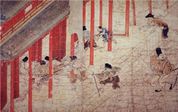
Below the nobles worked the court’s clerks, musicians and doctors, who earned far less rice.
Below the fifth rank stood the jige, the ranks from the sixth down to the eighth and the initial rank, held by the menials of the court. Every office of the codes had the same four grades of staff, from its head (kami) to its lowest clerks (sakan), even the bureaus of court musicians and court apothecaries. Their pay was a fraction of a noble’s: the average sixth-rank official might earn 22 koku of rice a year, a tenth of what the fifth rank brought. The ritsuryō state produced ever more records and archived them carefully: registers of the people, renewed every six years, and the yearly tax books on which the taxes were assessed.
Moving in or out. In the early days of the codes no one could advance beyond the sixth rank except by rare exception, so the line between the fifth and sixth ranks divided the aristocrats from the menials.
How many? Estimate: the clerks, musicians, apothecaries and other staff of the court’s offices from the sixth rank down; likely a few times as many as the 5,000 aristocrats, but the articles give no count.
Picture: Townspeople and servants running to a fire, from the Ban Dainagon Ekotoba scroll · Tokiwa Mitsunaga · Public domain · Wikimedia Commons

Soldiers, merchants and craftsmen · c. 0.5–2% (est.)
Bushi (Provincial warriors and local chiefs)
gunji (district heads), oryōshi and tsuibushi (the court's provincial warrior posts)
In the provinces, local families trained as warriors on horseback with bows and swords: they became the first samurai.
When Emperor Kanmu abandoned universal conscription in 792, local power holders again became the source of military strength. The court had no army and relied on professional warriors: the oryōshi, appointed to a province, and the tsuibushi, appointed over a circuit or for a task. Estate holders had men at their command, and with stronger bows, armour, horses and better swords, military service became part of estate life; on the estates, local chiefs of the peasants also served as district heads (gunji) and recruited their labour. Gradually the provincial upper class became a new military elite of samurai, who helped suppress the risings in Hitachi in the east and of Fujiwara no Sumitomo in the west; final authority still rested with the court.
Moving in or out. Regional military families formed around members of the court aristocracy who had become provincial figures, and gained prestige from court-granted military titles; the Taira and Minamoto were among the most prominent. After 1156 warriors took control of court affairs, and in 1185 the Minamoto founded the shogunate at Kamakura.
How many? Estimate: the provincial upper class that was turning into a military elite, with the district heads and the warrior posts of the court; the articles give no count.

Free commoners · About 96% (the rest, est.)
Ryōmin (Peasants)
shōmin (peasants living on an estate)
Most people were farmers who grew rice and gave part of every harvest to the estate owner or the government.
Under the codes all land and people belonged to the state. Every registered person over six received an allotted field, two tan for a man and two-thirds of that for a woman, taxed at about 3 per cent of the crop, and owed local products and labour and military service. The redistribution of fields decayed, and the last took place in 902–903. To escape the taxes and labour of the provincial governors, peasants gave the nominal ownership of their fields to a temple, a shrine or a court noble, whose estate won exemption, and in return paid the estate a share of the harvest. On these estates the owner could expel disobedient peasants and make his own penal laws.
Moving in or out. A family could commend its fields to an estate for protection from the tax collector, while a debtor who could not pay his rent could lose his land rights and be bound to the estate as a resident cultivator.
How many? Everyone not counted in the other tiers: chiefly the rice-farming families, the great majority. Several of the other ranks are estimates, so this share is one too.


Enslaved · c. 0.5–2% (est.)
Senmin (Base people)
kenin, shinuhi
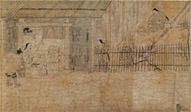
The old laws made some people “base people”, close to slaves, but by around the year 1000 that line had almost disappeared.
The codes divided the population into two castes: the ryōmin, the good people, in four sub-castes, and the senmin, the base people, in five sub-castes, close to slaves. Each caste wore its own colours. Under the land law the castes called kenin and shinuhi received allotted fields only a third the size of other people’s. The line did not hold. Some good people married base people to escape taxation, and the children of such marriages became good people, so that by the end of the 9th century and the beginning of the 10th the caste system had practically lost its substance.
Moving in or out. Marriage was the way out: a child of a base and a good parent was counted among the good people.
How many? Estimate: the base people of the codes; by the 10th century the line between them and the good people had almost lost its meaning, as children of mixed marriages became free. The articles give no count.
Picture: Rural life in the third scroll of the Shigisan Engi Emaki, 12th century · Unknown author · Public domain · Wikimedia Commons

Born into history
Where would you have stood? Chance places you on the ladder, as birth placed most people: weighted by how many each rank held.
Moving up and down
Birth decided most places in Heian Japan. The codes had meant rank to rest mostly on merit, but the children of high officials received a rank of their own, promotion was slow, and in the early days of the codes almost no one passed from the sixth rank into the fifth; hereditary high ranks soon let a few families, the Fujiwara, Minamoto, Taira and Tachibana, monopolise the great posts. At the bottom the line between good and base people dissolved within two centuries through marriage. The largest movement was of land, not of people: peasants commended their fields to the estates of nobles and temples, so that by the end of the period virtually all land had become shōen. In the provinces it was warriors who rose. Military families formed around court nobles who had settled in the provinces, and after 1156 they took control of the court itself: Taira no Kiyomori placed his grandson on the throne and filled some fifty government posts with his relatives, and in 1185 the Minamoto founded the first shogunate.
Women on the ladder
A woman’s rank was her family’s, and for the Fujiwara their daughters were the road to power: the consorts of emperors and crown princes were generally Fujiwara women, and an emperor was raised in his mother’s household. Under the codes a woman’s allotted field was two-thirds of a man’s. Court women were not trained in Chinese, the language of government, as men were, and wrote instead in the new kana script; the result was much of the vernacular literature of the age: the Kagerō Nikki by “the mother of Michitsuna”, the Pillow Book of Sei Shōnagon, an attendant of the empress, and the Tale of Genji by Murasaki Shikibu, herself a Fujiwara. Ladies-in-waiting were expected to write poetry as a mark of their status. A court lady’s formal dress was the many-layered jūnihitoe, its colours chosen by the season. The codes counted a wife’s killing of her husband, or her failure to mourn him, among the eight unpardonable crimes.
Compare with another society
Test yourself
3 questions on the ladder of Heian Japan.
The questions open here once the page has loaded.
Sources and further reading
- Asakawa, K. (1903) The Early Institutional Life of Japan. Tokyo: Shueisha.
- Bauer, M. (2020) The History of the Fujiwara House. Kent: Renaissance Books.
- Hurst, G. C. III (2007) "The Heian Period", in Tsutsui, W. M. (ed.) A Companion to Japanese History. Oxford: Blackwell.
- Morris, I. (1964) The World of the Shining Prince: Court Life in Ancient Japan. Oxford: Oxford University Press.
- Sansom, G. (1958) A History of Japan to 1334. Stanford: Stanford University Press.
- Shively, D. H. and McCullough, W. H. (eds) (1999) The Cambridge History of Japan, Vol. 2: Heian Japan. Cambridge: Cambridge University Press.
The shares are of the whole population, children included. Where a scholar has counted or estimated a rank, its share follows that work, named on the rank; where no count survives, the share is an estimate, marked est. and drawn dashed, made from what the rank was and did, from related figures and from the same rank in comparable societies, and its note says what it rests on. Population: the Heian period article speaks of "a land of perhaps five million".
Cite this page
- APA
- The Epoch Institute. (2026). Social Hierarchy of Heian Japan. In Social Ladders. https://the-epoch-institute.org/societies/heian-japan
- MLA
- “Social Hierarchy of Heian Japan.” Social Ladders, The Epoch Institute, 2026, https://the-epoch-institute.org/societies/heian-japan. Accessed .
- Chicago
- The Epoch Institute. “Social Hierarchy of Heian Japan.” Social Ladders. 2026. https://the-epoch-institute.org/societies/heian-japan.
- Harvard
- The Epoch Institute (2026) ‘Social Hierarchy of Heian Japan’, Social Ladders. Available at: https://the-epoch-institute.org/societies/heian-japan (Accessed: ).